
Karate-do is awesome, I love aiki-do, and I would even like to try sa-do, but I have found my true calling ... mamachari-do! The "-do" we are speaking of here is placed at the end of certain words and means, "the way" or "the path" and is pronounced "doe". It is commonly seen in martial arts like karate-do, aiki-do, ju-do, kyuu-do, but can also be in other cultural arts like cha-do (the way of tea). This "-do" denotes a spiritual path one can undertake in a specific art to cultivate themselves. To many foriegners, it may be desirable to study many "do"s to be a talented person in various fields, and even in ancient Chinese martial arts, one ideal was to study many other subjects to supplement martial arts like calligraphy, literature, tea, etc. However, generally it seems to me that the Japanese traditionally admire someone who undertakes only one art fully. I think that has some importance when discussing the meaning of "do". One art is not better than any other, and in the grand-scheme of things, they really aren't anything at all. But, these various "do" can be used as tools to reach higher planes of existence. By having one art, you can concentrate all of your effort for one goal.
Mamachari: heavy-ass, one-speed bicycle, with at least one basket and a bell. AKA, granny bike. It also helps if it is rusty and the brakes sqeak revealing diminishing effectiveness.
Mamachari-Do; this is my spiritual path.
When I came to Japan, I had two primary goals. One was to train in a traditional Japanese art. I would have taken tea ceremony or flower arranging if it was the most available, but I have been lucky enough to find what I really wanted, aikido. The next goal, was to travel around Japan and see as much as possible. When I asked my ALT predecessor here in Kurobe at Sakurai High School if she had travelled much around the area of Kurobe, or even Japan, she said no. I was very dissapointed. I ask other Japanese, and am culturally disappointed at their lack of knowledge of the various regions of their own country. I was going to be different, and explore everything from the tip of Hokkaido to the southernmost reaches of Kyushu and Shikoku. Well, though there certainly are trains connecting the whole of Japan, it didn't take long to find out that they can be extremely expensive, confusing, and time consuming. It is not so easy. Generally, for me to take a trip to Hokkaido or Kyushu, it would cost about $200 one way on the train system. Narrowing it down to a smaller and closer region, to go to Tokyo and Kyoto, it's about $100 one way. Then, down to my region of Hokuriku, it can be down to $30 or $50 one way to the farthest reaches like Fukui-ken. As the possibility of me traveling was getting smaller and smaller as regions go, I now arrive to my current traveling status: Niikawa, the area including the surrounding towns on this side of the Toyama-ken. Taking the regular JR trains in the region only drops you off in the middle of each town and city, and to take the smaller local train, it can be extremely slow and a bit expensive, and will only take you to smaller town centers. Walking, well, things are a bit too far to just walk. So, the mamachari is my preffered means of transportation. I was given my mamachari by my predecessor immediately upon arrival, but I looked at is disdainfully for a month, and thought it would be silly to ride. However, I soon realized it was just foolish to force myself to walk everywhere. 20 minutes one way to the grocery store, 25 minutes to my favorite bar, 40 minutes to the train station. My biggest and most time consuming travel experiences were limited to these locations, which is pretty lame. Once I finally jumped on my bike, the euphoria hit me instantly, and ever since then I have been flying all around Niikawa, weaving through the streets and popping tires from going off curbs to fast.
Mamachari-do.
In a small town called Kamiichi, which lies a bit closer to the mountains and towards Toyama city, I had heard of a temple with a waterfall that buddhist monks sit under in the coldest throws of winter for spiritual cleansing. I hadn't heard of it until recently, which means its not among this biggest of attractions here, which means that it may still have elements of less popularized locations that I find enticing. At school I asked the social studies teacher, who is also a buddhist priest, and he gave me some very vague information about it in Japanese that was particularly difficult to understand. But I had names of places, and a sense of direction for these kinds of things, and the next free chance I had I was off. That happened to be this weekend.
For those that are determined to proceed with this post, make sure you have the time, and your favorite internet browsing beverage at hand, because you are about to start an adventure that took me up several mountains in search of castle ruins and hidden towns. You may want to stop reading if you do not enjoy epic adventures across foreign lands and deep into the soul. For those that continue, thank you and enjoy!

Friday night we had stayed up late playing poker, and I had the idea to wake up casually the next day and start my trip after noon sometime. But that Saturday morning I woke up around 8:30. I looked at the clock, got a drink of water, and tried to convince myself to get more sleep. But I couldn't. Despite feelings of grogginess, something was forcing me up. For years I have been trying to get up earlier to do something "productive", usually in the form of martial arts or traveling, and in this case, it may be a sign of its fruition. I talked with my parents on skype for a bit, and around 10:45, it was time to go. On my last bike trip to Unazuki, I had talked to my mom on skype before, and it is becoming a bit of a pre-adventure ritual that seems to help me on my way.
Into the increasingly hot and humid early Japanese summer, and through the rice-fields I cruise!

Here is a picture of the dojo where I practice aikido from the backside. On my way towards the mountains.

There are small rice-fields connected to the majority of houses all throughout Kurobe, but once you start heading to the outer-reaches, the houses become less and the rice-fields become much bigger. If you're heading to the mountains, you can see wide rice-fields in amazing terraces. This is a picture of an Obaachan (old woman) working the fields. I was able to get a lot of good shots like this today. But I have to admit that I passed-up many oppurtunities due to an uneasiness I have about taking people's pictures. Perhaps this is one thing that will forever keep me from photo journalism. The thought of traveling to third world countries and taking candid pictures of the local people just turns my stomach. So here in Kurobe, I would be cruising down these small roads between the rice-fields with blonde hair, shorts, sunglasses, on my mamachari; all of which are about as rare as I am in Kurobe. So my presence was usually always noticed, and so my pictures of such instances are pretty rare.

When I head from my apartment towards the mountains, I'm starting to find a routine of routes I take, and this time I came across a park I had visited many months back. It was closed at the time, but now it was open, and I discovered quite a gem hidden in Kurobe.
 I think these are cherry-blossom trees, and if I'm right, this place must explode in pink wonder during hanami; cherry blossom viewing season.

With a huge sloping hill and wide grassy lawns, this would be absolutley ideal for beer, lounging in the sun, and frisbee. Or even cheap snowboarding during winter? I couldn't believe my eyes when I found this place, because like all of the most amazing parks in this country, they are somehow hidden and tucked away, and thus very hard to find without prior knowledge or an adventurous spirit. I am 99% sure no other gaijin in the area know about this. Maybe I can open it up to them.

I have no idea what this is, but it looks very Japanese to me, and very cool.

More interesting Japanese park structures. I'm really going to miss this when I leave someday. So much quality and individuality put into each and every park that hardly anyone visits. Certainly more than just a bench and a barbecue.

Back on the road. I have a loooong way to go. My last trip to Unazuki was the longest yet. One way with no stops it would take between one and one and a half hours, but this one to Kamiichi would easily be twice as long. However, it was in a direction I had never been on my bike before, so I knew there were going to be a lot of side-trips. Actually, this is an important thing to know about me when I go somewhere new. When I explore, I tend to go uphill, towards any enticing distraction, and get easily turned around. I am coming to believe I have quite a nose for these interesting paths, but that has little to do with staying on task. Beware travelers accompanying Gaijin.
 For instance, this tunnel is certainly not going to get me to Kamiichi ... but how could you not go through!? Always towards the light at the end of the tunnel right?

Ah, just as I thought, an overgrown road to nothing! This does give me a great happiness as I become nostalgic of my home on Orcas Island, where such roads are more common than those regularly used. From here I turn around, and find another way.

Oh, what's this? "Please ... blah blah blah ... blah blah blah." I'm sure it's something really important, but I can't read it. That sums up a lot about my kanji (Chinese characters in Japanese language) proficiency. I can read some things, but if it's important, I can only tell the overall message it's trying to convey. This says to please do or do not do something. Whatever. I'm just a silly gaijin anyway. I have yet to find myself in trouble with authority and claim no Japanese language or cultural knowledge, while playing the silly stupid gaijin card.

This was an awesome downhill cruise; that led to some generic industrial compound. I would have to ride my mamachari all the way back up. If you somehow skimmed over my description of a mamachari earlier, I mentioned it was a "heavy-ass, one-speed bike." If you haven't had the experience of riding such a bike uphill, well, it's a bit taxing. And yet ... this is all part of mamachari-do! Ying and Yang, for every up there is a down, and each with their own qualities. It is a philosophy of self-sufficiency, and there are no escalators or lifts to carry such a practitioner up hills.

Wow, uphill on the mamachari in 80 degree weather is awesome! This is part of the euphoria of physical suffering that comes from such a spiritual practice. At this point, I couldn't be more wet if I had jumped in the Pacific Ocean. I was swimming in sweat all the way to the top. Upward and onward.

Ah, rest at the top of this level was sweet. Here is a view of the lowland area where Kurobe and it's neighboring towns rest. Just beyond is the ocean, and a bit further, you can sometimes see the Ishikawa peninsula stretching out across the ocean. However, on this kind of day, it's a bit too hazy to sea. I'm not used to such effects, as the summers where I grew up were not humid at all. Is this lack of visibility due to humidity? I'm not sure.

At this point, I have certainly gone uphill towards the mountains, but slightly in the opposite direction of Kamiichi, which requires me to go parallel with the ocean for a couple of hours. But I know that I'm on the right path to somewhere because of this bear warning sign. Follow these and you'll find cool spots.
 Ah! This is a beautiful sign! In mamachari-do, this is a reward of sorts for you hard work. 7% downgrade runs make that inchi-by-inch uphill peddaling worth the while.
 With the rice-fields, towering mountains, and bear signs, it's easy to forget that you're in a fairly industrial part of Japan. In fact, the home of YKK, as well as other large industrial and technological companies such as this Panasonic one. The parking lot was fairly full, which meant there were thousands of Japanese pounding away towards an over-worked lifestyle for national commercial success. It makes me cringe, and so I pedal on.
 Here ends Phase One of the journey, and the beginning of another: Matsukura Castle. A castle? I know enough about traveling in Japan that if there is a legitimate castle around, everyone knows about it and it will be the focus of many tourist pamphlets. I've never heard anything about such a castle in tiny po-dunk Niikawa, which only means I must inquire.
 The road become little more than one lane, and wound upwards towards the mountains in highly forested areas. I had no idea such a place or route existed, and slowly I realize there is much more to this area than I had never known. Where would this road go? Why is it here? And what am I doing on this mamachari in such hot weather up seemingly endless winding roads? I'm supposed to be going to Kamiichi anyway, and this was not the way.
About 30 minutes of snail-pace upward struggle finally revealed signs of civilization, and a potential end to my search for this unknown castle.

There were no more signs in English about a castle, but at this point it seemed to be about the 8 kilometers the first sign had told me. The road wound up to this small village. Again with the questions: What is this place? How come I have never heard of this? What are the people doing here? Before this trip I was under the impression that human settlement in Niikawa was limited to the main towns like Kurobe that went across the coast. But now I am seeing when you go away from the ocean and towards the mountains, there are many more small anonymous towns.

I followed the signs which Ithink signified the main attraction of the town, maybe the castle, and it lead me here. The castle? It was certainly a center of sorts, with some cultural importance, but it was locked, and I was there to ponder to myself, if this was a building on the remains of a castle, if I had followed the right road, and what the sign said above the bike in the picture. Exhausted, I sat on those steps, and let the frenzy inside of me settle in the silence of this early-afternoon.

Unknown towns surrounded by unknown forests in unknown mountains. I felt as though I was in another world and I had only slightly strayed from the borders I call home. I wonder if any gaijin had ever sat on these steps as I had. I wonder how many Japanese who lived ten minutes away by car even knew this place existed. Everyone could marvel knowing the second highest mountain in Japan was in the mountain range that was so close, but other than that, little attention is put in this direction. Metaphorically speaking, It seems everyone gets to the lodge at the base of the mountain and cries, "We made it! Look at us! Hey honey, take a picture of me. Wow, this is definately going to be my profile pic on Facebook. Man, I need a soda. Ooh, look, thise vending machine's hot dogs are only $10. Geez, I'm really tired, let's get home before Idol is on." I grew frustrated with this thought. All I could think of were the limitations of the stupididy of mankind. Why? In this Age of Information, if something is important, then it will have its own entry in Wikipedia and will have a website. Therefore, one should go to it and take a picture with it. Perhaps older "savage" civilizations were right when they thought a picture would steal something's spirit. Perhaps the most amazing people and things on the planet were hiding in such mountains. Perhaps it requires effort and determination to find something special. The cultivation of spirit requires work and individual discovery. I looked at my mamachari and smiled.

I began my departure from this town, but as I was headed out, I thought I could spend the 60 seconds it would take to cover the breadth of the town on my bike. The end of the road led to a small shrine, which actually, was one of the most intricate and beautiful one's I have ever seen.

This is but only one of a few intricate carvings on the shrine. I could only imagine the time and skill needed to make such a beautiful carving. It was not in some gift shop to be marketed, but on a shrine in this far-removed town.

I rarely perform the Shinto ritual which is often done at such shrines, but I believed it would be appropriate here. Really, its a few claps and bows, not much to ask for. Though the large and more popular temples in Japan are of Buddhist origin, I love these Shinto shrines the most. There are many in every town in Japan, and rarely visited.
It was time to leave this place and resume my journey to Kamiichi. The half hour I spent pedaling up to this location, would now reveal an epic downhill flight!
 Half-way down I noticed a small bridge and path into the woods. I stopped to inquire, and found a wondrous overgrown path to somewhere. This is precisely the kind of adventure I like most. However, I only looked and appreciated it, as today called for something different. Maybe next time.
Here ends phase two: Maybe Matsukura Castle.
I glided down the hill that was so menacing before, and was blessed by the wind that blew my hair back.
And yet, at the bottom of that hill, was the beginning of another.

I uttered an explicative common to such instances, snorted sweat and snot out with a gruff, and began another ascent.

In Japan, many police and construction signs are marked by cute little woodland animals such as raccoons, frogs, monkeys, and moles like this. I think it has quite a different connotation than ... pigs.

At this time, I had made some progress towards my goal, and found a sign for another potential side trip. Ruins of Masaguta Castle ... only 1.9 km? Sure! My optimism was beaming from a recent downhill section. Here begins, Phase Three: Ruins of Masugata Castle.
What looked flat from the sign, soon shot upwards through rice fields. This would be a 1.9 km straight uphill. More sweat, more pedaling. At this point in the journey I have developed quite a technique for getting up these hills which sends my torso bobbing to each side of the bike each time my foot completes a pedal. Hunched over the handlebars on my bike, I can see my fleshy lungs from the inside, filling, emptying, and my heart surging blood to keep this organic engine pumping. All of these separate gears of organs and powering limbs urged on by the spirit of mamachari-do.

Signs of the castle! This must be one of the chariots Niikawa samurai rode in 15th century feudal Japan.

Soon I reached the top of what I could see, and found evidence of attractions. This marker, a covered area with picnic tables, and maybe one of the only drinking fountains in all of Japan. In Japan you can easily find vending machines with a various assortments of drinks, yet a drinking fountain is really a rare sight.

I dismounted my mamachari with an authority that accompanies the premonitions of a victory of sorts, and started up a path to the ruins on foot.

Here it is! The ruins of Masugata Castle! Wow, these trip is really redefining my idea of what a castle can be.
Oh wait! There is a samurai! Let's ask him.

He muttured something unintelligible from an ancient language, so I turned around to gaze upon this mountain spot. Something called me toward the forest and I started walking where there was no path. All I could think of was how exciting it would be trail blaze through such mysterious territory, when all of a sudden, a crash from the woods made me shriek and leap, and I looked over to see some medium-large black figure leap away from my direction into the forest. What the f*&^ was that!? Seriously, it was definately not a deer, and I'm pretty sure not a bear. In fact, it looked like a huge pig. Wild Japanese boar? I don't know, but I became very nervous about being alone in the woods and quickly biked away.

A glorious downhill glide brought me back to more ricefields and flat land.


The difference between Tokyo and Kurobe is, that when you walk down the street in Tokyo, you see tall sharp businessman headed towards the most profitable and serious of endeavors, and when you walk down the street in Kurobe, you see ojiisan and obaasan (old men and women, think image of elderly grandmothers and grandfathers), all of which are afflicted by the most distortioning of hunched-over backs. I wonder as to the transition period between the 40 and 50 year old black haired straight backed Japanese, to these more horizontal than vertical ojiisan and obaasan. Well, it's clearly from working the rice-fields there entire lives. This is extremely hard work, requiring you to wade knee deep in water while you're hunched over placing thousands upon thousands of seeds into the mud. In modern Japan, the young adults flock to the cities for business oppurtunities and dreams of eccentric city life, which leaves work in temples and fields for those of generations past. What is happening to this part of Japanese culture? Who will tend the temples and fields when these toiling wonders of the old ways are gone?

Maybe the streets will be lined with abandoned granny wagons? What? This is weird. Earlier I had climbed this hill and passed an obaasan on a similar vehicle, and now coming back, I find it abandoned on the side of this one lane road. With no sign of it's rider, I wonder if like Yoda, she disappeared into the Force.
By this point, I had probably only made it a third of the way to my goal of Kaimiichi, and had already spent 4 hours climbing three mountains to castles that didn't seem to exist. Time to get some Ramen, and get on the road.
With my goal being the Buddhist meditation waterfall that I think is called Nisseki-ji near Kamiichi, my notion of its location was a bit too foggy, so I bothered some locals in a barbershop for directions. An old man grumbled something, and who seemed to be the wife took me outside and revealed the way. "Arigatou gozaimashita!"
Pedal gaijin, pedal, pedal, pedal. Hot sun burning skin. Legs tired from mountains climbed. Body leaking sweat and quickly depleting vital fluids. Pedal, pedal, pedal.
Kamiichi! I eventually arrived, and found that there were a quite a few different famous sites, so I followed to the signs to what I thought would lead me to Nisseki-ji. But along the way I saw a sign for something else that had a cool name, and the path lead upwards into the woods, so I would have to make just one more detour before the climax.

This was definately one of the most appealing of roads I had been on so far. It's not so often in this area that you have large forest immediately off the edge of the road, but here it was, and the afternoon light beamed through the trees for a mystical effect.
This was a steep hill, and my legs were so tired I had to resort to walking my bike most of the way. Up this hill, to what? The name was interesting, but I wasn't sure exactly what it was. All I knew is that it had the kanji that read "Dai" which means great or big, and that was enough to pull me up the hill.

Well, this is what I came to, and it sure looked a lot more castley than anything I had seen before. The doors at the base were locked, which was a pity, but I investigated the building from the outside as much as needed, and admired the viewpoint. Patience was dwindling for the end of the journey, but the idea of a downhill cruise through the woodland road gave me a surge of excitement. Next stop, Nisseki-ji ... or whatever it is I'm going to find.
I followed the signs down the main road all the way to it's end, where it became a small one lane road into the woods and up a mountain. Here, there was only a small building that smelled of onsen, and a few cars parked outside. I walked around the building and came back to the front to read the kanji: Nisseki-ji. This is where buddhists come to pray?
I walked inside, and it looked more and more like an onsen. As I entered, a small old man shuffled around and went behind the main desk. We both looked at each other confused. Our conversation began in Japanese:
"Is this Nisseki-ji?"
"Hai."
"Is this an onsen?"
"Hai."
"What's further up the road?"
"Mountains."
"Umm, are there any temples?"
"There's nothing up there."
"What's up there?"
"Mountains."
"This is an onsen?"
"Hai."
"Oh."
"Oh. ... Do you want to enter the onsen?"
"Uhh ... Yes, but later. Not yet. Ummm ... I'll return."
Confused looks, a few bows, and a few thank yous. I went outside to gather myself and try to figure out what was going on. This was certainly not a place where buddhist monks come in the winter to pray under a waterfall, and it must be around here somewhere. I have found that often old men in this country are by far the least reliable source for such information. So I decided to proceed up the hill on the one lane road a bit to see what I could find.
I pushed my bike up the hill, and found two signs. One pointed to something in one direction that led up for 2 km, and the other way was something that denoted a temple that was 10 km up. I decided it was too far, and started back down the hill. Then 10 seconds later, I told myself I had to go up and see. Then, 20 seconds later, I changed my mind again and stopped and sat on the ground to think.
My clothes were drenched with sweat while I was still having a continuous flow of sweat from my pours. My arms looked red and my face felt burnt. I had no more water. I certainly could not bike up any more hills, and at the least would resort to pushing the bike. It was almost 5:00 and I had been riding for about 6 hours. The next possible point of attraction that could maybe be the temple I was searching for was probably the one another 10 km up. And if this would end up like the rest of my escapades, I would find nothing resembling a temple. What more could I ask for than an onsen to mark the climax of the trip. And so with that, I crawled upon my bike and floated down to the onsen, to meet the old man once again, and enter the onsen.
When I got inside to change, I took off my clothes and looked in the mirror to find quite a sight! It was me, but greatly distorted by the trip. My face was very burnt, except where my sun glasses were, and my neck and arms had become so red compared to the rest of my body which hasn't seen the sun since last September, and I had what was the most amazing farmer's tan that has ever been found on my body. From the sweat and wind, my hair shot up into a flat top, making me look like Guile from Street Fighter, and I stunk very badly. The old man I asked questions of was probably too shocked by this gaijin to communicate effectively, and I got more strange looks than usual when I got in the onsen.
As a matter of fact, this has become my second favorite onsen to Kintaro, though it was very small. Something of the ambiance, and perhaps my experience, made this an especially nice onsen trip. I actually liked the sensation created from the burn on my arms reacting in the sulfurous water. One Japanese man attempted to talk to me, but I had absolutley no clue at all what came out of his mouth, and so I said some key phrases I've learned to use in such situations to keep a conversation going though I understood nothing.
After the onsen, I drank a bottle of water, a bottle of lemon vitamin water, and a bottle of cold oolong tea from the vending machine, and began to muster what it would take to make the straight road back to Kurobe.

Like most trips, I always forget that I have to get home, and so I was left with what ended up being another hour and a half ride up and down a few hills to my home in Kurobe. I had much to reflect upon. What had I seen today? Maybe two ruins of castles, some outlook tower, and paths to things I don't know through towns nobody knows exists outside of their small populations? What would I tell people when I get back? What really happened?
As a matter of fact, I met with a few other friends to play poker that night. They laughed at my burn, and couldn't believe I rode my bike to Kamiichi. I tried to explain that it was much more than that, and I had followed paths into the mountains to castle ruins and found towns they've never heard of. But they just laughed at the raccoon eyes made from my sunglasses, and wondered why I was crazy enough just to ride my bike to Kamiichi. To them, nothing existed beyond two streets from the main road.
I can't wait until Monday when I still have a sunburn on my face and I probably have realistically over one hundred Japanese people ask me about what happened to my face.
I drank a lot of beer, and lost a bit of money at poker. We watched some of the World Cup. I was a content gaijin.
What are we to make of such experiences? How could anyone understand their significance? Most of my friends here know I do aikido, but they certainly don't know how important it is to its practitioners. I haven't told anyone in this country about my blog. I have different activities I do with each friend to satisfy different facets of social interaction, but it seems rare to find one quality friend these days.

This journey is mine, and only my own two legs will get the pedals going on my mamachari. Mamachari-do is as serious as any other Japanese art, and I look forward to continuing it's training. But for now, I must rest, be an assistant language teacher at a high school, find a way to get some food and pay bills before payday, and practice aikido. Such is the ebb and flow of a gaijin on the path.


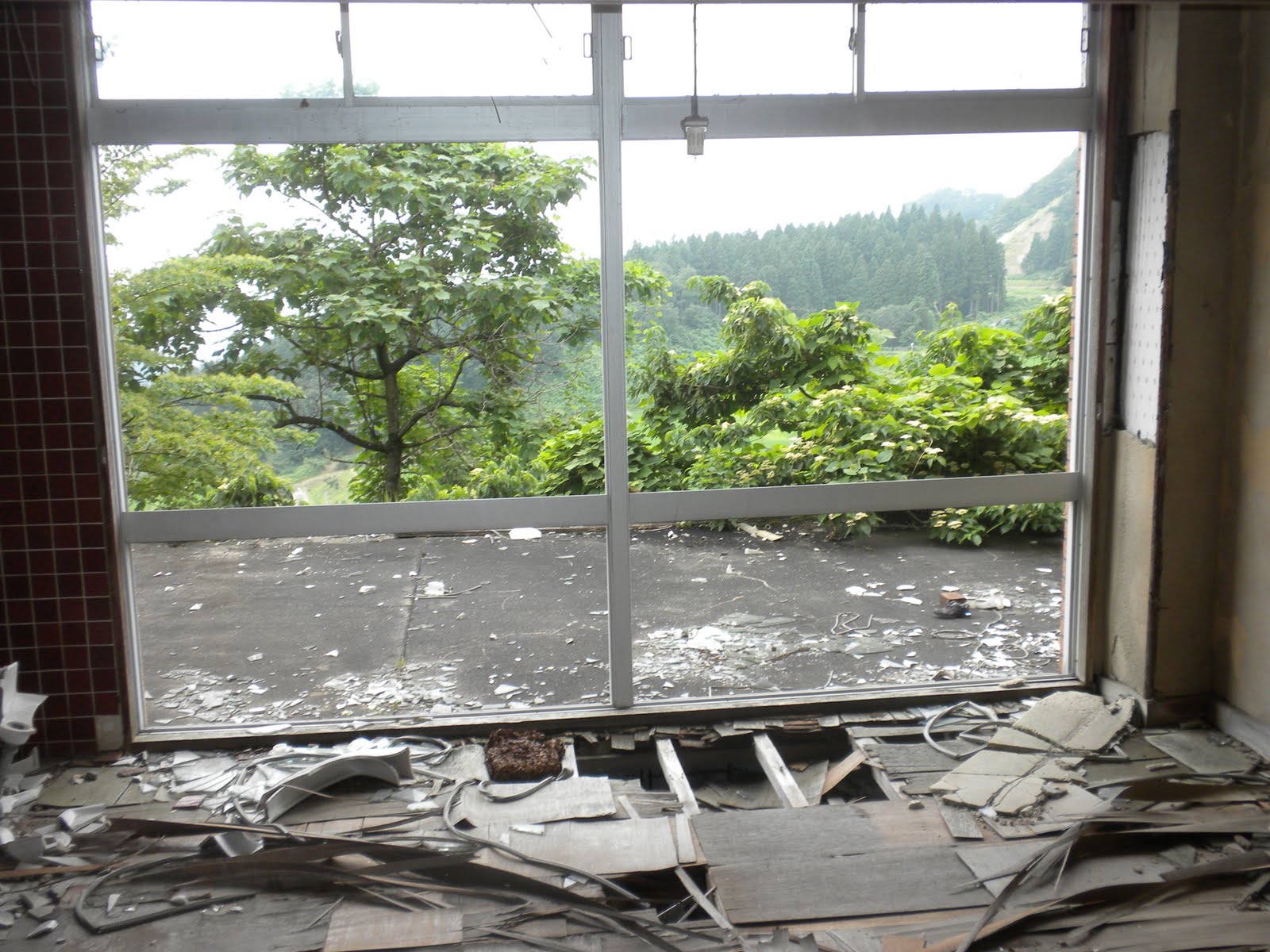
 This place was really tagged up. I couldn't see a single intact window, and any space along the inside looked like it was covered in graffiti. I looked down on the sleepy farming village, and then back to this giant decrepit builidng ... it didn't make sense. From my perch I looked for an entrance and then descended upon the mystery.



 Ah-ha! Some hard evidence! 2002. Almost ten years ago. I would imagine if someone had been there since for such destruction, it would be written on the walls. But I checked every square inch of wall in the building and this was the only date. That's a pretty long time for the residents of the town to tolerate such a monstrous monolith of youthful rebellion in their sleepy farming village. Such a demolition. project would be incredibly expensive and time consuming.
