Showing posts with label Toyama Prefecture. Show all posts

Sunday, January 5, 2014

Winter Travels - New Year Fresh Start

Hello!
 
Hisashi Buri!
 
Happy New Year!
 
Akemashite Omedetou Gozaimasu!
 

It's been a busy two week break with lots of movement. I went back to Toyama to pick up my wife while staying at her house and meeting with old friends. I had a great time with her family, was super excited to meet with old friends, and had very strange feelings going back to this second home. First I rode a train for an hour from Nakatsu to Kokura (Kita Kyushu City) and then took a twelve hour midnight bus to Osaka, where I rode another bus for 6 hours to Toyama. Once I breached the Hokuriku border when entering Fukui Prefecture, the sky went dark black and snowy mountains loomed in the distance. This is my ancient home, just like northwest Washington where I was raised, and northern Europe where my ancestors came from. I might be getting a little corny, and to be honest I'm not really sure where I came from, but I feel a connection to Toyama that is a little more than mysterious. Anyway ... it was interesting to see the place after 2 months away and adopting a new home ... I love Toyama, and the mountains are absolutley unbelievable. I feel like I could move back anytime and stay a long time ... but now I live somewhere else, in a land of funny shaped cone mountains in the warmer southern island of Kyushu.

So I picked up the girl, and we got in her car and drove to Osaka. We realized when we reached the city borders because the highway walls loomed high enough to conceal our surroundings and giant trucks congested all around us.


We got through the city on time despite rush hour traffic, and boarded our overnight ferry from Osaka to Beppu Port in Oita Prefecture. This was our bed for the trip. (It went well with the giant sento bath on the ferry! A giant bath on a ferry!)


The ferry also came with a buffet that looked way better in the brochures, but it was a nice ferry.


On the ferry deck my wife and I said our great farewell to Honshu (the main island of Japan).


We arrived safely to a much warmer Kyushu, and our home of Nakatsu! Also home to a cool castle.


We had a few days together before two other friends from Toyama came to stay for a couple days. We went to Usa Shrine in the neighboring town of Nakatsu. It's certainly famous in Oita Prefecture and this area around Nakatsu, but one brochure even said it was the most important Hachiman Shrine in Japan (Hachiman is generally considered the god of war in Japan, but is also described as many other things and in much more detail).


We went on New Year's Day, and for some reason I didn't realize how many people would go to the shrine that day. I lost all confidence while we were stuck in traffic on the small country roads, but once we got there I was happy to go to such a special shrine on such an auspicious day.


The shrine was great, and on the ride home I was utterly happy with my wife and a couple of best friends in the new home of Nakatsu ... and a beer in the belly.


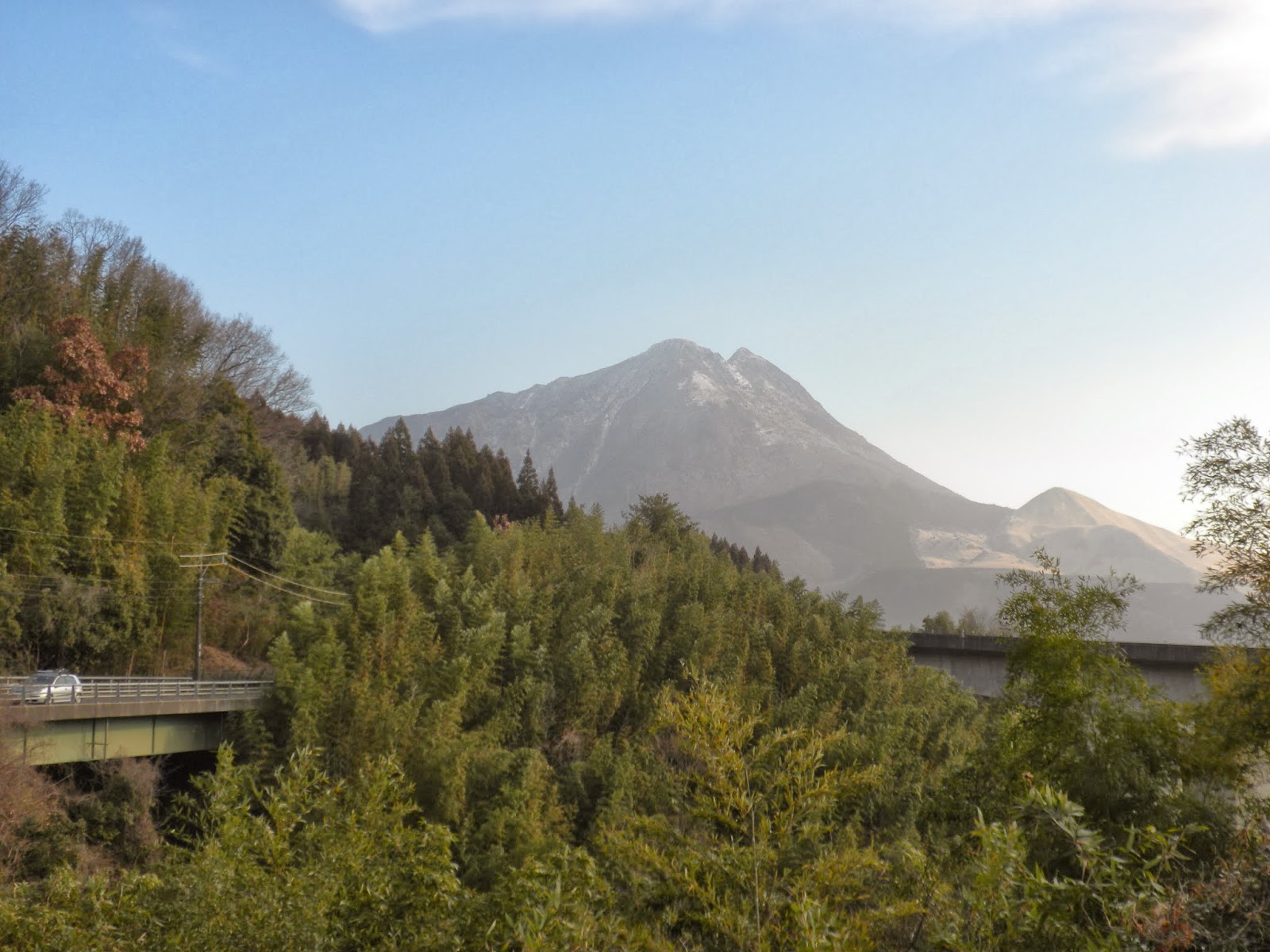
The next day we went to Yufuin, a place in the mountains of Oita Prefecture, famous for the single mountain of Yufuin Dake (shown below), lots of amazing onsen, and a quaint tourist town area. It's been the number one destination in my mind for a while and it didn't dissapoint.


At about 1600 meters it's certainly not the tallest mountain in Japan, but definitely worth a visit, or many.


It's a touristy town with all the touristy qualities one can expect, but it was fun.


After that we went to Beppu, the onsen mecca of Japan. We went to a really cool onsen, ate food, and went home. No pictures, but at about an hour and a half away from where I live, I know I'll be back again and again and again.

The next day we headed to Fukuoka City, the largest city in Kyushu, and one of the largest in Japan.

Getting there takes a little over an hour by express trains and about $50 round-trip. It's close enough to feel like I can go anytime, but far enough to be completely separate.


It really is one of the biggest cities in Japan, and you can feel it immediately. Lots of big fancy building and hordes of people. Very fun to visit.


I've been having small technical problems with the blog lately,


my computer keys are sticky and there is some lag with the typing,


And the amount of Tateyama Sake I'm drinking is enough to draw my attention away from this typing...

So I'll leave you with this ... HAPPY NEW YEAR! I've had millions of budo thoughts lately and want only to tell them you all here. I assure they will flow in a continuous and constant wonderful pattern this year here at Gaijin Explorer.

今年もよろしくお願いします!


Monday, September 9, 2013

I Still Don't Know!


How can I find something I don't know?

In kyudo I'm searching for perfect technique. I watch those better than me, I listen to sensei's advice, I have small goals, but I just don't get it.

On the one hand I'm trying to achieve something I'm not, so that I can be better. If that happens, I become an advanced person.

On the other hand, it's something inside of me that's been there all along. All I have to do is realize that power inside of me and then I'm there. But I don't know what it is. Is it not inside of me? Does it need to be placed there first so I can reveal it?

It's like I'm mining for gold in this mountain. I think I know it's there, and I'm trying to think about it intelligently so that I can better find it, but in all honesty I don't know the gold is there until I see it, feel it, be it.

The weirdest thing about kyudo is that you'll realize something and do it, and then completely forget it. It's eternally frustrating. Last week I really had confidence in my tenouchi (left hand that holds the bow). I was realizing things I had been trying for so long, all of a sudden my hand was doing things I couldn't before, then this week I can't do it at all. It's like I've been transported back in time to where I was really sucky. I realize this, and try to fix it, but I couldn't do it today.

Somehow I've lost confidence in kyudo. I don't have the confidence to hit the target like I have in the past. My eyes blink amid the shooting, and I know I'm not going to hit the target. It's just a waste of time. Before I finish the arrow I already want to go on to the next, even though I know I won't hit that one either.

It makes me want to just walk straight up to the target and stab it right in the center.

I'm mining for gold, but I really don't know what it's like.
After all this time, I still don't know. Maybe everyone is like this.

I don't know!

Hurrying doesn't help, muscling it in doesn't work ... so I'll be patient and humble, and trust that that gold is in fact below the pick and axe.

Tuesday, June 18, 2013

Sensei Won't Let Me Die

The other day I participated in a kyudo tournament at my dojo with all of the members from Takaoka City.

If I hit two out of the eight arrows, then I could participate in a big Prefectural tournament.

I hit zero arrows.

Sensei said I can go to the tournament anyway.

...

That morning was a new low in kyudo. I went into the tournament after a couple weeks of frustrating but kind of good kyudo practice. It was frustrating because of two reasons: the thumb on my left hand which holds the bow hurt, and I wasn't hitting the target much. All of that compounded on the morning of the kyudo tournament: my thumb really hurt and I hit zero arrows.

I talk a lot about humility on this blog. I talk about how it's not so important to win and that it's OK to realize that we are really just a small piece of the world. But, I really ... hate ... failure.

I've had a few experiences in kyudo of not hitting the target while standing in front of people to the point of embarrassment. I feel like I've done that already and really need to do that anymore. But that's not how kyudo works. I guess that's not how the world works. Kyudo is simple cause and effect: If you do this, that will happen. Just because you don't want it to work like that, doesn't mean it will change for you.

The only issue with cause and effect in kyudo, is that I don't understand what they are. Why does this happen? Why does that happen? Sometimes these questions are easily answered with technical corrections in your form. Nobody has perfect form, so this is an issue that concerns everyone. But you certainly don't need perfect form to hit the target, most definitely not. I've gone through periods where I feel like I can't miss the target at all. That was in the past, when my form wasn't as good as it is now.

How do you explain that?

Isn't that cause in effect? I put this much time into practicing form which enhances my ability to put the arrow where I want, and yet I'm hitting it less.

Do I not want to hit the target?

I remember in practice I asked sensei if he saw anything strange in a shot I made seconds earlier.

"Sensei, did you see anything strange in that shot?"

"Not really, I'm suprised you didn't hit the target."

"Well, why didn't I?"

"I don't know. I can't see what's going on inside of your heart."

Why don't I hit the target, especially after I've practiced so hard, want it so badly, and really need to? My initial response to this has been to just go harder.

I've learned I'm really good at putting a lot of effort into something. I can focus all of my physical and emotional will into something, even at the expense of damaging other things like health and peace of mind. But now that I see that, it's really not all that special. Putting that kind of effort into something is like pushing a button: it's a "yes" or "no" question. It's clear, and doesn't require much thought. I guess that's the answer I wanted. I wanted an answer that didn't require thinking or problem solving, just a pure, "Yes, Zac ... just try harder."

Kyudo cause and effect doesn't work like that. Maybe it does, just not how I want.

More effort = less hitting the target.

But that's too simple as well.

Kyudo requires a great balancing of things. Generally, there needs to be a balance between physical and mental ability, an ability of the kind which is not just strength. Achieving this kind ability will not come about by blind effort.

After the tournament I started talking to one of the other sensei in the changing room. He's another sensei who trains in the morning at the same time as me. He's not the main one that works with me, but he is a great man who's company I enjoy and someone who has given me a lot of advice to fill in the cracks. My main sensei teaches me by correcting technique. He's also strict. I go to practice, sensei watches me, tells me something I should fix with my technique, and will focus on it until the problem is fixed. It's a very practical approach, and I like it. This other teacher I was talking with in the changing room though, has a much more philosophical approach.

"Sensei, did you see anything strange in my technique today?"

"Not really. Your technique is generally fine. Maybe something with your hanare (release)"

"Really? Like I should do it like this?"

"No, it's not really just what you're physically doing. If you were my student, I would give you less advice and say JUST DO IT!"

"..."

"You are your own greatest teacher. We other teachers will come in and give you little pointers here and there, but your body is what teaches you the most. Learn by doing, have fun, and don't care so much."

Personally, I listen to my main sensei give me advice about my technique, and then focus all of my energy into fixing it. However, these problems cannot be fixed in a single surge of effort, and instead require a long period of constant small effort. Furthermore, focusing on one particular thing takes your mind off other things that need your attention. One's focus of effort is important, but that alone will not save your kyudo soul. Actually, such blind effort will make you a demon.

I looked around at all of the other people in the tournament. Why did he hit the target so many times? What makes her so special? Chaos reigns in hell where cause and effect cannot be seen.

On the day of that tournament, I understood I didn't need to care so much and just have fun, but my desire to "win" was stronger ... so I was unconfident and shaky. I was relaxed, but my hands still fumbled with everything they touched throughout the morning, my kyudo gear, my train ticket, my coffee. My will powered through the pain in my hand, and my technique was adhering to all I learned, but something kept me from hitting the target. It was impossible, and I understood this before I even finished. I lost before I even finished. Maybe I wanted to fail. Maybe I wanted to die. Maybe I didn't want the satisfaction of earning my way to this next tournament.

When I finished shooting and still had a lot of time before the tournament was over, I moved with my thoughts and confirmed, "Yes, I wanted this to be over. I have died, and will be resurrected to shoot again, but this is over and will be forgotten." At the end of it all before everyone went home, my main sensei gave an announcement to everyone who will participate in the next tournament and said something about me. I was nervous and didn't understand what he said, and just nodded in agreement like I usually do when I don't understand what's going on in Japanese and immediate recognition doesn't seem to be important. Everyone laughed and we all dispersed. Afterwards, one of my training partners came up and said that it's great I get to join in the next tournament.

"What!? I'm going to the tournament even though I didn't pass?"

"Yeah, sensei says you can, so it's all good."

I went up to sensei and asked him about it, talked for a bit, and thanked him.

I am happy, but it somehow made me sick, like I didn't deserve it.

"Sensei, just let me die!" I thought to myself.

I want things to change. But that will alone will not be enough ... no ... it's not about being "enough". Just do what you do. When you hold your kyudo equipment, you don't grip it with all of your strength, you hold it softly, and thorough enough to complete the job.

What's my job?

Enjoy my life. Enjoy my practice.

Strength and success is not about winning. It's about not being able to win, it's about failing, and still being OK. This may be the ultimate secret of budo:

No matter what happens, you're OK.

This is invincibility, and it isn't about strength. It's also not just about intelligence, or effort, or luck. It's invincibility even though you are going to lose, freak out, make mistakes, do incredibly stupid things. It's invincibility even though you are going to die.

Who are we to choose when we fail or succeed?

Who are we to choose when or how we die?

I'm going to take the week off to rest my hand. Then I will go back to kyudo.

When I walk to the door of the dojo, I will not swing it open shouting "I am going to win!"

I will just open it and say, "Onegaishimasu."

Thursday, June 6, 2013

Aikido Seminar in Toyama Part I: Ukemi

2 days.

4 featured teachers.

About 50 participants.

The main event of this seminar was a 7th dan (degree blackbelt) named Kuribayashi Takanori (栗林孝典) from the Aikikai Hombu Dojo in Tokyo. With him came Oyama Yuuji (小山雄二) a 4th dan. This seems to be the normal case for such seminars, at least in Japan: a main teacher brings one (or more) lower ranking member from their dojo. It helps for a teacher to have a familiar uke (partner) who will react properly to his techniques in order to effectively communicate with an unknown audience, gives the younger member a chance to watch and participate in such events in order to one day conduct them themself, and is usually a good model and source of information for the other participants as well.

From Toyama Prefecture, there were two teachers from Takaoka City (second largest city in Toyama Prefecture).

The seminar ran as such:

          -One hour session with Oyama Sensei
          -One hour session with Kuribayashi Sensei
          -Lunch
          -One hour session with one of the Takaoka teachers
          -One hour session with the other Takaoka teacher

On the second day, the last hour session was omitted, but the training sessions were stretched a bit longer. There was also time for a closing ceremony, which always takes a good chunk of time in Japan.

So, on with the juicy Aikido details.

Oyama Sensei was great. Young (maybe mid to late 20's, but it's hard to tell, he could have been early 30's) and full of fresh energy. He has great technique, but his focus was mainly on ukemi, the person receiving the technique. Actually, receiving the technique is not a good way to explain it, really, and Kuribayashi Sensei explained at length why it isn't. I say receiving the technique, because you usualy have two people, and one of them is predetermined to do so-and-so technique will the other person will be the body to practice with. So, that other person in a way is the practice dummy, but they are far from such. They are a living reacting skilled partner to practice a technique with. There are predetermined ukemi for particular techniques, but the uke doesn't just blindly follow through the motions. That is empty and meaningless aikido. The uke reacts to each motion from the tori (person executing the technique). If the tori does good technique and the uke reacts accordingly, then both the technique and the ukemi generally end up as they are supposed to. One cannot do the technique without the other, and the success of the technique depends upon both members.

When we practice, think about, and visit seminars about aikido, it is easy to often get stuck on just doing the technique from the tori side of things, but if the ukemi isn't correct, then there is nothing. Working with somebody who doesn't do the proper ukemi is probably the most frustrating thing in aikido. It's really not about being good at ukemi as much as doing it right. I suppose if you're good at ukemi, you can move faster, deal with more successful technique from the tori, and the ukemi may be less painful ... but that's really not important. That is something that happens after you learn to do it correctly, and spend a lot of quality time practicing. What's important is initially doing it correctly.

Ukemi is actually really simple if you follow the proper steps. Some of those specific steps I remember Oyama Sensei talking about were:

1.) When you are being thrown back and bend one leg to fall in that direction and eventually slap (breakfall) on the ground ... one should not just fall straight onto their back because our neck will whiplash and the back of the head will hit the ground, which is very very bad as this may result in concussions, uncosciousness, death, etc. Instead of falling straight back, one should fall on their side, reducing risk of head and neck injury, enabling a proper break-fall, and enabling one to do a high fall if necessary.

2.) When you are lowered, one should do their best not to bend their back, but bend their knees instead. This is in order to keep one's balance through the movement of being unbalanced. One's back won't be perfectly straight through technique, but it ends up being diagonal (45 degree angle with the floor) instead of flat (parallel) with the floor. This should be natural and easy. It's like picking up something off the ground. If you just bend with your waist, it puts a lot of tension on your muscles and puts you off balance. Also, if you're holding hands and walking with someone much smaller with you, if you bend your waist, it's uncomfortable and tough on the muscles and joints. If you bend your knees you reduce a lot of that unnecessary tension. Of course, it's a strange picture, and one wouldn't walk in such a way holding hands with someone that much smaller, but then again we also wouldn't choose to be thrown by someone in the real world as we are doing with ukemi. Ukemi is not a permanent situation, but a way to move through adversity and regain balance.

3.) When doing iriminage, in order to keep the back straight and bend the knees, it's OK and recommended to put your inside hand down to brace against the floor for a brief moment before you stand again. Also, one should look inside towards your partner who is throwing you. If you look to the outside, you are putting yourself further off-balance than you already are. It's like walking straight ahead of you, but turning your head and looking directly to the side. It's uncomfortable and will make you walk in the direction of your head. One should turn their head in the direction they are going, which is to the inside towards your partner in iriminage.

4.) MOST IMPORTANTLY! So so so very very very much importantly ... when you grip your partner's wrist, arm, whatever, in a technique, one must maintain the grip with the whole of their hand, or more specifically, the center of their palm. By grabbing your partner's hand, you are connecting with them, and you want to connect with them as much as possible in order to have good technique. I say this MOST IMPORTANTLY because it's soooo basic to technique, and it's something most people I've encountered don't do. This is what I'm talking about with frustrating partner's who don't do proper ukemi. The purpose of aikido techniques is to unbalance your opponent, and you can only unbalance your opponent is if they give a real committed attack. Most of the time, the partner grabs your wrist, you move to unbalance them, and they don't get unbalanced because they are not connecting with you. At that point, everything else is worthless.

The really shocking part about all of this is the fact that people don't do it no matter how many times they are told. Even in seminars like this, when everyone is looking and supposedly listening to the one teacher who is telling them to do this very simple and easy thing ... people still don't do it. Why? WHY?! Didn't you come here to learn something? Apparently not. You came here to just play with yourself. Might as well go home and masturbate.

Whoa! Sorry about that, but it's true. The last seminar in Toyama where a sensei from Tokyo came, the same thing was said, and immediately after, even sensei's from Toyama didn't do this simple thing. They merely went through the technique as usual and smiled and did nothing. This is the most frustrating thing in aikido for sure.

OK. So, ukemi is so super important in aikido, if you don't do that right, everything else is nothing. It's the most basic part of the art, but apparently a part that doesn't usually get enough attention.

This is a source of various issues with aikido in Toyama. It's political stuff between the different teachers here, and at a very basic level it is an issue with technique, or more appropriately ukemi. I don't want to spend much time on this issue, and so I will make it as brief as possible, but it needs to be said to understand basic things in aikido, and my particular situation.

When my current sensei was a lowly 2nd dan, he came to Toyama and looked for dojos to train at. He found the main one in Toyama City and began training. Though the teacher was much higher rank, maybe 5th dan, my sensei felt his technique was much better. The teacher couldn't do successful technique, because he couldn't do ukemi properly. Training was a huge waste of time, and the teacher didn't seem to recognize his own faults or desire to improve them, so my teacher started making trips to the Kobayashi Hombu Dojo in Tokyo to train. There he found what he was looking for, and started running his own classes in eastern Toyama.

The schools around Toyama, mainly the largest one in Toyama City, wants to organize a Toyama Aikido Federation. The hombu dojo in Tokyo also feels this way. By making a federation, aikido-ka around the prefecture, and throughout the country, and world I suppose, can unite under accepted levels of technique and better connect to practice. This is a good thing. However, in the way it is being conducted, my Sensei doesn't care to participate. The process requires a lot of talking, meeting, and aikido un-related business that would need to fit into an already busy enough schedule of working, living, and training. That's not so bad (though actually unbearable in a lot of ways, maybe), but the part is who this federation is with. In my Sensei's eyes, it's with a bunch of unskilled "teachers" who want to make Toyama special through beauracracy. My Sensei doesn't care to train with them, and all of this seems like a waste of time. However, the Hombu Dojo in Tokyo does seem to be encouraging this kind of activity in Toyama, and if they're going to keep sending teachers here, that kind of thing will be a requirement, it seems.

To be honest, I really only hear the side stories here and there, and even of that don't understand it completely, both linguistically and politically, but I think my impressions are pretty accurate. Honestly, I sympathize with my Sensei on this. Our dojo is doing just fine. Whether or not the federation is made, we still train well, and visit/receive other teachers from around the country.

Well, all this is necessary to the discussion, but has taxed me and probably you as well, so let's leave it at that for now. What did we learn?

Oyama Sensei was awesome and I learned a lot about ukemi, both its particulars and overall importance.

Dojo politics are lame. Just train effectively and have fun. That's what we're all there to do anyway right? Anything else, and I'll go learn about tea ceremony or calligraphy.

Check in next time for details on Kuribayashi Sensei's teachings and the rest of the seminar.

Tuesday, April 2, 2013

First Kyudo Tournament & No Competition in Aikido

 
(The pictures included in this post are of a bike ride I took to Jouyama in Kamiichi Town, of my  home Prefecture, Toyama, on this lovely over-cast early spring day-off. Please enjoy.)

Yes! It happened.

The night before I had a very pleasant and relaxing night, going to aikido, watching the current anime of my interest "Darker Than Black", drinking a couple cheap fake Japanese beers ... but then I couldn't go to sleep. So I drank some more, and then fell asleep.

 
The next morning I woke up, nervous, without enough time to drink my coffee, and had temporarily been separated from my wallet. The frantic search-time gave me a chance to finish the coffee and curse about how I couldn't believe I had signed away another precious Sunday to doing something other than not being tied to something I am required to do.

I showed up, signed in, met with Sensei and many others, and got started.


I'd call it a success. It was a great learning experience. It shook me out of my comfortable nest. It introduced me to a lot of new people, dojos, and ways of kyudo. Most importantly, I didn't do anything incredibly stupid, and a few of my shots at the target felt really good.

But as far as awards and hitting the target and all that ...  I wasn't considered a "winner" I guess.

In this kind of kyudo competition you enter in a team of three and shoot eight arrows each ... four arrows in a turn. I hit one ...


One single stinking arrow!

I usually hit more than one in eight, so in a way I am disappointed. But then again, there's a huge difference between one and zero, so I'm happy to get that one. If I got zero though, I probably wouldn't feel any different, and it wouldn't mean anything else at all. I had a couple arrows that felt really good, but just missed. Sensei says that's most important: To know when you made a good shot. Hitting the target represents the achievement of your tangible goal, but doesn't necessarily mean you shot well.

So, overall I feel good about the experience, and in that "overall" kind of wholistic kyudo experience category, I learned a lot. In the dojo every morning I'm chiseling away at the skills I'm developing, putting small bricks into my kyudo castle. But at events like these, you get to step back and look at it all a little better.

 
I spent a lot of time talking to Sensei about certain aspects of shooting, and am making a lot of progress internalizing and slowly producing results. Most of all, in my tenouchi (left hand that holds the bow). This is my weakest point in kyudo, but as mentioned, one that is making progress.

The most memorable part of it all though, is something ... less than exciting. In fact, it might be the opposite of exciting. The tournament was a reminder of how much "not-shooting-arrows" is part of the kyudo experience. I was at the dojo from 9:30 a.m. to 4:30 p.m. That's seven hours. 10 minutes of that time, I was shooting an arrow. Seriously. That means I spent seven hours and fifty minutes standing around, chatting with people, eating free munchies and drinks, watching kyudo. It wasn't hell ...

but really ...

Seven hours and fifty minutes doing not-kyudo when I was at a kyudo event!

I know how "not-doing-kyudo" is actually also "doing-kyudo" and all those zen philosophical meanderings, but frankly, it's way less interesting when you're actually doing it.

It is true, that we learn a lot about what we do, by not-doing, and sometimes it's fun to talk about these kinds of things in an objective space separate from the mud and sticks of building technique, but it's a space that doesn't require much time. I spend a lot of time "not doing kyudo" in my daily routine. I get it. I'd like to spend that time I devote to "doing kyudo", actually doing kyudo, and leave my philosophical clouds to train rides and drinking parties.

I love kyudo. It's a huge challenge for me. It's a huge challenge for anybody. That's kind of the point. But, budo-wise, sometimes I feel like it doesn't quite click with me like some other arts, like aikido. I love aikido, and I love kyudo, but they are very different. I feel like I can kind of just walk into aikido and fall into the seams of its movement fairly easily. I think I'm naturally good at aikido and pick up on it's nuances quicker than other people. I don't think I'm being over confident, rather just conscious of my strengths and weaknesses. I could tell you a million things I'm less good at than aikido, and a large percentage of those things I'm worse at than the average person. For the discussion at hand, I mention kyudo. Every single movement of the shooting process seems to be a huge leap for me. Improvement takes longer, more obstacles appear, and the truth of failure feels a little more stark than I've felt in other arts. Aside from the techniques, all the other parts seem to take a little more effort to adjust to. With aikido, at least with my dojo, we show up, practice, and enjoy each other's company. We are all searching for truth, but not at the expense of everything else, and we also love drinking together. With kyudo, there's so much extra stuff, and so many different people. That part of doing kyudo, the "not-doing-kyudo", gets to be really big, and sometimes feels like a waste of time.


This certainly is a difficult discussion to conduct.

Lastly, I'd like to end on a positive note with kyudo; specifically, concerning competition. This is a very good thing for kyudo, and any form of budo in my opinion. In a competition, you most likely go to a dojo you're unfamiliar with, other competitors you don't know deeply, and are set out within a limited space that reveals your ability. In front of everybody, most of which are looking very intently at every little bit of you, you must complete the act of shooting an arrow. Actually, you shoot eight, and what you hit is what you hit. There's no "buts" or "maybes". Kyudo is about managing a lot of psychic energy inside of you with a lot of physical technique based on minute movements and balances, and so a lot of getting good at the art is managing these in a place where you can actually start dealing with them: usually a quiet dojo with fellow practitioners and supportive teachers. Competitions shake this all up so that you need to readjust, finding a solid base to shoot from. Some people don't like competition. Some people love it. Most people like the idea of it, but are scared. No matter where you are, participating every once in a while will make you a much better archer. That goes for tests too, but I'll wait for the next one I go through to imbellish this subject.

 
Aikido, my great unquestionable love, on the other hand, has no competition (at least the kind I practice). In aikido, you don't get this kind of experience, which is kind of a shame, really. When you test, you're in a "competition-like-scenario" like I described above: you're set out alone to complete certain techniques, what happens happens, and failure is possible (perhaps the key to all of this competition-testing conversation). However, you can't measure things in a strictly black and white, win-lose, kind of way so easily in aikido. There's too much grey. What is considered winning and success in aikido? Successfully throwing an opponent? Nope, that's judo. Is it successfully being thrown? (A very interesting topic perhaps only aikido could indulge, but yet not clear enough). In aikido there are so many small variables that depend much upon one's partner, it's really difficult to see the benefits of competition might afford, at least for beginners (like me!) You could say randori (aikido's free sparring of sorts where partners attack and one moves with techniques as one would like) is a good form of competition, but first of all, I don't have much experience with it, and two, it's still very difficult to see one's actual ability. The greatest problems I find in people's aikido is when they define a level of success and start chasing after it. The comes in the guise of young agro dudes at seminars throwing each other around with faces that reflect the epic tension of the battle inside. Actually, it's one of the most ridiculous things I've seen in martial arts altogether. These dudes who "go all out" at a seminar showing off to a crowd, of usually none others than aikido practitioners (who should have some idea what's going on) feeling like they're on a battlefield fighting for their lives. You know what is way cooler? The doshu (head of aikido) doing aikido with his partners with skilled technique and a calm expression, as if he's doing this as a demonstration for other practitioners of aikido.

Aikido: such a gem of practical martial arts technique and mode of self cultivation, yet so very often abused.

 
Anyway, this is difficult, too. It seems no matter where you step down with a statement, it leaves you vulnerable to a sweep.

But this blog and budo itself are less about making definitive statements, and more about doing your best and questioning reality.

I'm now left with memories of various very important conversations with my aikido sensei which all ended with the same theme:

"If you think you know aikido, then you have no idea. If you think you're good, then you're failing."

This isn't indulgence in shallow (though helpful) proverbs, but the words of a man who sincerely believes this of his practice.


If you practice an art that has competitions and tournaments, go try one! If not, do your best to shake yourself up. And if you think you know ... well, you probably don't.


Tuesday, March 12, 2013

Open Gaijin Explorer Season: Mountain Bike + Zhan Zhuang


It's finally come! I've waited long, yet the arrival feels abrupt. BAM! Sunny weather and tolerable temperatures to rip through the wind on two wheels. The snow has receded just enough to give me passage to the foothills here in Toyama. A random day-off in the middle of the week couldn't have been more timely, and today I made my first real adventure of 2013.

 An island of trees. Amid clearings of rice fields, one can always find a shrine where cedars sprout upwards.
 
 
One year ago, I entered my first spring living in Toyama City. It was the same prefectural home I had had two years prior, yet I was separated from my normal riding grounds in the east where adventure lay only about fifteen minutes to the mountains. In Toyama City, it's a tedious one hour until the real fun, yet the adventures compensate adequately. Each month I discovered new routes into the mountains while losing myself on their one lane roads and pouring over various road and topographical maps. Despite the latter, the former seemed more frequent. I closed the year, along with most of the forseeable journeys completed. Plans have been made to evacuate Toyama for a new version of Japan in Kyushu as early as June, but it seems such a move will happen in late summer to early fall. With all this time ... where will I go?


A bit reluctantly, I opened my Toyama mountain guide book to look for places I didn't believe existed. Yet it was only minutes until I had already planned enough trips to fill few months. This place is certainly not dry yet. I plan to make the most of my time here, and I don't think I'll be lost for mysterious mountain destinations. Spring is floating up the mountains devouring snow, but it's quite a slow process. I found the smallest of the mountains assuming it had the least amount of snow, and so today I went up Hageyama, 466 meters high in the Kamiichi area of Toyama.


This is what I love about the woods. This is what I love about Toyama. This is what I love about Japan. This is what I love about life. This, whatever you want to call what I did today. Alone, except for those I meet along the way. Free, except for the setting of the sun. Inspired, by the experience of a place I've never been. It's my secret life, yet it's not really a secret in a "people aren't supposed to know about it" kind of way. You're reading it now. But perhaps you've never met me, which makes this a different kind of experience for both of us, you: reader, me: writer. Some of you know me personally, which makes this a special experience as well, you know this side of me not many others do. I've told other people about my adventures, but they don't care, do I don't. It's not worth the trouble unless someone is actually listening, but if they are, maybe it's not such an interesting story anyway.


ANYWAY ... it's been a long dirty winter. The seasons mean different things to each of us. This is something I have a great amount of interest in. I'm very mindful of the changes of the seasons, and enjoy tracking its effects on the human world: mostly, my own. Very often, the winter is a quiet time for me where I enter some kind of hibernation and refrain from doing a lot of things. I had my hibernation, but it was cluttered and fanatic. Then I took on a lot more extra responsibility for a couple months making me busier than ever. Now, I'm looking forward to the spring in order to start over, with a lot less, doing what I want.


What I want has to do with ... less. Throwing out all of the superfluous crap I've hoarded and constructed, or inadvertantly accumulated, and making room for all the good stuff to happen. This is where Zhan Zhuang (standing meditation) comes in. Though it is an activity of itself, which requires energy and time, it is a great purifier, aligning me to be in my life as I ... am, and allowing me to avoid all of the stuff ... I don't need to do. It's not like there are lots of physical objects to get rid of, or habits to stop, but more so making a shift in perspective. Yet it's not just an instantaneous shift of viewing the world which will change it all for good, but rather the maintanence of a kind of being where I can live in a way that ... I prefer. That preference is not just "me" and "what I want", but also about accepting "what I don't want" and all of the outside phenomenon of the world, for better or for worse.


It's about action. It's about being. Thinking is important, but it's a tool to be used appropriately. Thinking certainly cannot be underestimated. However, I feel my young adult education in Japan has been teaching me to act, and then think later on. I make plans, I have ideas, but if I get stuck inside of them, I lose myself somewhere other than where I am for the most part. It's a strange quandary: I would like to write about it all, but if I just write about it all, then I won't be having the experiences that make life worth living. But if I just go out and experience, then I won't have time to write it down for the world. I have never regretted putting down the pen and picking up the bike. Perhaps this is the trick of life. We put our own personal style into the world by how we make our decisions. No one person will do something exactly the same as another. Often, what two people do can be completely contrary. Many people will stay inside to hone their craft away from the world. I, however, will abandon my craft for the world. This is apparent in everything I've ever done, and perhaps a curse preventing me from specialty in one specific area. Doing this, saying this, thinking about this, this is very much me. Perhaps I will never be rich or famous like I've dreamed, but I know I'll be happy.


Tsurugi-Dake, not the highest, yet arguably the most impressive mountain in the Northern Alps. A feature of the ride I enjoyed from beginning to end.
 
Back to Zhan Zhuang. For years I've been in and (most often) out of the practice, but two years ago there was a period of three months I was able to stick with the practice almost everyday. That's the longest single period I've ever done it for, and it felt amazing. How was I able to maintain it? By starting very small, and building slowly. As I've said before, I think forty minutes is the ideal for me, but going from nothing to forty, and expecting to maintain that is foolish for me, I know I won't last. Instead, I will start much smaller than what I can actually do, and build at a pace unrecognizable from day to day. Small accumulation. So I started at 5 minutes two days ago. It's over before I realize it, and that's ideal for the beginning, I think. Yesterday I did 6, couldn't feel a change. Today I did 7 atop the mountain under the sun before the view of Tsurugi-Dake, and it was amazing. By the time I get up around 40, my body will have naturally adjusted to the practice and I will have re-learned how to incorporate it effectively in my daily schedule. We'll see how it goes. I'm very excited about this routine, which is most important.
 
 
 The Toyama Plain where I sleep everynight! Down there in the middle of the horseshoe lies Toyama City, the small city sprawl I call home. In the distance on the other side you can (maybe) see the Noto Penninsula in Ishikawa Prefecture. Very cool.
 
 
It's all time and energy, both of which we have a lot of. Or we don't, and it doesn't really matter. Nothing really matters. But that's not true. There are quite a few things that really matter, but it feels different when they're mired in excessive mental refuse. Often times I'm shocked at the great numbing. Gasping for air amid the mundane trivialities, it's a sea of grey I could care less about. But rising to the mountains, standing, all falls away with our eyes closed, and we open them to see a few things that really matter. Those things, are certainly enough. They are certainly worthy of all of our human effort. It's enough to make you cry. It's enough to make you laugh. It's enough to make you want to live. It's plainly, enough.

A place no one has been for a long time.


Monday, March 4, 2013

Early Spring

 
I say "early" because Spring seems to be coming earlier than usual this year in Toyama. Today it's a warm 6 degrees celsius (42 F). The sun is shining in a way that doesn't happen in winter here. It's bright, even a bit golden. Later in the week it's supposed to get up to a whopping 19 degrees celsius (66 F). Yesterday may be the last day snowboarding for the year. It was an epic day boarding-wise. I could leave it at that.

Aside from the physical rise in temperature and the end of snowboarding, this is also the last week of a two month side job teaching English on Tuesday and Wednesday mornings to station and hotel employees. This will take away a lot of added stress from work, and open up those two mornings for kyudo. This is huge. Also, my rib injury has healed and I can return to weekly aikido. I've gone the last two weeks, and it has been a wonderful home-coming of sorts. In times of absence from our passions, especially when added errands demand our energy, what one really wants to do becomes much clearer. Perhaps not "clear", but certainly less foggy. I want more writing and budo.


Funny thing is, I'm taking on a small project that will temporarily fill the empty space: playing video games! HA! I should be more specific though, this is no mere waste of time mindlessly spent in front of the Box. If you know me, or have read my blog for some time, then you know I have quite an affinity for the Zelda series of video games produced by Nintendo. It's so much more than just a game, to me at least. It lies at the bottom of my stomach where my inspiration for adventure springs; or at least it is one of my most ancient images for the feeling. When I adventure on my bike, or hike through mountains and forests, I am Link, the main character of the story; journeying through foreign lands to unlock mysteries, fighting demons, and bringing peace to the land ... all with the final goal of saving Princess Zelda. (That's funny, too. Haven't really thought about that.) So I've borrowed a Nintendo Wii from a friend, pulled out the TV to use for the first time since I've lived here in a year and a half, and bought the game "Legend of Zelda: the Skyward Sword". Part of it is just embellishing in a luxury I love on such a base level. But more so, it is an adventure and study into the creative imagination. Nothing sparks my imagination like these games, and I think this one will be just what I've been looking for. Or it won't and I'll go elsewhere.


So yeah. Postings have been a bit infrequent due to a rise in business over the last two months, and will continue for a bit more so that I can indulge in video game fantasies.

I've had more fascinating revelations in kyudo and life than I could possibly write about, but I'm pretty sure they're not going anywhere, so a more frequent cataloging of them will continue soon.

All of course for the purpose of sharing my experiences of my life so that you may gain a bit of inspiration yourself. It is not just me, it's you too, and all of this world we are living in.

If you are wondering why the gaijin isn't posting, just know, he may be less than five feet away on the futon sailing the cosmos of creativity as my favorite alter-ego: Link.

Monday, February 18, 2013

Ugly Rain, Ugly Kyudo

 
Where do I begin. I'll start with what I see, and then tell you what I did.

Today there is ugly rain. The rain itself isn't ugly, but where it falls is. Or maybe not where it falls is ugly, but it doesn't look good in the rain.

I have a great affinity for the rain. I grew up in the Pacific Northwest of the U.S. If you know anything about the region, you know it rains more than anything else. I grew up on a small rural island there. It rains a lot. When it does, it's beautiful. The rain falls through the grey clouds and onto a monotone of green forest in fog. One cannot clearly see where the dark green forest ends and the clouds begin. I used to look out my back windows at the stretching yellow field that rose into a mountain. I grew up in that beatiful rain.

Now I live in Toyama Prefecture located on the Sea of Japan. If you know anything about this region, you know it's also famous for its precipitation. It's raining, but it falls on grey and brown buildings. You can see clearly the slime of civilization escaping the cracks and running down the sides of things. The streets are wet, making the cars loud. Riding my bike is hastened to escape the wet, and not without streaks of puddles splashed up from my back tire onto my ass, seeping through my pants. People walking on the sidewalks aren't looking around them and are instead hunched over staring at the ground, trying to escape the rain that surrounds them. The work doesn't stop, it just makes transport more difficult. That empty floating space is filled with inconvenience and hurry. People's faces naturally distort under such undesirable circumstances. People are rarely attractive in the rain. In fact, people are ugly in the rain. Civilization is ugly in the rain. I need green hills and fog. Now I can think of nothing but the dreary sludge of my day. I want to naturally slack in the rain, but as a teacher, I cannot do this. My students will slack further doing nothing, or go crazy under my lack of care. I must be 110% all the time no matter what with them. Teachers have great responsibility indeed. You don't see this when things are good.

Speaking of snow, there is a great lack of it in the city despite being mid Febraury. Actually, the mild winter we've moved into here is throwing the rest of things out of shape. The branches of the sakura trees are already changing color, to a kind of haunting red-pink, reminding me of agitated nerves reaching into the grey sky. And there are mosquitos! I found one in my bathroom this morning. I went out on my balcony and saw tens of them hovering in the air. I pity any nature that is waking up, because it will die in the next heavy snow.

WHAT IS HAPPENING!

I went snowboarding in the mountains yesterday and it was amazing. Sunny blue sky, white mountains, powder snow, too many people, but one can get over it in such circumstances. Yet the dreary Monday morning down here is almost unbearable.

Sensei didn't come to kyudo this morning, so I was left to my downward spiral tendencies. I started the day off well, but gradually dug myself into a hole of bad technique. How does that happen? One of the other teachers was there trying to help me, but he was giving me information directly contradicting what my main Sensei usually says. Perhaps they're saying the same thing, but it translates differently. I never really experienced this in other martial arts. Kyudo is a prickly bitch sometimes. Yelling at it usually doesn't fix the problem, but sometimes doing your best doesn't seem to either.

Kyudo is like sailing. (Not that I know much of sailing, but I really don't know much about kyudo either, so what the hell.) When wind fills sails, and you're cutting through the water, even more so due to your efforts, it feels great. You're passing through the beautiful ocean, but can't even see around you because you're moving forward so fast. However, when that wind is absent, you're left fumbling to compensate, but the efforts only drive you further down. In the end, you're on a bit floating, maybe backwards. Staring at the endless nothing around you. "Why?" You ask the gods. No answer. That's how kyudo felt this morning. I've said for so long, "Just go to practice! The results will come!" Well I went! And it wasn't immediately gratifying. Maybe I'm investing in good future karma. Maybe it was perfect. Maybe it was totally worthless. Maybe it doesn't mean anything. Maybe it was a huge waste of time because I want to sleep and write, not ride trains in the rain to toil and work.

A rambling post for a wet gaijin trying to make sense of this city rain. Why doesn't anyone else here understand. Today I hate the street that lies between my apartment and the train station, and the walk from the bicycle garage to the ticket gate.

It's supposed to be snowing. I'm supposed to be getting better at kyudo. I'm supposed to be happy.

I'm investing a lot of hope into this hot cup of coffee I've just made.

Thursday, February 14, 2013

Preparing for the Revolution

 
(Picture taken from "Dark Souls: Prepare to Die Edition", looks like a sick game, but haven't played it, just liked the art)

There's got to be an entry in the I Ching that deals with exactly what I'm speaking of, and I bet it's called "small preparations", or something to that effect. I'm talking about a very specific detail, smaller than the grand event itself, which fits into the grand scheme of the Great Cycle, which its name itself is only a part. In my grand life, there will be a great revolution coming up soon this summer when I move southwest to Kyushu. It will be a great revolution because a lot of things will change. My physical environment and possessions will change. That will be "outside". But what arguably greater effects change, are certain phenomenon inside of me. I believe it will be the "outside" that will be the greatest agent of change, but its effect will be drastically affected by what's going on inside of me. Specifically, if I don't get myself out of the way, I won't be able to fully engage the new world I move into. Small preparations are about preparing yourself so when the revolution does happen, you're ready to hit the ground running. As opposed to falling on your face, realizing you've got to take care of a lot of things before you can start properly.

This is one of the greatest 2-part lessons I've learned from budo that I can apply directly to my daily life:

1.) Cleaning all of the unnecessaries out of the way so that you can focus on what you decide to focus on.

2.) Deciding on a goal, and making small efforts everyday before you expect to have substantial results.

I don't want to get to Kyushu and flounder around to get things started, I want to begin perfect. This doesn't mean that the results will be perfect, but it means the problems I run into are ones I was not aware of. Truly new terrain, and yourself finding the way; that is perfect.

In Kyushu I want to write more, and differently. I'm not sure exactly what that means, but I'm going to explore that a bit before I get there.

In Kyushu I won't make formally practicing budo a necessary in my life, so I'm not going to sweat it if I don't make it to practice now and see how that feels.

I want to focus all of my efforts on whatever it is I decide to do in Kyushu, so that means eliminating excess spending of money, physical energy, and efforts. That means practicing a bit of discipline now, and seeing how that feels. Supplementing that with sitting, which I've been away from a bit, will greatly affect things I think.

We'll see how it feels. Small test flights before the eagle just falls from the tree and into the canyon.

But this is all because I have time. Some revolutions, some tests of budo, leave one with no time to prepare ...

That's why we prepare before that happens :)

Thursday, February 7, 2013

Split Your Mind in 2

I've just finished reading the amazing fantasy novel, "The Name of the Wind" by Patrick Rothfuss, and it talks about a magic technique that seems very relevant to kyudo.

The main character is a young boy learning to perform magic, "sympathy" as referred to in the book, and for particular abilities, he must split his mind into two different parts to concentrate on various phenomenon. I can't quote it directly, but I remember being duly impressed by the author's description of such a feat that boggles the logical mind, but nevertheless is a recurring theme in some martial arts and zen philosophy; particularly kyudo, which incorporates qualities of both.

In kyudo, your hands are doing completely different, but equally important jobs. Your left hand is working on the tenouchi, your grip of the bow, which is comprised of holding the bow in the proper way before you release, as well as moving the bow inside your hand in transition through the movements and during the rotation of the bow within your hand during the release. In your right hand, which is inside of a kake (glove), is placed where the arrow is knocked (clipped into the string) and the string is pulled by this hand. The hand must maintain the correct position with the back of the hand facing up (if you've read any of my posts concerning kyudo you know why!), and is responsible for the hanare, release.

Up until now, with about seven months of training, I've gone through correcting and improving a wide array of issues in kyudo form. I think first you have to get to a point where you can stand and learn to safely shoot on your own at the target while generally adhering to the basic principles. That took me about two months (the two month introductory course seemed to successfully achieve this goal.) After that, some main issues have been:

Keeping my back straight. (I had a tendency to lean my chest too far forward for many reasons.)

Turning my head far enough. (It seemed very unnatural to turn it so far at first.)

Positioning my arm and rotating my left hand so I didn't get slapped on the forearm by the string. (I see a few details of the why's concerning this issue, but the problem seriously just disappeared on it's own! Strange stuff.)

Positioning my right hand so that the string doesn't come out too early. (Nightmare. See many previous posts for more details.)

Pulling the string back far enough over your head into a full draw. (Perhaps the number one issue I've been working on recently, and the one that effects shooting the most.)

Scooping the bow in front of you. (When you raise the bow in uchiokoshi, it's not just a straight up movement, but a slightly curving one that resembles scooping up a big net full of water.)

Correct Daisan posture. (After raising the bow over you head, you move into this posture, slowly raising your hands, aligning a correct angle with the target, moving your left hand slightly before the right.)

This doesn't include a lot of smaller issues I haven't really had specific problems with, as well as all of the problems I've never even thought of.

This also includes all of the movements of etiquette that are performed before and after the shooting, like the proper movements for entering and exiting the shooting area in a demonstration, test, or competition, movements for practicing on your own in the dojo, both sitting and standing.

This also includes putting on and taking off your hakama, traditional kyudo super hero outfit, which is by far the most complicated clothing I've worn to date. Doing this by myself took way longer than any one would expect.

This also includes some simple maintenance on your arrows, like fixing deformed feathers, and fixing a fraying string on the bow.

This also includes setting and taking down the targets for shooting and cleaning the dojo.

Wow, I guess I have learned a few things.

ANYWAY! Back to the splitting the mind in two idea ...

Now my current issues are dealing with the left and right hands as mentioned earlier. These seem to be some of the most basic issues in kyudo, but also incredibly difficult facets that remain the focus of practitioners for many long years (now seemingly more so than other parts of technique). Up until now, much time has been spent on them already, but they've finally seemed to override other issues and take the spotlight.

For another explanation of what's happening with my tenouchi (left hand grip on the bow), I'm working on:

1.) Getting a proper grip in the beginning to set up the rest of the movements.

2.) Turning the bow in my tenouchi so that it doesn't break down the form (seemingly the most difficult part right now).

3.) Propelling the arrow forward with the inside base of my thumb, instead of turning my whole hand during the release.

As for my right hand inside of the kake (glove), I'm working on the form of my hanare (release). When you release with the right hand, it should release behind you, as if you're hitting a drum a foot behind you with the back of your hand. I have had a tendency to release my hand up, but instead I need to release it out more in front of me while slightly dropping my elbow.

So during practice, I keep receiving advice concerning one of these.

"Zac, be mindful of your tenouchi and do it like this." (Enter lengthy verbal descriptions and physical examples)

"OK."

"You forgot about your hanare!"

"What the hell! You told me to focus on the tenouchi!"

I don't ever say that last part, but I can't tell you how many times I've heard it howling from the inside of my head. But I also understand that when doing kyudo you have to be mindful of all of these things at the same time, or at least you can't compromise one for the other. I'm aware of the ideal, I just can't put it into practice yet. This is why budo takes so much time. One must practice all of the basics until they are ingrained so deeply in one's movements that they don't require your conscious attention.

It's funny, this phenomenon of not focusing on something that matters often relates to aiming the arrow. While practicing kyudo, I'm working on all of these various things with all of your attention, and so often I don't even aim! So many times Sensei has asked me where I was aiming, and my mind draws a blank, because I totally forgot to do so!

It's amazing, you hit the target a lot more when you consciously aim.

So ... dividing your mind in two:

It is impossible. But you can do it.

Until now I've only been able to do one at a time, but I need to do both. The concentration required is intense, and quiet. Standing there at full draw with all of the tension of the bow between you. Parts of you begin to shake. Eyes staring through the bow in straight into the target. Relaxing your core, rising from the solid trunks of your legs, to your chest and shoulders spreading impossibly outwards, extending your skeleton beyond human design. Slowly the breath is leaving you like a small gas leak, expanding from your tanden (dantien, center 2-3 inches below your navel) in reverse breathing. There in that moment, you split your mind in two, one for each hand. On your left hand you are pressing forward with the base of your left thumb in order to launch the arrow forward at the release. On your right hand, you are preparing to drop your elbow and release your hand forward.

HANARE!

That tension explodes, shooting yourself out of each hand in opposite directions, as well as up through the crown of your head. Your chest expands out, breaking from the center of your heart.

SMACK! The sound of the arrow piercing the paper (or plastic) target.

Split your mind in two while doing something else completely. It feels less like a man doing two different things, and more like God tending to everything from the sky at once. From the sky, in the middle of your mind, deep in your heart, located in your tanden, which exists nowhere, and everywhere.

Kyudo is irrational science. The result is magic.


Monday, February 4, 2013

No More!

(This great photo was found at http://taintedink.com/hit-the-heart/, a site well worth a check. Though I'm not sure if it's the original source. If not, I will cite it correctly if notified.)
 
The other morning I really didn't want to go to kyudo. But that's not interesting, because it's niether strange or rare. Most mornings I awake early after long hours of       dreams, and the long trip to training ranks below more sleep on the "want-to-do" list. However, I've realized that this is the best omen for a good practice. On the contrary, it's when I'm going to kyudo full of enthusiasm and confidence that I usually am greatly disappointed. Actually, it's not quite disappointment, as much as stark reminders of my humble less-than-master state; the epic ego battle within myself is just a side effect of the greater force of Truth in cause and affect. For example, I'll go in with a plan to fix whatever problem I find most important, only to have Sensei demand my attention elsewhere. Or maybe I go in with the intention to hit the target. That's when I miss the most. Maybe I'll go in thinking everything is OK, and then I'll find another way to misuse the equipment so that it injures me. I'm already well practiced in the string slapping my forearm and face. What other forms of budo masochism can I find? Basically, it's when I go in expecting the secret skills of budo to reveal themselves to me that I get slapped in the face.

Speaking of that particular issue, it's pretty well taken care of. It doesn't happen anymore primarily for two reasons. First, I just don't want it to. I won't let the string hit me anymore. I won't tolerate it. I'm so sick of it that lousy situation, it's just not going to happen anymore. Make sense? It's the same thing teaching particular kids that make my life a living hell for the hour they are in my classroom. I would spend weeks devising new plans to break them, but usually it wasn't until I finally said, "No, they're not going to do that anymore. They're not going to f$#k with my class anymore" that they magically stopped being so powerful. This does not mean beating your kids physically or emotionally into submission, and it's not overcoming the kyudo bow with invincible strength. It's a very soft and quiet strength: it's fact. It doesn't need loud proclamations or physical effort. It's fact. "I'm not going to get slapped in the face anymore."

Second, and perhaps more important, is that I understand completely that I need to keep my hand properly rotated throughout the pulling back of the bow so that the string doesn't slip out. That is another fact. It doesn't matter what I do otherwise, if I turn my wrist the wrong way, the string will come out. This is something I made sure to fix the other day, and I got hit a total of 0 times. But I still have a bit of the fear in me. I pull with confidence, but I'm incredibly sensitive to the potential of a slipping string that more than a couple times in the middle of the draw I got spooked and returned. This isn't good, and Sensei reminded me of it when he caught me.

Also, this may be the most important part of the post, in case people are actually reading this blog looking for technical pointers on how improve their kyudo. Luckily, I don't think that's the case. People shouldn't take my words of technique as fact for quite a long while. Anyway, in a post or two back I mentioned one method of pulling the bow back which would better ensure my safety from the string. Instead of pulling the string straight back to the position it should be behind my head in one motion, I would pull it back in front of my face, and then touch it to my face in it's proper position. This way, in case the string pre-released, my face would not be in the way. Seemed like a brilliant idea, actually. Well, the day after I wrote that post I went to kyudo, and the first thing Sensei said to me, even before I took my first shot, was to be careful of not doing that. I didn't understand completely at first, but it makes perfect sense now for three reasons:

First, it makes your shot incredibly innacurate. After you raise the bow over your head and move into the daisan posture, the arrow should be aimed at the target, and aimed thusly until it's stuck right through the middle of the bullseye. If you pull the string back in front of you, the arrow points far to the left, so that when you are in the full draw, you have to readjust to the target. Aim, misaim, aim again. That's no good. Your arrow should be locked into the target from daisan until the very end.

Second, you can't pull back fully, which also makes your shot innacurate. This has been my number one immediate issue lately: not pulling back enough. More than anything else, Sensei is always telling me "More!" "Pull back more!" "Farther!" Those words are pretty well burned into my head whenever I'm going through the motions, which I'm thankful for. He says once I start pulling to my full potential, I'll begin to hit the target a lot more. Those few times I do pull back successfully, the result is usually a hit target and a great feeling, not just because of hitting the target, but because of the great release from the maximum tension. For one to execute an effective release, one must pull back as far as possible. All afterwards depends on this.

Thirdly, it's not economical movement. If there's one common theme my teachers have linked to the theory of budo, it's economy of motion. The shortest path between two points is a straight line and less is more. By pulling the string in front of my face, I'm adding superfluous movements which weaken the structure of the whole.

So yeah, no more string slapping. That's really exciting. Hopefully I won't have to talk about it anymore in future posts.

Now for a couple exciting improvements to my kyudo.

Sensei started teaching me his style of shooting. In this area of Japan, the most commonly practiced style of kyudo is reisha 礼射, which is what I started learning and what probably 95% of practitioners in Toyama Prefecture practice, but it's not what my Sensei does. Reisha is basically the standard form of shooting. But what my sensei does is actually called musha 武射, because he spent most of his formative years in kyudo in Fukuoka City in the southwestern island of Kyushu where this style is more prevalent. He says you can shoot more accurately with it, which is probably one of the many reasons he uses it instead of the reisha. To be brief on the subject, this is very exciting to me because he's teaching me this style which he doesn't do for everyone, and I believe it has more roots in the practice samurai used back in the day. Soon I'll do some more hard research on the subject and let it be known here.

Also, I upgraded to a stronger bow, 16 kg to be precise. As you practice kyudo, it's natural to move up, and symbolic of one's progress. The feeling is completely different. It wasn't so hard to pull as I had expected, but when you release there's a lot more force going into the shot, which is really fun to feel. I'll have to speak more on this in a future post.

Obviously I'm running out of juice here, but I'd like to say one more thing about kyudo before I sign out.

I feel incredibly lucky to have the teacher I have who spends so much uninhibited time and effort into my progress. My kyudo would be completely different without him, and lacking I think. One cannot do kyudo alone, and it cannot be well without an excellent teacher. This is true with all budo, but for some reason, it's really that way with kyudo.

From an eager practitioner to all teachers: please continue to give your absolute excellent best no matter what.

From an eager practitioner to all other eager practitioners: give everything you can every second the light shines on you, and just as much when you're in the shadows. It is indeed a privelage to receive and give to the various practices of budo.

That is all.