Showing posts with label a gaijin living in Japan. Show all posts
Thursday, March 6, 2014
Putting Down the Sword, For Real This Time
I can't help but remember breaking up with a girlfriend I had in college.
We had been together about a month. She was amazing. But it just didn't fit.
It was something I thought about for a long time. When it happened, I said we were finished, and she didn't really understand why, but also did.
I had tears of sadness and frustration, listened to loud music, and indulged in herbal remedies not uncommon for a student in San Francisco.
But then I felt better, and it was something that needed to happen.
That's kind of how I feel right now.
I just called my iai sensei and said that I'm doing too much and that I'm going to quit iai for now. We talked about this at length before and it's not completely out of the blue.
I dreaded making the phone call, but knew I couldn't put it off any more. (This is something I feel like I've gotten stronger at with age ... dealing with these types of things immediately and swiftly.) Sensei was super understanding and accomodating and said I am welcome back in the dojo anytime.
That made me happy. I respect him greatly as a teacher in this.
I feel bad and want to do something to compensate for the feelings, but there is nothing to be done or said. Just move on to the next step in life.
Iai is great. The dojo here is awesome. But trying to fit iai into my life is too much.
It's extra money to be sucked out every month when I'm worrying about bills.
It's a day taken away from kyudo which I only want to practice more.
Perhaps I could move the iai day to Thursday when the kyudo dojo is closed, but then I'm full everyday. I haven't been to the mountains in so long. I haven't comfortably relaxed on a weekday morning in a long time. Writing projects keep getting moved back for training. Time spent in the house is overcome by the desire to swing the sword.
I just have too much going on right now with things I want to progress. I had a great couple months with iai and feel like I learned a lot ... far too much to write here now, but there are a lot of important subjects I will touch on in the near future.
Generally, I feel like I have made some large steps in my mind and heart concerning budo practice.
We only need one.
If that one is good, it will be complete, and worthy of your whole attention. For now, kyudo is that for me.
Budo is not my entire life, and does not deserve all of my free time. I thought maybe it did, which is why I started iaido, along with a genuine curiousity. But it is not everything.
Budo is a very important part of my life, but just a part of the whole.
Budo is my study of life, in a very physical, intuitive way. It is a practice that is made rich by the people I meet along the way. I don't think I could live happy without my budo practice now, but that does not mean there aren't other similar things as well.
I also work full time. I'm looking for more work. I'm studying Japanese.
And that's just the bolts and nuts not so important stuff.
I'm also a husband, a son, and a brother. I have a life to live and experience.
In the big picture ... it's just that ...
A big picture.
Sunday, March 2, 2014
Busy/Changes/Wordpress
Whatup!
Been a while.
Been busy.
So much to write, not enough time or space allowance here. But I've had serious withdrawals from being away from the blog, so I hope this little post will give me some peace.
So what's been happening lately?
-Trying to get my driver's license which is as long and drawn out as I've heard from the horror stories. Hopefully that can end Wednesday as Oita Prefecture hands me a license, or maybe I'll have to go back again.
-Been getting paperwork for getting married lined up. Not too difficult, but lots of time and thoughts. Perhaps in an ideal world this happens in a flash. Or maybe it's supposed to be drawn out.
-Getting used to bills in the new apartment which are way more than I was informed about in the beginning. Wife looking for a job.
-Been going through a plateau in kyudo, but last week I feel like I've unlocked something huge in my tenouchi (hand that holds the bow) and I think my kyudo will change greatly for the better.
-I don't feel like quitting iaido, and am just trying to enjoy it and keep that one day of practice alive while swinging the sword when I feel like it 15 minutes here and there in the apartment. Hopefully I can move it to another day which will give me more time for kyudo.
-Been exploring some really cool places around the new area of northern Kyushu I hope to post about in the near future.
AND MOST OF ALL...
getting ready to change the blog. I'm preparing a switch from blogspot to wordpress.
WHATCHA THINK OF THAT!?
I've read enough times that wordpress has more options and is a bit of an upgrade from blogspot, and I want some kind of change, that I'm ready to make it happen.
So over the past couple weeks I've been getting started and setting things up ... and like I've read, it's definitely not as simple as they make it out to be. I remember when I started this blog I basically spent about 15 minutes getting things started and I was rolling. Given I'm trying to add more things from the start and make it a bit nicer, but holy crap, I don't know how many hours I've spend already and I'm not ready to start rolling. IT BETTER BE DAMN GOOD! Through all the frustration I feel confident about some of the options that wordpress has, and yet on the other hand feel a bit skeptical of all the change.
I don't know.
Is it worth all the trouble?
Is any of this worth all the trouble?
Who cares! This is life.
Any thoughts?
Any advice from wordpress users?
Wednesday, February 19, 2014
Talking With My Iai Sensei: Difference between "Jutsu" and "Do"
Budo.
This is a word I use more than any other in my blog. It's what I believe it is that I'm doing when I practice various disparate arts. It's the connection between everything. It's the reason. It's what I seek.
I feel like it is the best word to describe what I do, and yet I've only rarely heard it used by Japanese people. The few times it has been used, I think it was used directly for me because my interest is in the specific term of "budo," whatever that really means.
I think the topic has come up more with iai than any of the other arts I've practiced.
Why?
Perhaps the biggest reason is just myself: I deem it an important part of my practice and life, so I use it more and make it more relevant, though others may not think so.
I use the word "budo" because I'm looking for the connections between lots of different arts, many of which are practiced by my iai sensei, and I think he must have the same thoughts as me.
When I first joined the class and sensei asked me why, I said it was because I had an interest in budo.
When I say this, it is very clear to me, and is certainly a specific term in Japanese, but do we really know what we're talking about?
There are a lot of words Japanese people skillfully avoid saying. Usually they are words that specify a subject, which is usually averted. This can be in the simple words of, "I" and "you". I think the term budo is avoided on purpose often, because people shy away from using a word they aren't completely sure of.
Does anybody really know what budo is?
Sensei helped clarify this the other day. I'm not sure how the conversation got started, but the important part went something like this:
"What we are practicing are various types of jutsu (technique [not necessarily including the "-do" part of martial arts, and budo])". Sensei looked up at the scrolls on the wall that have all of the techniques of the various arts he teaches. "All of these jutsu have been used and cultivated since hundreds of years ago, and they are a kind of treasure. Because we're lucky enough to have these techniques passed down to us, I think we should practice them and pass them on. But this isn't necessarily the "do" that is connected to various arts like iai-do, karate-do, ju-do, etc. As the arts left the battlefield, they have very little practical application today. We have no reason to carry swords or bows and arrows or settle arguments by punching and kicking. Instead, it was decided that we should practice these arts for self-cultivation, and we call that -do, as opposed to just -jutsu which is bare technique. But what we are training here is jutsu.
"Budo is a very difficult thing to describe. Though I've been practicing these arts for decades, I don't think I can describe it very well. I think it's something that at the very end, if you can find some kind of definition for budo for yourself, you can be happy. What we do here is practice these jutsu techniques. After a while, perhaps it seeps into our daily life naturally. Maybe that is budo.
"Perhaps budo is the way of living.
Budo is the way of being human."
Budo: not the way of martial arts, but the way of being human.
This has been ringing inside of me for the week that has passed since we had this discussion.
I don't need to practice swinging a sword. Perhaps it's good to carry on the tradition. By swinging the sword we can perhaps learn valuable lessons of being human.
Budo is not a cheap term to throw around. It is also not a magic term that I should substitute for what I'm really trying to say.
I shouldn't substitue budo for what I really want to do.
There is a big discussion about the difference between mindless jutsu and soulful do. I think the popular trend is to follow the latter while condemning blind techniques. I believe in this as well. However, to ignore the jutsu while that is specifically what we are doing because of some elated ideal of "the Way" ... I think we're being lazy, overconfident, and self righteous. We should be honest with ourselves and our practice and each other.
In the end the jutsu is what we're doing but it's not really a big deal.
Learning to be human ...
just being human.
We are human.
Sunday, February 2, 2014
I Am Not an Empty Cup
(pic found at http://blogs.yahoo.co.jp/don_babacho2002/9927771.html)
Improving the ability to empty on demand, little hesitation to spill what's given to fill up with something better.
For a guarantee I'll spill anything I already have.
Calculating gains I wake up already with a cup full of crimson desire, this hungry blood infection. Give me give me give me something new.
I'll empty my cup cause you told me I should.
...
In budo there is the analogy of the empty cup. If our cup is full we can't receive anything else. In order to learn or experience something new we must empty our cup. By practicing budo I've learned to cultivante an empty mind to learn new techniques. When I go to a class I have confidence in forgetting all else in order to focus on what I'm doing at that moment. However, the rest of the time my cup is overflowing with ideas of gain and elaborate plots of attainment at a terrifying speed.
On a day off I wake up and before I get out of bed I already have planned a day using every spare minute to achieve my desires. I leave nothing up to chance, the unknown, or the people around me because I'm just following the track of my obsessions. In that there is no life, no inspiration, no experience. Instead of taking advantage of the life I have and enjoying it, I'm wasting it all on mindlessness.
My cup is always full until someone tells me to empty it for something new.
What a waste.
What a low level of budo.
What small understanding.
Like this we wear budo apparel without changing anything on the inside. We are merely consumers paying for self-esteem and entertainment, but really it's just a lie.
I think if we want to really become the budo we practice, if we really want to experience the world honestly and do honor to the people we encounter, we must cultivate an empty cup from the beginning, and for no purpose at all.
We must be ready to accept whatever failure or success may come our way instead of paying for something before we even get started.
I'm sure I will experience more pain and suffering than I can ever imagine in my future. I'm also just as sure that I'll find joys I could not possibly comprehend.
I don't know these things, but I am not afraid.
An empty cup just because.
Monday, January 27, 2014
Release the Pressure
Like overworked machines we combust all of this hot pressure, condensing the furious fumes inside of our constricting bodies, shaking increases speed and sharp high pitched sounds slowly spike until one giant very unsatisfying explosion occurs. Before you realize it, the pressure has already begun to build again.
We need to release the pressure before all of this happens.
We need to just relax and not care so much, and the magic will just happen.
I used to read and hear stuff like that and consider it bullshit, or something you can do after you've acquired the skill that you want. I used to say, "Ha, that's nice but bullshit, tell me exactly how to acquire the physical technique and I'll do it." Perhaps a lot of other people feel the same way. If that's how you feel though, I'm guessing you haven't spent much time practicing budo.
I think it's essentially an issue of power, strength and desire. These are all things that are utilized in budo, but in very specific instances, like little slivers of toothpicks inside of a clay mold. The rest is basically putting our bodies and selves into the right shapes, which doesn't necessarily require strength and power. We think it does, and in order to find the shape at first we use excessive strength to get there, but more than often it just gets in the way.
We want so badly, so anything less than what we want is considered failure and not tolerated. Effort and concentration is used to isolate problems and overcome them, but in budo we're dealing with a lot of factors of sensitivity beyond our seeing eye. We're dealing with our bodies which are far more complicated than understanding through logic in a moment, so we have to intuitively feel out the movements and differences of our bodies instead of just thinking. We're also dealing with pieces of equipment that are not us and completely foreign to our bodies. We're working on goals based on the works of masters, that cannot possibly be acquired by beginners. And yet we still strive to be perfect on the very first day.
I remember one of the best days I ever had in kyudo was when I was sufficiently hungover. I went into the dojo, sensei said I stunk like alcohol, I said I went to a farewell party the night before, and then started getting ready. I wasn't thinking about kyudo at all, because that function of my body was hindered incredibly by the hangover, so I just picked up the equipment and shot. For some reason it felt great and I hit the target twice as much as usual. It was uncanny. It was because I didn't care, and just subconsciously went through the motions ... albeit it was a little sloppy.
Hail drunken kyudo!
It makes me think of the rest of the time I live a sober clean life where I do my best in everything. There are many benefits to that, but I can feel it when I go to kyudo, that I expect it all to be perfect. I appear "relaxed" and tell myself so because it's what I "should" be, but it's largely because I want to please myself and everyone around me. There, there is already pressure building. I pull the bow staring so clearly and focused on the problems that they are all I see. I don't do it perfect so frustration builds, concentration focuses, and then other problems start arising because of my tunnel vision and tension of muscles. Everything is a waste of time, and all you're doing is hurrying so you can try again and maybe get it right, but that rush already compounds it all, and you've already started your next shitty shot in your head.
Why?
I'm doing my best?
I didn't drink last night and am living healthily?
I'm nice to people and pay all of my bills on time. Kyudo is about having a correct spirit. I'm doing everything else perfect, why can't I do kyudo right?
This is how I felt today. Remarkably I hit the target 50% of the time, which is ridiculous because I used failing technique the whole time. I was either really lucky, subconsciously adjusting to my faults, or my desire to hit the target overrides my crappy technique. I'm not proud of any of those, and focusing on any of them I think will just breed worse kyudo. Today was a practice. Perhaps it's not my favorite, but I went, did my best, will go on to reflect, and it is a very important chink in my kyudo chain.
There is an obsession of sobriety that is incredibly dangerous.
We must release the pressure.
We must breath big and consistently. We must not care if we fail. We must accept our imperfections. We must see with our belly.
Who are you pullling the bow for anybody?
There's nobody else there. There's no riches to be made. You will die and be forgotten.
Why are you trying so hard?
Monday, January 20, 2014
Martial Arts Solo Practice: Good or Bad?
(Cool pic found at http://www.layoutsparks.com/pictures/forest-7)
I wander in the woods inside of myself, where I just move. Maybe I'm teaching myself. It's good because it's where I go.
But in the dojo I'm holding a tool. I'm working together with this foreign object to fly on invisible straight lines. Alone I warp myself into comfortable awkward positions and become acclimatized to my own particular grains.
Then someone comes and puts stints on my limbs, they turn my head, pull my shoulders back and paint a red dot to catch my attention. It is no longer me but the lines and a master. Because of the world as a whole, my arrow can fly straight.
...
Some say that the bow can teach ou how to shoot properly in kyudo. I've also heard the same with the sword. When I first heard this I thought that you could practice faithufuilly on your own and you'll naturally find the correct principles.
However, in my practice it seems that 95% of the time I just fall into lazy counterproductive habits. (But then that's where all my attention goes. Maybe that 5% is an unseen world of beautiful progress?)
After a while of swinging the sword and shooting the bow on my own, I go to practice to be corrected. A lot of it has to do with kuse. I didn't know what it meant at first, but I've heard so much of it lately I've come to understand it quite thoroughly. A kuse is basically a bad habit.
It's like changing your grip on the sword after everytime you swing it, or bob up and down when you swing the sword. It's like moving your thumb around on your left hand when you do you kyudo.
Perhaps one can learn proper technique on their own, but I'm guessing it would take a looooong time, with a lot of introspection and some natural genius. (but don't we all have these things in our own amount?)
Practicing kyudo and iaido and even aikido without partners or teachers is like falling in darkness alone. Working together with a teacher and other students is like rising to the sun with proper technique.
This makes me think of my solo Tai Chi and Ba Gua practice. I practice alone and believe that by doing it over and over again I can improve in my own way. Yet I don't know for sure because I have no teachers and partners here to check with. I don't know if I'm getting good. I'm not even sure what getting good is. I guess I don't even know really what I'm doing at all.
But I kind of like that. I worry about doing things right in my other arts. Doing Tai Chi and Ba Gua forms is my free time flowing through the movements. It is my own special experience.
I don't know if it's the best because some ideal of "the best" is not where I am. I'm just here, never stopping through the dark forests.
I'm just walking through the forest.
Sunday, January 19, 2014
Meeting the Head Iai Sensei
(Cool pic found at http://wallpoper.com/wallpaper/samurai-347997)
So iaido is going well and slow. I meet on Friday mornings to practice with Yamamoto Sensei and one other student and practice on my own time in my apartment (trying my best not to slice up the walls and ceilings.)
But last Snday afternoon I got a call from Yamada Sensei, the head sensei of the dojo. I was surprised to get the call and picked up immediately. He asked if I had time to meet the next morning for training. I was caught off guard but accepted and told him I'd be there at any time in the morning or early afternoon. This is what I'm here in Japan for anyway, right?
So I showed up about 15 minutes early for our 10:30 training, earlier than I usually do. The dojo door was slightly ajar. I went in and said my morning greeting, but nobody was there. Maybe somebody was in the bathroom? I heard nothing for a few minutes, so I assumed I was alone. I thought about getting changed and ready, but then I decided against it. In Japan, and as a student, it seemed best to do nothing until I was specifically told to do something. But then maybe one plays into the stupid student role where the teacher comes in and gets mad at you for not getting changed, but if you got changed the teacher asks you why you took the liberty of getting changed without knowing if that's what you should do. Or maybe that thought is just silly. Regardless, I decided not to get changed.
So I walked around the inside of the dojo looking at the scrolls and weapons on the wall waiting for something to happen. After about 5 minutes nobody came and I felt a little weird just standing in the dojo alone, so I decided to wait outside next to my bike. About 3 minues later Yamada Sensei came around the corner fully dressed and said good morning. We went into the dojo. He told me to go ahead and get changed so I did. When I got out we started talking about budo. He's a nice guy and was asking me the normal questions one would ask like, "Why did you want to start iaido?" This was normal, but he seemed much more inquisitive in a way. He was very silent while I talked, which made me a little nervous. I said that I have a great interest in budo, have practiced a few other arts, and since I found the dojo's website online and I've never done iaido before I wanted to give it a try.
We talked more and he mentioned another foreigner who trained with a partner dojo in Tokyo. He's an American and has been training for a while and is currently a 6 dan in iaido.
Then he asked me about reigi in the other arts I've practiced. Reigi is roughly translated as etiquette, and I thought he meant about formal bowing in and such, so I said that in aikido when you enter the mat you bow and then before beginning you bow one more time in the seiza sitting position. I think he was more concerned about timing. Specifically, I think he was trying to get to the point that in this dojo if the sensei says 10:30, then the student comes with enough time to get dressed, sweep the dojo, and get stretched so that practice can begin at the agreed upon time. At that moment is was about 10:43, and the point was made, those thirteen minutes should be spent training, any getting ready and chit chatting should be done before. He was very polite and matter of fact about it, but I laughed a little inside,
"This guy might be more strict than other teachers I've had before."
But that's good. Part of trying new budo is seeing the way other people do things, and I will do everything to adapt to this new environment. I'm happy he told me this straight up because I've actually been a little weary about the reigi of this dojo. The other teacher Yamamoto Sensei is much more informal, and when I was initially told to come at 10:30 the first day, I did and got changed and we usually just start when we do. Now I know, and if I go to another iaido dojo I'll do the same.
A little later on, the other woman who I usually train with showed up (she agreed to come at 11:00), but it was more like 11:04 and the sensei mentioned that she was late. I could see the look on her face which was the same as mine when he told me.
We got started and we did a lot of the same things we have done with Yamamoto Sensei. I think largely Yamada Sensei was gauging these two new students and making sure that we were clear on a lot of the basics. First he asked me to explain what I was doing when I swung the sword, which wasn't easy, but I did so and he reminded me of things I forgot to mention. He spent most of the time repolishing a lot of the things we had learned. It was great and made me much more attentive of the little details. He's the kind of teacher that will naturally make you a lot more conscious of doing the little details right when he's around.
Here are a lot of the specific details we went over in the class:
-Don't move the body up and down when you swing.
-Slice with the tip of the sword, the landing spot being an opponents face, and from there pull back to your stomach.
-10 back, 8 forward. This is with swinging the sword. Raising the sword to the ready position is arguably the most important, because if you're not there, you can't swing it down, so there is an emphasis getting to that ready position, which makes it a bit fast than the downward slice. Also, it puts a good tension in the movement, spreading the chest and elbows out.
-When raising the sword above your head with the previous points, act as though you're stabbing something behind you.
-The power of the cut comes from your rear hand, the forward hand is largely for guiding the blade, and so tension should be taken out of that front hand on the sword.
-When stepping forward, you step (pat-pat) instead of sliding the feet. Also, when stepping forward, the blade slices before the feet, because that is where speed is most important.
- Also practice in the left stance.
-Keep mouth slightly open to relax, act as though you have a small egg you don't want to crack in your mouth.
-Breath in as you raise the blade, out as you swing down. Hide the breath so that an opponent can't read your intentions and movements.
He's a very nice man, and seems proficient in his art, but honestly I really can't tell well what it means to be a great iaidoka yet. I enjoy his crisp and strict attitude and greatly look forward to training with him again. I'll go to the next normal Friday training with Yamamoto Sensei, but then he asked us students to come again on Sunday.
Anytime I hear the word "Sunday" come from a teacher is a small time of panic for me. I keep myself busy through the week, and Saturday is usually no different with work, errands, budo, or planned events, so Sunday really is my sacred day. I never really worried about this so much until I came to Japan, the number one offender of countries not respecting Sunday freedom. Generally, everyone in this country works hard at jobs or school throughout the week, and so when special group events happen (as they often do with work, school, extra curricular activities) it happens on Sunday. I think when Japanese do relax, they are really good at doing absolutley nothing or drinking a lot, because they usually do have to do something on their days off. Anyway, I cringed at the sound of Sunday training, but then again, this is what I came here to do anyway, so I agreed happily, if not a bit hesitant. The wife and I are strapped for cash after making the recent moves and perhaps this Sunday training will keep me from extra spending. No matter how awesome the budo, I don't think I could ever consistently give away the Sunday.
But then who knows.
The path of the sword continues!
Thursday, January 16, 2014
My Greatest Budo Lesson
I don't need to be good.
Sunday, January 12, 2014
Budo is Selfish
This is an idea I have every once in a while. Most recently, I had this thought on New Year's Day while watching a Japanese traditional dance at a shrine.
New Year's is arguably the biggest holiday in Japan. It is also one of the few times that Japanese people visit shrines en masse, and perhaps the best chance for modern people to reconnect with older Japanese traditions. One of these traditions is seeing/participating in dance.
A common scene at a shrine on New Year's Day is a long line of people waiting to give their prayers at the shrine while a dance goes on on the shrine grounds. The dancers are specially trained and perform in great costume along with musical accompaniment, usually a drum, flute, and bell. These people practice their art, and probably do so because they like it, however it has no immediate monetary value, similar to many of our practice of budo. However, it's not something they just do with each other or in private, it's something they present to the people, it's something they can give to the people. When people watch these dances they have a multitude of experiences depending on the individual. It is a gift of inspiration in a way. I suppose this can happen with budo in demonstrations, but it seems more selfish in budo for some reason. It's more like "Hey look at us and our practice which makes us stronger." instead of "Hey, look at this dance if you like and feel whatever you want to feel."
The particular dance I saw (which is a common theme in traditional Japanese dances) included two people, one acting as a Japanese Shinto priest dressed in traditional garb, and another acting as a demon wearing a bright red mask with large white hair. I'm not sure exactly about the specifics of the dance, but it looks like they are fighting. It seems to be a dance of deep spritual significance, but to show only that deep spiritual side I think is to be selfish in a way and limiting. For those who are interested in the subject of deep spiritual matters this can be incredibly intriguing, but for those who aren't, or who are averted in someway, it can be very alienating and restricted. To counter this feeling, and in attempt to include all of the people around, aspects of comedy and participation are included.
People go to the shrine to pray to the gods for good luck. One could also say participating in the dance is equally beneficial in the eyes of the gods. So, during the dance, the demon goes into the crowd and pulls young children from their parents to dance with them. Usually, this looks like the demon pulling a baby or small child from the parent while the baby is screaming in terror while grasping the parent. The parent laughs, the child is eventually taken, and held by the demon while dancing and being blessed. The child is returned and another is taken until everyone is satiated.
This is something unique to Japan. In America I think this wouldn't be met with much approval. Why would you terrify small children while tearing them from their parents. This can be seen as a very traumatizing experience! It certainly is for most children at first, but many start laughing amid the dance and are happily returned to the parents, or they're completely scared shitless and have a new found love for the safety of their parents when they're returned.
Japan likes scaring it's children. I think it's to make them stronger. I think it's good and funny. But surely not everyone thinks so. I saw a program on TV where they followed some people dressed up as demons around New Years who ran around towns with giant bamboo sticks spanking young boys. Most young boys see this and run, only to get caught and spanked, but everyone understands what's going on and accepts the pain of tradition with a laugh. However, they showed one boy who really didn't want the spanking, but received it regardless. He was crying uncontrollably afterward asking why he needed to be spanked. The demon consoled him telling him it was to make him stronger. I understand the demon and society's perspective, but I'm sure this kid just thinks the demons a big asshole and getting spanked has nothing to do with anything, which I can understand as well.
ANYWAY!
What I saw on New Year's with the dance was a group of people using Japanese tradition to help, inspire, and include all of the people in society. When I thought of my budo practice, it looks like a very small selfish practice benefitting only myself. Largely what we are doing in budo is exactly that, strengthening ourselves. A big part of this is being able to overcome obstacles with strength and determination. But if all we're doing in budo is working on making ourselves stronger in order to defeat others, I think we're missing the big picture.
I think what we really should be doing in budo is helping ourselves along with everything around us. I think it should be an all inclusive practice with clear merits in society. We can accomplish this by reaching out and working with other people. But how far can we go?
I think at the first step we learn to work with ourselves, as if we are two people. We start a conversation with ourselves in our solo practice, fighting and working together to unite ourselves as one entity progressing on our path.
Next is working with a teacher who we interact with. The teacher gives his/her time unselfishly to help the student improve. The student puts aside him/herself in order to progress according to the teaching of the student. I think this is the first and most necessary stage where we learn to put ourselves in a secondary position to another (while still maintaining our self-preserving strength, but that's another conversation in and of itself.) This is the intimate transmission of life practice through martial arts.
Next is working in a class with others. You have your teacher/student relationship, but then a myriad of other student/student relationships where you work together as a whole. This becomes a small community where everyone benefits each other with their particular personalities and efforts. It is a melting pot where everyone effects others with their own particular presence.
Next is branching out to those who are not directly involved in the art, and I'm not exactly sure how that goes, but maybe we can brainstorm here a bit.
It could be demonstrations to the public. In doing this one can share the beauty and inspiration of the art with others. Some may be influenced to begin a practice, but to focus only on that becomes a form of proselytizing, which is definitely not in-line with the core of budo, I think. Such demonstrations could be less about promoting the art, and rather revealing it like an art exhibition in a park or museum, whose only purpose is to inspire the public.
One could use the specific benefits of an art to help others. But this can be difficult since most arts have become greatly separated from daily use. How can shooting an arrow in kyudo or swinging a sword in iaido be of any direct help to someone who isn't genuinely interested in the art? (Interesting how I've found myself in these two seemingly irrelevant arts!)
However, there are some arts that have great immediate benefits to society. Three immediately come to mind:
First is using martial arts as self defense. Living in a society where violence is a potential threat, one can benefit greatly from having a practice of self defense. This was one of the big draws to martial arts for me at first when I started karate. The teacher focused heavily on practical self defense, and also ran workshops specializing on women's self defense with people who had no experience in martial arts or whatever. This is one of the best ways I've personally seen martial arts be a functional part of society.
Second is using martial arts as a physical means to protect people, by that I mean especially police and military. I have no experience in either, and am pretty sure with those two you're dealing with two different things. Perhaps in military training you're learning to physically eliminate opponents in life-threatening situations where serious violent techniques are required. But for the police, one would need to work on techniques to restrain people instead of harm them. For this I think aikido or jujitsu would be of great worth.
Third is using the martial arts for health. All martial arts can help people improve their health, but for those who need serious rehabilitation working on a soft art like Tai Chi Chuan can be of great help. Perhaps this isn't limited to just physical health, but mental health as well. By utilizing the meditative aspects of Tai Chi Chuan, one can certainly bring balance to a turbulent emotional life. Furthermore, instead of a practice focusing on violence and relying upon phsical strength, one is working with movements that massage and strengthen joints, tendons, and fluids ... which seem to often be the most influential parts of our health.
Having a practice that benefits the self is the first foundation of martial arts, but to have only that is a lonely and limiting experience. How can we use our art to help people? I believe by answering question we will reveal the true worth of martial arts while also progressing it's methods in the modern world and future.
I don't want to talk about budo with only other budoka, but people who seem to have no relation to its practices at all. I want to find the underlying principles of daily life that can be translated by movements found in the martial arts. I want budo to be a gift to those who are suffering. Budo is a way, one that climbs a mountain making us strong and wise and giving us inspiration.
Budo is not a stagnant practice of ancient violence, but a way of living that can benefit mankind.
Sunday, January 5, 2014
Winter Travels - New Year Fresh Start
Hello!
Hisashi Buri!
Happy New Year!
Akemashite Omedetou Gozaimasu!
It's been a busy two week break with lots of movement. I went back to Toyama to pick up my wife while staying at her house and meeting with old friends. I had a great time with her family, was super excited to meet with old friends, and had very strange feelings going back to this second home. First I rode a train for an hour from Nakatsu to Kokura (Kita Kyushu City) and then took a twelve hour midnight bus to Osaka, where I rode another bus for 6 hours to Toyama. Once I breached the Hokuriku border when entering Fukui Prefecture, the sky went dark black and snowy mountains loomed in the distance. This is my ancient home, just like northwest Washington where I was raised, and northern Europe where my ancestors came from. I might be getting a little corny, and to be honest I'm not really sure where I came from, but I feel a connection to Toyama that is a little more than mysterious. Anyway ... it was interesting to see the place after 2 months away and adopting a new home ... I love Toyama, and the mountains are absolutley unbelievable. I feel like I could move back anytime and stay a long time ... but now I live somewhere else, in a land of funny shaped cone mountains in the warmer southern island of Kyushu.
So I picked up the girl, and we got in her car and drove to Osaka. We realized when we reached the city borders because the highway walls loomed high enough to conceal our surroundings and giant trucks congested all around us.
We got through the city on time despite rush hour traffic, and boarded our overnight ferry from Osaka to Beppu Port in Oita Prefecture. This was our bed for the trip. (It went well with the giant sento bath on the ferry! A giant bath on a ferry!)
The ferry also came with a buffet that looked way better in the brochures, but it was a nice ferry.
On the ferry deck my wife and I said our great farewell to Honshu (the main island of Japan).
We arrived safely to a much warmer Kyushu, and our home of Nakatsu! Also home to a cool castle.
We had a few days together before two other friends from Toyama came to stay for a couple days. We went to Usa Shrine in the neighboring town of Nakatsu. It's certainly famous in Oita Prefecture and this area around Nakatsu, but one brochure even said it was the most important Hachiman Shrine in Japan (Hachiman is generally considered the god of war in Japan, but is also described as many other things and in much more detail).
We went on New Year's Day, and for some reason I didn't realize how many people would go to the shrine that day. I lost all confidence while we were stuck in traffic on the small country roads, but once we got there I was happy to go to such a special shrine on such an auspicious day.
The shrine was great, and on the ride home I was utterly happy with my wife and a couple of best friends in the new home of Nakatsu ... and a beer in the belly.
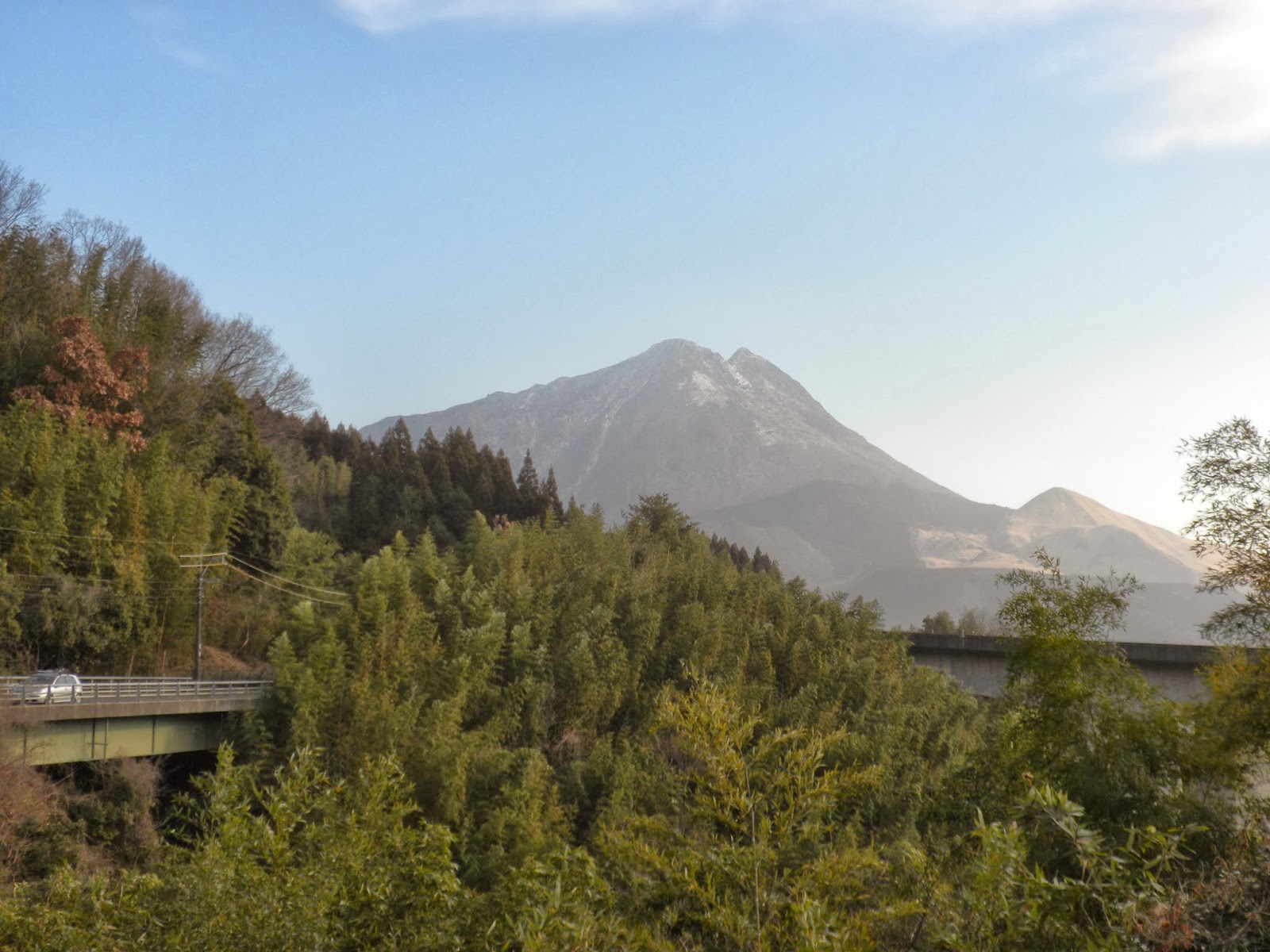
The next day we went to Yufuin, a place in the mountains of Oita Prefecture, famous for the single mountain of Yufuin Dake (shown below), lots of amazing onsen, and a quaint tourist town area. It's been the number one destination in my mind for a while and it didn't dissapoint.
At about 1600 meters it's certainly not the tallest mountain in Japan, but definitely worth a visit, or many.
It's a touristy town with all the touristy qualities one can expect, but it was fun.
After that we went to Beppu, the onsen mecca of Japan. We went to a really cool onsen, ate food, and went home. No pictures, but at about an hour and a half away from where I live, I know I'll be back again and again and again.
The next day we headed to Fukuoka City, the largest city in Kyushu, and one of the largest in Japan.
Getting there takes a little over an hour by express trains and about $50 round-trip. It's close enough to feel like I can go anytime, but far enough to be completely separate.
It really is one of the biggest cities in Japan, and you can feel it immediately. Lots of big fancy building and hordes of people. Very fun to visit.
I've been having small technical problems with the blog lately,
my computer keys are sticky and there is some lag with the typing,
And the amount of Tateyama Sake I'm drinking is enough to draw my attention away from this typing...
So I'll leave you with this ... HAPPY NEW YEAR! I've had millions of budo thoughts lately and want only to tell them you all here. I assure they will flow in a continuous and constant wonderful pattern this year here at Gaijin Explorer.
今年もよろしくお願いします!
Friday, December 13, 2013
My First Iaido Practice
What a very special day in my budo life. After this much time on the earth, I've come to really appreciate beginnings, "first days", and such. Our life is sprinkled with them sparingly here and there. Any day we begin a new training, or anything at all I imagine, it's the first last and only time that will ever happen. I will appreciate this first day and the great changes that will grow from it.
I feel like a puppy that just learned a new trick. Man, it's been a long time since I started something new like this. So fresh. I am the unmolded clay, and today were the first imprints. When starting something where so many movements are unknown, so much honest concentration is used, nothing but focusing on what your teacher just told you and trying to put all of those pieces together before he comes back again. It's been a long time since I've been in this place.
And MAN do I reek of newbie green wood. :)
So, last week I went to watch a class. After that, he said come back next Friday to fill out paper work, and maybe I can do a little training ... a little he said while smiling. Well, I brought my aikido dogi (training outfit) and hakama (black traditional Japanese warrior skirt [ha, I like that description]) first to see if it would work to train in, and then to actually use in it in case it was alright to start swinging weapons around. Maybe he would have me watch again, or maybe he would have me train. In case of the latter, I was damn well going to be ready.
So I got up and went through my morning routine. Saddled the bike, and began the thirty minute ride to the dojo. It rained all night, but had stopped just before I left, lucky me. I cruised at a medium high speed and it felt great. Then my bike slipped on a metal grate and had a little mini crash falling over and scraping my hands. Luckily I was right in front of a conbini and there weren't more than a handful of people in cars to see my embarrassing folly, so I went in, cleaned up, and continued on. I got to the dojo a few minutes early and Sensei walked out just as I pulled up.
"Ohayou gozaimasu!"
"Oh, ohayou gozaimasu!"
We both had big morning budo smiles.
I went in, we chatted for literally a minute and then he asked me if I brought my dogi.
"Yes, I did" :)
He said go ahead and get changed.
SEE! One must always be prepared to pick up the stick and swing.
I was really glad he asked me to get changed, of course because that meant I was going to train, but also because I was worried about my random pieces of a uniform working out. I have my aikido dogi, but I wasn't sure if it was different than the dogi they usually train in. It's a different company, and a little different, but as far as I know, a dogi is a dogi and it's good to go. What I was really curious about was the hakama. I have a hakama for kyudo, and I'm all good and used to it, but it always looked a lot different than what non kyudo people used. When watching my aikido partners put their's on, for some reason it looked so different. But I began to put mine on while sensei watched, and he said that it's all good. There's just one difference in the last bit when you tie it. I have to say, I felt super awkward at first, half kyudo, half aikido, starting iaido. But after I started swinging the sword I forgot about it all, and I now stand as this strange amalgamation starting a new journey in iaido. My super hero outfit is good to go.
He said at first we'll start with iaido, and after a while if things are working out I can begin the jo.
That's perfectly fine with me. This time, slow and steady is OK. Let's start with iaido and move from there. OK OK OK.
During this time there is another woman student who apparently just started about a month ago. She's in the same boat and hasn't started the jo yet either. It looks perfect. We can begin together in iaido and continue to wherever we go. It seems as though my Friday mornings from now on will be like this: Sensei, the other woman, and I.
We started training, and the teacher spent his time between the two of us. He gave me a bokken and showed me how to swing it in the mugai-ryu iaido fashion, then told me to do it a bunch while he taught the woman. He came back in a few minutes and showed me how to swing it while stepping. Then he'd go back to the woman and come back a few minutes later to show me what I was doing wrong, then go back. Then he came back, showed me how to unsheath and sheath the wooden sword, then went back. Next time, he gave me a real sword and told me to practice. WOW THIS IS COOL! I thought, and dangerous, so I was super careful and slow at first. But after a few times you get used to it and I ended up leaving the dojo without losing my fingers or killing anybody, so I'd say it went well.
But wow, this is all new.
And I totally suck at something again.
Perhaps it's not quite that. You can't really suck at something if you've never done it before. You can only suck at something if you've already had experience in it.
A more accurate sentence might be: I suck at kyudo.
This iaido, is just completely foreign ground, like arriving on Jupiter for the first time.
And oh how much I love it. I couldn't slice the broadside of a drunken samurai if I tried. Everything is weird and wrong and awkward. I couldn't help but laugh at myself looking the mirror, concentrating so hard on doing a simple movement and being so wrong. How many times have I been here before in all of the other arts I've tried? How many times have I been just a stupid white belt, and here I am again. It's a thrilling feeling, and I understand that this is what it's about. It's about starting something completely new in a world where you know nothing, and making the steps of progression which require nothing other than simple time, effort, and instruction. This is how it goes, and nobody just walks in moving like a master.
But, it is different this time, and my past experience does have a great effect on this new beginning.
"How so?" you ask?
WELL!
I think a lot of learning a new martial art, and being good at one, includes two major things:
First, is fitting the shape. This is about putting your body in the places it needs to be in order to do what you're trying to do. We attempt this at first, and maybe we get the general points, but our bodies expend a large amount of effort in doing so, and often find ourselves off-balance and tense.
Next is relaxing. Can you fit the shape while not expending extra effort? Can you move through those shapes and keep your balance?
I think once you achieve these two goals of fitting the shape and relaxing you can start moving on to more intermediate techniques ... but for now ... in the beginning ... it's all about these two points.
So for me, my budo experience makes this a bit easier or faster. When I first begin, I'm just as fumbly as the next beginner, but when I look at my teacher and listen to his voice, I'm picking out specific points I know he is trying to emphasize. I focus all of my attention on what he is trying to get me to do, and I'm mimicking him as closely as possible. My eyes and ears are soft, picking up everything without expending extra energy on the uneccessaries. There is nothing but focusing on the task at hand, but also everything else in the periphery at the same time. This is fitting the shape. Next is relaxing. Of course I'm finding myself off-balance and tense at times, but I can feel that my recognition of this is much faster than it used to be and I can immediately relax the muscles. So it's not perfect, but it's fast. Also, I suppose there is a sort of obeying straight lines and circles in budo as well. Behind all of the movements are shapes and circles, and aligning your body and movements with them is what a lot of budo is about. For example when you cut horizontally with the blade you make a large arc. Once the teacher tells me this, I make connections to the wide arcs used in aikido and it helps me. Also, when sheathing the blade, one must make the blade and the saya (sheath) a straight line, and sheath the blade along the line. In kyudo there are a lot of movements where you must keep that straight line while holding the bow or arrow, and so that feels familiar as well.
But along with that positive experience, are also old habits which can disrupt the new technique. There were two big ones that I noticed, and will have to be careful to watch out for.
First is the position of the hips when swinging the sword down. In Aikido we practiced with a bokken (wooden sword) which is dangerously similar. I say dangerously similar because they are basically the same weapon, but are used differently. In aikido when we swing the sword down, we start and end in the hanmi position (belly button facing a forty-five degree angle from the front instead facing straight ahead) and cut at a slight angle. In iaido (at least with this first introductory strike), we have the hips facing forward the whole time, and so the blade follows a straight vertical line. Now matter what I do, my hips naturally rotate changing it all, which will be something I need to be mindful of when practicing iaido.
In connection with that, when bringing the sword over your head, in Aikido we would let the sword flip down our backs before swinging again. I suppose this practices relaxing your body and flowing instead of inserting strength, and so I got used to it. But in Iaido, this definitely won't fly, and when bringing the sword over your head, you definitely don't go past parallel with the ground. Interestingly enough, this was a big problem I had with aikido at first. I didn't understand why you let the sword move so far back, and I thought it was incredibly unpractical. I suppose that is because the purpose of the aikido sword is to help empty hand techniques and relaxing, whereas the purpose of iaido sword is to ... best cut something (?).
Wow ... what is the purpose of iaido!? I don't know ... but you can bet I'll be writing about what it might mean.
OK, so next big difference is in stepping/walking. He had me practice swinging the sword while taking steps forward. This is like sliding forward, permanently staying in a right (or left) fighting stance, but you're really stepping forward. It's like a step-drag movement in karate. Actually that is exactly what I thought of when going through this. Also, I was naturally stepping like I do in kyudo, where your feet don't leave the ground. In kyudo you slide your feet across the floor as you walk, maintaining your connection with the ground. However, in Iaido, he said we must step forward and bring the back foot forward by stepping, not sliding. He said we must step forward keeping our weight above our center of gravity. He demonstrated this by holding a stick straight up and down to represent his body weight. If you connect the bottom of that stick to your foot, and step forward with that foot while keeping your body weight on your back foot, the stick goes diagonal, which is not what we want. Instead, we keep our body weight above our front foot, so that when we step with that foot, our body weight is above it, keeping the stick vertically straight. This is so we can keep our balance and have a stable structure once we make that step. That all clicked with me well, and I was impressed with how clearly the sensei was able to convey this point. The part that is difficult for me is not dragging that back foot. No matter what, my instincts tell me to let it drag, but I'll have to work on picking it up slightly when stepping.
I left full of new things to practice on my own, and next time I'll come back ready for more, with a pocket full of cash and the required paperwork. Just as I thought in the last week, I didn't know how much this training was going to cost, but I knew it was going to be more than what I had been used to with aikido and kyudo. It ends up being about $50 a month for iaido. When I decide to start jodo it will become $90. That is definitely more than I'm used to (kyudo $10 a month, aikido $30) ... but then again I'm also getting a teacher's almost full attention and beckoning when I'm with him. This is different from kyudo when you go in by yourself and receive instruction as a volunteer favor, or aikido when your renting dojo space and working with quite a few other people. I understand, I can pay, and there's no problem.
But it's hard not to think about money when it comes to budo ... but that will require another post.
I also need a sword. Before when I talked to Sensei I thought he said I could get one close by pretty quick, but today when I asked he said I should find one somehow or maybe get one on the internet (from a credible source of course). It's important to have a real sword in the early training in order to get used to the weight and feel, but on the other hand I don't know how long I'll continue this so dropping a lot of money on a sword right away isn't such a good idea ... mostly because I'll beat up the sword and scabbard a lot with my flailing technique in the first couple years. But I need one.
When I left the dojo, I met the main sensei who had just picked up someone from Tokyo who had come to train.
I'm not sure exactly what the situation is, and I'm running out of steam on this blog as you are too probably ... but I think the Sensei who is teaching me is the second in command, with the main Sensei teaching at other times with other people. But I met this Sensei by coincidence when I was leaving and we had a great little interaction. We made chit chat and he was super nice and funny ... more like a normal Japanese old man than the other guy. Basically he asked what sword I was using and said I was borrowing the other Sensei's. He said using another person's sword was not good. So I asked what I should do and that I was ready to get one as soon as possible. I saw the wheels turning in his head and imagine some kind of solution will appear next week when I go in.
This is how people stay young, by trying new things that they are really interested in. I feel like so many old channels of excitement have lit up in my imagination. All of a sudden I want to do a lot of dorky things I like to do like play zelda video games, Magic the Gathering card game, and read fantasy novels for some reason. I want to ride my bike into the forests. I want to create. I don't want to destroy myself, I don't want to forget, I don't want to run away.
Until I get the real blade, I thought about how I was going to practice all I was learning on my own. I have a whole week! At this point I can't go 15 minutes without running through the freshly learned material.
So, I bought my first sword,
for 158 yen at a children's toy store.
You do what you can with what you have.
Wish me luck.
I feel like a puppy that just learned a new trick. Man, it's been a long time since I started something new like this. So fresh. I am the unmolded clay, and today were the first imprints. When starting something where so many movements are unknown, so much honest concentration is used, nothing but focusing on what your teacher just told you and trying to put all of those pieces together before he comes back again. It's been a long time since I've been in this place.
And MAN do I reek of newbie green wood. :)
So, last week I went to watch a class. After that, he said come back next Friday to fill out paper work, and maybe I can do a little training ... a little he said while smiling. Well, I brought my aikido dogi (training outfit) and hakama (black traditional Japanese warrior skirt [ha, I like that description]) first to see if it would work to train in, and then to actually use in it in case it was alright to start swinging weapons around. Maybe he would have me watch again, or maybe he would have me train. In case of the latter, I was damn well going to be ready.
So I got up and went through my morning routine. Saddled the bike, and began the thirty minute ride to the dojo. It rained all night, but had stopped just before I left, lucky me. I cruised at a medium high speed and it felt great. Then my bike slipped on a metal grate and had a little mini crash falling over and scraping my hands. Luckily I was right in front of a conbini and there weren't more than a handful of people in cars to see my embarrassing folly, so I went in, cleaned up, and continued on. I got to the dojo a few minutes early and Sensei walked out just as I pulled up.
"Ohayou gozaimasu!"
"Oh, ohayou gozaimasu!"
We both had big morning budo smiles.
I went in, we chatted for literally a minute and then he asked me if I brought my dogi.
"Yes, I did" :)
He said go ahead and get changed.
SEE! One must always be prepared to pick up the stick and swing.
I was really glad he asked me to get changed, of course because that meant I was going to train, but also because I was worried about my random pieces of a uniform working out. I have my aikido dogi, but I wasn't sure if it was different than the dogi they usually train in. It's a different company, and a little different, but as far as I know, a dogi is a dogi and it's good to go. What I was really curious about was the hakama. I have a hakama for kyudo, and I'm all good and used to it, but it always looked a lot different than what non kyudo people used. When watching my aikido partners put their's on, for some reason it looked so different. But I began to put mine on while sensei watched, and he said that it's all good. There's just one difference in the last bit when you tie it. I have to say, I felt super awkward at first, half kyudo, half aikido, starting iaido. But after I started swinging the sword I forgot about it all, and I now stand as this strange amalgamation starting a new journey in iaido. My super hero outfit is good to go.
He said at first we'll start with iaido, and after a while if things are working out I can begin the jo.
That's perfectly fine with me. This time, slow and steady is OK. Let's start with iaido and move from there. OK OK OK.
During this time there is another woman student who apparently just started about a month ago. She's in the same boat and hasn't started the jo yet either. It looks perfect. We can begin together in iaido and continue to wherever we go. It seems as though my Friday mornings from now on will be like this: Sensei, the other woman, and I.
We started training, and the teacher spent his time between the two of us. He gave me a bokken and showed me how to swing it in the mugai-ryu iaido fashion, then told me to do it a bunch while he taught the woman. He came back in a few minutes and showed me how to swing it while stepping. Then he'd go back to the woman and come back a few minutes later to show me what I was doing wrong, then go back. Then he came back, showed me how to unsheath and sheath the wooden sword, then went back. Next time, he gave me a real sword and told me to practice. WOW THIS IS COOL! I thought, and dangerous, so I was super careful and slow at first. But after a few times you get used to it and I ended up leaving the dojo without losing my fingers or killing anybody, so I'd say it went well.
But wow, this is all new.
And I totally suck at something again.
Perhaps it's not quite that. You can't really suck at something if you've never done it before. You can only suck at something if you've already had experience in it.
A more accurate sentence might be: I suck at kyudo.
This iaido, is just completely foreign ground, like arriving on Jupiter for the first time.
And oh how much I love it. I couldn't slice the broadside of a drunken samurai if I tried. Everything is weird and wrong and awkward. I couldn't help but laugh at myself looking the mirror, concentrating so hard on doing a simple movement and being so wrong. How many times have I been here before in all of the other arts I've tried? How many times have I been just a stupid white belt, and here I am again. It's a thrilling feeling, and I understand that this is what it's about. It's about starting something completely new in a world where you know nothing, and making the steps of progression which require nothing other than simple time, effort, and instruction. This is how it goes, and nobody just walks in moving like a master.
But, it is different this time, and my past experience does have a great effect on this new beginning.
"How so?" you ask?
WELL!
I think a lot of learning a new martial art, and being good at one, includes two major things:
First, is fitting the shape. This is about putting your body in the places it needs to be in order to do what you're trying to do. We attempt this at first, and maybe we get the general points, but our bodies expend a large amount of effort in doing so, and often find ourselves off-balance and tense.
Next is relaxing. Can you fit the shape while not expending extra effort? Can you move through those shapes and keep your balance?
I think once you achieve these two goals of fitting the shape and relaxing you can start moving on to more intermediate techniques ... but for now ... in the beginning ... it's all about these two points.
So for me, my budo experience makes this a bit easier or faster. When I first begin, I'm just as fumbly as the next beginner, but when I look at my teacher and listen to his voice, I'm picking out specific points I know he is trying to emphasize. I focus all of my attention on what he is trying to get me to do, and I'm mimicking him as closely as possible. My eyes and ears are soft, picking up everything without expending extra energy on the uneccessaries. There is nothing but focusing on the task at hand, but also everything else in the periphery at the same time. This is fitting the shape. Next is relaxing. Of course I'm finding myself off-balance and tense at times, but I can feel that my recognition of this is much faster than it used to be and I can immediately relax the muscles. So it's not perfect, but it's fast. Also, I suppose there is a sort of obeying straight lines and circles in budo as well. Behind all of the movements are shapes and circles, and aligning your body and movements with them is what a lot of budo is about. For example when you cut horizontally with the blade you make a large arc. Once the teacher tells me this, I make connections to the wide arcs used in aikido and it helps me. Also, when sheathing the blade, one must make the blade and the saya (sheath) a straight line, and sheath the blade along the line. In kyudo there are a lot of movements where you must keep that straight line while holding the bow or arrow, and so that feels familiar as well.
But along with that positive experience, are also old habits which can disrupt the new technique. There were two big ones that I noticed, and will have to be careful to watch out for.
First is the position of the hips when swinging the sword down. In Aikido we practiced with a bokken (wooden sword) which is dangerously similar. I say dangerously similar because they are basically the same weapon, but are used differently. In aikido when we swing the sword down, we start and end in the hanmi position (belly button facing a forty-five degree angle from the front instead facing straight ahead) and cut at a slight angle. In iaido (at least with this first introductory strike), we have the hips facing forward the whole time, and so the blade follows a straight vertical line. Now matter what I do, my hips naturally rotate changing it all, which will be something I need to be mindful of when practicing iaido.
In connection with that, when bringing the sword over your head, in Aikido we would let the sword flip down our backs before swinging again. I suppose this practices relaxing your body and flowing instead of inserting strength, and so I got used to it. But in Iaido, this definitely won't fly, and when bringing the sword over your head, you definitely don't go past parallel with the ground. Interestingly enough, this was a big problem I had with aikido at first. I didn't understand why you let the sword move so far back, and I thought it was incredibly unpractical. I suppose that is because the purpose of the aikido sword is to help empty hand techniques and relaxing, whereas the purpose of iaido sword is to ... best cut something (?).
Wow ... what is the purpose of iaido!? I don't know ... but you can bet I'll be writing about what it might mean.
OK, so next big difference is in stepping/walking. He had me practice swinging the sword while taking steps forward. This is like sliding forward, permanently staying in a right (or left) fighting stance, but you're really stepping forward. It's like a step-drag movement in karate. Actually that is exactly what I thought of when going through this. Also, I was naturally stepping like I do in kyudo, where your feet don't leave the ground. In kyudo you slide your feet across the floor as you walk, maintaining your connection with the ground. However, in Iaido, he said we must step forward and bring the back foot forward by stepping, not sliding. He said we must step forward keeping our weight above our center of gravity. He demonstrated this by holding a stick straight up and down to represent his body weight. If you connect the bottom of that stick to your foot, and step forward with that foot while keeping your body weight on your back foot, the stick goes diagonal, which is not what we want. Instead, we keep our body weight above our front foot, so that when we step with that foot, our body weight is above it, keeping the stick vertically straight. This is so we can keep our balance and have a stable structure once we make that step. That all clicked with me well, and I was impressed with how clearly the sensei was able to convey this point. The part that is difficult for me is not dragging that back foot. No matter what, my instincts tell me to let it drag, but I'll have to work on picking it up slightly when stepping.
I left full of new things to practice on my own, and next time I'll come back ready for more, with a pocket full of cash and the required paperwork. Just as I thought in the last week, I didn't know how much this training was going to cost, but I knew it was going to be more than what I had been used to with aikido and kyudo. It ends up being about $50 a month for iaido. When I decide to start jodo it will become $90. That is definitely more than I'm used to (kyudo $10 a month, aikido $30) ... but then again I'm also getting a teacher's almost full attention and beckoning when I'm with him. This is different from kyudo when you go in by yourself and receive instruction as a volunteer favor, or aikido when your renting dojo space and working with quite a few other people. I understand, I can pay, and there's no problem.
But it's hard not to think about money when it comes to budo ... but that will require another post.
I also need a sword. Before when I talked to Sensei I thought he said I could get one close by pretty quick, but today when I asked he said I should find one somehow or maybe get one on the internet (from a credible source of course). It's important to have a real sword in the early training in order to get used to the weight and feel, but on the other hand I don't know how long I'll continue this so dropping a lot of money on a sword right away isn't such a good idea ... mostly because I'll beat up the sword and scabbard a lot with my flailing technique in the first couple years. But I need one.
When I left the dojo, I met the main sensei who had just picked up someone from Tokyo who had come to train.
I'm not sure exactly what the situation is, and I'm running out of steam on this blog as you are too probably ... but I think the Sensei who is teaching me is the second in command, with the main Sensei teaching at other times with other people. But I met this Sensei by coincidence when I was leaving and we had a great little interaction. We made chit chat and he was super nice and funny ... more like a normal Japanese old man than the other guy. Basically he asked what sword I was using and said I was borrowing the other Sensei's. He said using another person's sword was not good. So I asked what I should do and that I was ready to get one as soon as possible. I saw the wheels turning in his head and imagine some kind of solution will appear next week when I go in.
This is how people stay young, by trying new things that they are really interested in. I feel like so many old channels of excitement have lit up in my imagination. All of a sudden I want to do a lot of dorky things I like to do like play zelda video games, Magic the Gathering card game, and read fantasy novels for some reason. I want to ride my bike into the forests. I want to create. I don't want to destroy myself, I don't want to forget, I don't want to run away.
Until I get the real blade, I thought about how I was going to practice all I was learning on my own. I have a whole week! At this point I can't go 15 minutes without running through the freshly learned material.
So, I bought my first sword,
for 158 yen at a children's toy store.
You do what you can with what you have.
Wish me luck.
Thursday, December 5, 2013
Half Learning, More Internalization & and Meeting Sensei
It's difficult to drawn the line where one must seek teaching and where one must forge on one's own.
I'm talking about kyudo, but this is evident in other martial arts, and life as a whole.
This is evident everywhere, but it seems to be more distinct in kyudo. Receiving guidance from a teacher is so necessary in certain specific spots and times in kyudo. That line between receiving careful instruction and not is extremely thin. One day a teacher will tell you one small detail, or keep you from making one small habitual mistake and everything will change. Writing this, it is the same in other arts such as aikido, but I find that in open handed arts the line seems wider and more blurred. Of course you can't do the technique perfect in aikido at first, but you can do it to a point of sufficiency. After that, a teacher will continue to tell you these details you probably won't do immediately. You're listening to the teachers' instruction, but at the same time, when you finally are able to do that technique, it is a product of your own body finding the result. Looking back, it's really amazing.
I find kyudo to feel different. I make a mistake and can't see how to fix it. A teacher will explain it to me, but my hands just can't do it immediately, and the result is still horrible. In aikido I could do these things almost immediately, but in kyudo the time is infinitely long, impossibly long. The dissent between what a teacher does and what I do is so vast, the immiediate results so unsatisfying.
Interestingly enough one of the other members in Kyudo was helping me out and told me a couple things that revealed some inspiration. First, he said that it takes about 6 months for the things we're working on now to finally show their effects. That doesn't just mean we practice something today and it magically becomes a reality in six months time. It means that after six months of focused effort, some flowers will begin to bloom ... due to that focus and hard work is the point. Second, he tried to explain tenouchi (the left hand which holds the bow) which is a term used in lots of martial arts, but is mainly concerned with the yunde (left hand) in kyudo. We can watch each other out in the open, even give pointers to each other, but essentially the tenouchi is our own secret to unravel. Everyone's bodies are different, so what works for one will not work for another. Also, a lot of what happens goes on inside of the hand happens where nobody can see. We imitate the shape of our teachers and let our insides form according to our own evolution.
We need instruction to begin and progress, but I'm beginning to think that we learn all of this mostly on our own, and the end result reflects our individual selves. Mr. Parker over at the Mokuren Dojo (http://www.mokurendojo.com/) often talks about this and calls it "Watakushi-do", I'll take the liberty of calling it "the Way of Me". We are studying these arts that have specific names and ways, but we are really creating our own style. In this I'm not sure that it matters so much what art we study, as long as we do our best to strive for progression, listen to those who have come before, and internalize the world to make it our own.
I met the main sensei for the first time the other day. Being a hanshi (8th dan [8th degree black belt]) he has a bit of fame in the area and is certainly considered the head of the dojo. Until now I've only had one chance to go for night practice, but I went yesterday and finally was able to meet him.
He's great:
A strange balance of what I expected and an unknown I wish to explore.
Physically, he's pretty much like a normal Japanese dude. He's a few inches shorter than me and not particularly fat or skinny or anything at all. His hands are smaller than I expected. This might be a weird thing to notice, but so much of kyudo has to do with the hands, it's hard not to apply reasons to success or failure in technique to such a physical part. My sensei in Toyama had long fingers, and the way he held the bow seemed so easy for him, where as I have smaller hands and shorter fingers. I know technique depends upon technique itself, not just our physical bodies, but for some reason it was harder to see with him. Now with this sensei in Nakatsu, I can see hands similar to mine reach success, and that gives me hope.
He certainly has a presence, but I have to say "presence" in Japan is largely affected by the surrounding people. Because he is who he is (not just his title, but his vast experience and history with all of the other people, I'm sure) people make way for him and hold him up in a certain way. Aside from that, I perceived the calm strength that usually marks an aged practitioner in budo.
He's super nice, but won't bullshit you. When I first met him, I was nervous and polite (probably two characteristics I've subconsciously been adopting in Japan! Not too much though ... enough to translate my feeling in Japan effectively, I think ...) he saw this, but also saw that I came seeking knowledge and teaching, and I think he understands me pretty well though we haven't had much time together. He was super nice and talked and joked and relaxed with everybody, while also shooting with others in zassha (sitting form), and would give advice freely about people's form.
But like he said, he also won't bullshit. I feel as though when I left Toyama and first came to Nakatsu my technique was as good as it could be, and something I'm not ashamed to show. But after a month of not practicing, and then a month of sparse training due to messing with my hand, my technique has crumbled to something I'm embarrassed of, but have to progress on nonetheless. Anyway, so I went and shot and knew he was watching me. I got worse and worse and just went straight up to him and asked him questions about my tenouchi.
This is strange in Japan, I think. For a beginner student who only just met the head sensei to walk straight up to him and ask questions. I think the mark of a good teacher is one who will take the question as if it came from anybody and answer to the best of his ability. A lesser teacher may be offended that you don't respect unsaid rules concerning a certain distance from the teacher until after a long time. I don't know. These are unsaid and unwritten rules sensed by feeling, something I will not be very good at being gaijin. Maybe I violated some kind of faux pa, or maybe it's nothing at all. Anyway, I'm gaijin, so I do have a bit of leeway with such things, because I'm not expected to know, or maybe we do things different from where I'm from ... well, both of those are correct I guess.
Regardless, sensei seemed happy to receive me and went in depth to answer my questions. He explained the basics of what one should do, and how that was different from what I was doing. This is good. How could it be better? But it's also what I've heard before, what I don't quite understand, and what I can't quite do yet.
What I was really happy about though was the attention he gave to the condition of my hand.
What has happened is that I push the bow with part of my thumb instead of the the base of it where it meets my hand, and so a blister developed. The blister didn't heal correctly so it was torn and a cut-like injury appears. I'm doing my best to hold back until it's healed completely again, but this happened in the past and instead of waiting for it to heal, I trained through it and developed scar tissue that has built up underneath the skin. It's relatively harmless and will go away with time if I practice in the proper way. But the issue is, the problem has come back (WHY IN THE LORD'S NAME I DON'T KNOW!) and the wound has reopened.
Anyway, I showed this to Sensei and he recognized it immediately and said lots of other people get this. One surrounding guy came in and showed me he had a callous as well from past mistakes. Sensei had me look at and touch his hand which had absolutley zero marks. No one needs a callous there, and if you're doing the technique right you won't have one.
From there he felt my hand and squeezed the skin as if searching for that built up scar tissue. It's as if he could see exactly everything that had happened and went straight to the source. In the past I've had discussions with this problem with my sensei in Toyama, but never got any good answers I felt. The fact that this sensei felt my hand for the scar tissue makes me feel at ease, as if he knows just what I'm going through, and whether I should continue or rest.
That's the real question. I have the image of perfect technique in my mind, but I can't do it. When my hand hurts, I certainly can't do it, but how should I progress? Should I wait a long time until it is completely healed? Train through it regardless? Wait a bit of time and accept it won't be perfect right away while progressing slowly?
These are the answers I must give myself.
In this light, it's a dark world where only I can hold the torch.
I'm impressed with sensei and will go as often as possible to night training to meet with him as well as all the other extremely talented archers.
But what to do with the mornings. Of course I will go to kyudo ... but my angst is so persistent ... should I inquire about the iaido and jodo???
Life is a mystery we unravel with our actions. Nobody knows what will happen. All we can do is quiet ourselves to better see that path which lies before us.
The weakest part in the grass.
Wednesday, December 4, 2013
I Can Be Perfect When I Die
(Art found at http://www.hdwallpapers.in/eclipse_warrior-wallpapers.html)
I don't trust anything that I can't fully feel.
I'm now 28 and bursting with energy, begging for somebody to give me a goal I believe in to run at as fast as I can.
I've always felt this most with physical activities. In grade school it was sports, since then it's been martial arts. Through the arts I've spent time in, I'm now living in Nakatsu where I practice Kyudo. It's a wonderful art, but I can't expend the energy like I fully desire. On top of that, my hand keeps me from practicing full-on everyday. I know Kyudo is teaching me patience and intelligence, but it doesn't satiate my hunger. I think I need something to physically beat me down until I'm too tired to care.
And so my mind wanders ...
I've found another dojo that teaches two arts I've been foaming at the mouth to get a chance to practice: iaido and jodo (joudo - short staff). Here is there website if you want to check it out: http://www.kenwa-kai.com/index.html .
I've been idealizing about formally only practicing one art for the time being ... but now that I'm here, I feel that I want more. Perhaps it's just because my hand keeps me from practicing kyudo as much as I want, and when it heals one art will suffice, but I don't want to wait. I have all the materials sitting right in front of me and I want it so bad. Why would I hold back?
3 Reasons:
1.) Being able to focus on one art, which more specifically means physically focusing all of my available effort into one skill, letting myself subconsciously adjust to that one art in the downtime, and learning about the art through reading and writing.
2.) Allowing myself opportunities to fully participate in extra activities related the one dojo I practice at like weekend tests, competitions, or parties. This is a big one I never expected before I started. The core of the practice is the routine practice itself, but without being able to participate in all the extra stuff robs one of the most exciting and experience-altering facets of the art. Also, dojo fees start pulling you in two directions.
3.) One big one that I'm not to sure about is the feelings of the other teachers and practitioners. Japan really likes focusing on one thing at a time ... or actually more like your whole life. If I were to focus on only Kyudo, I would receive uninhibited attention and care. If it were to be known that I had a second budo lover, that attention might become limited. As for keeping it a secret, that would definitely not work. If I were to practice two arts and then have it figured out later that I was when everything thought I was only doing one, it would be awkward ... like finding out you were not the only one. In a lot of ways, Japanese are against this kind of divided love for a lot of deep reasons I don't think anyone really understands.
So there are lots of reasons to keep me limited to only one art for the present time, but there's also a lot to make me want to branch out again:
1.) I want to practice martial arts, and many different kinds until I'm gone from the world. I suppose taking one at a time is one way to do it in which I can focus on only one at a time, but that kind of putting-off of plans and desires doesn't seem realistic to me. Plus, I want to feel the mix of the different arts while growing in each at the same time, not just getting good at one and then forgetting ... though that's not so bad either.
2.) I don't trust one art. By only focusing on one you forget the others and isolate yourself away from the rest of the world. I don't trust that this one art will give me all that I need. I don't trust that I'm getting everything I want. One can say that we can experience everything in one simple act, and by progressing in Kyudo I can experience everything I could in another art ... but I don't trust it, and that doubt gives me a strength I can feel.
3.) I'M WILD CURIOUS ABOUT IT. I've wanted to practice iaido and kenjutsu for so long but have never had the chance. Also, I heard jodo was famous in Kyushu and in coming here I thought I might get a chance. This curiousity and enthusiasm is one of the greatest ingredients to success in budo. When I've progressed the most is when I'm too interested and having too much fun to worry about anything that could hold me back.
Sitting here with a bum hand and extra time, my mind has already taking this idea and begun to form a new future. That is incredibly exciting. Perhaps I get too far ahead of myself, I do that often. But what a waste of such enthusiasm isn't it? I can be perfect when I die, for now, I want to experiment and explore.
The reality is I have come this far in kyudo and have found an excellent dojo and will continue no matter what, naming it my main for now. Also, my time will change considerably once the wife gets here next month. Furthermore, I've been wanting to spend more time writing, and if I adopt another budo, that might take away all of the time I've been wanting to give to the blog and other projects.
I suppose I'll think about it a bit more to see if I'm really interested and really can't wait, contact the dojo, and go from there. Until that time, I know nothing. The dojo could be a bunch of punks practicing a bunk art. They could only want students who will devote all of their time to it. Or maybe it's exactly what I want ...
It could be the greatest opportunity ever just waiting for me to contact. Maybe it would be perfectly fine to practice 2 or 3 mornings a week, taking it slow, allowing me to live me life in all it's faculties while still being able to do all else that I want.
Why wouldn't it be?
Because I need to sacrifice everything for one thing?
Bullshit.
Because it's being to greedy on my part?
Bullshit.
Because I expect the world to be given to me just how I want?
Bullshit.
All there is is a feeling: I want. From that my mind and body begins to move: achieve. If I mis-step I'll know it and readjust. We become humble on the path of budo, but you don't get anywhere unless you're ready to step.
Any thoughts?
Monday, December 2, 2013
Kyushu Bike Explorations & the "Raiki-Shagi"
On this Sunday day-off I did what I haven't done in what feels like years, just ride the mountain bike into the unknown. Over the past couple years, bike rides have been dominated by great plans in search of high mountains leaving the apartment early in the morning. That is good, and usually where you find the really epic spots. But on this Sunday I took advantage of being in a completely new place and the jewels that are revealed in merely cruising around with no plan.
I rode west to the neighboring town of Buzen and then headed towards the hills where I thought I may find temples, hidden roads, and onsen. As you can tell by the pictures it was a dreary day. Partly rainy on this morning, the clouds hung low and it was cold enough to warrant a coat and hat with readied gloves and scarf in the bag. On this first of December, the shape of winter is almost completely upon us, with the last of the autumn colors hanging on before their eminent fall. These days are quiet. Many complain or stay indoors. However, this is where I thrive.
These days are quiet. When I ride, I feel isolated in the mist. The people are all indoors and the mountains are hidden behind thick veils of white and grey. Nothing but me and my thoughts, and those small treasures in the mud I normally wouldn't recognize. A big part of the move to Kyushu was about simplifying a lot of things in my life, and being able to marshal all of my concentration into the few things I decided to keep. That's the image, and it's a peaceful one for me: quiet, clean, focused. But the reality has felt a little more hectic, getting the new apartment together, getting adjusted to the new environment, trying to get in a routine with kyudo. Looking at it, I have all the right parts, but there's been a chaotic sky over it all. Why? Why does it still feel like the apocalypse? Why do I still feel failure and urgency grating beneath my skin?
Let's take a look at Kyudo.
I'm ready to focus all of my energy into this physical art, but have been plagued with blisters opening on my left hand. First I got a blister, the next day I tore it, took three days off and went back, wasn't enough time so it tore open again, I took a week off to make it heal, it was barely enough but I still kept doing the same things that make the blister in the first place and it tore open again. The good thing is, I finally talked to someone who told me why this was happening and what I need to do to make sure it doesn't happen again. I think I've got it and I'm dying to get back. I finally have a Monday off and want to go at night when most people practice, but the blister isn't completely healed and I'm afraid it will just tear open again if it's not 100%. I'm still not sure if I'm just going to go anyway tonight, or wait until it's 100%.
Point is, my experience in kyudo here hasn't been settled yet, and is usually just leaving me infuriated. With this time away from the dojo, I've been revisiting the "Kyuu-hon" official Kyudo Manual. It's main sections are posted in all kyudo dojos everywhere, in written tests they take questions from which all practical answers can be found in its contents, and it's the one thing all teachers will ask you if you have and tell you to read it over and over again. I received a copy from a friend last year and read through it fairly quickly.
The thing with kyudo books, is that they're not so easy to read cover to cover. One could divide most kyudo books into these sections:
-Introductions written by authors which can be often be subjective and superfluous.
-Descriptions of ettiquete and movements unrelated to shooting, which are just stone-dead boring and useless without physical instruction.
-Descriptions of technique which are good, but also worthless without physical experience or direct help from a teacher.
-Short sections of interviews or classic texts written by the masters, which are the gold gems of these books.
Wow, the descriptions of those first three sections were really negative. I guess that's the impression left with me from the few kyudo books I've read. On the good side, those subjective introductions can entice people to the art of kyudo, which is largely misunderstood. As to the technical descriptions, I suppose they should be referenced when one has a specific question. For example, if you can't remember exactly what angle or when to bow in a certain procedure, or how to properly pick up an arrow dropped mid-shooting, it can be a helpful reference. As for shooting technique, things can get very complicated and confusing after a long time of practice, and by returning the the texts you can be reminded of the essential basics involved.
Generally, I suppose a kyudo book should be bought and read cover to cover at first to get as much information as possible to help your practice, though it will probably require a large amount of discipline and intoxicating drinks. After that, they should be put away and picked up again for reference when stumped by a question.
But what I really want to talk about today, is the very first section of the "Kyuu-hon" (Kyudo Manual) and one of the main texts (sayings, documents, ?) the Raiki-Shagi, "Record of Etiquette-Truth of Shooting."
This is one of those super-important sections written by the masters that should be revisited from time to time to remind oneself of what may be at the core of the art as a whole. It's one of those texts that both beginners and masters can read and benefit from, though what each individual finds may be completely different from others.
So without further ado, the Raiki-Shagi:
"The shooting, with the round of moving forward or backward can never be without courtesy and propriety (Rei).
"After having acquired the right inner intention and correctness in the outward appearance, the bow and arrow can be handled resolutely.
"To shoot in this way is to perform the shooting with success, and through this shooting virtue will be evident.
"Kyudo is the way of perfect virtue. In the shooting, one must search for rightness in oneself. With the rightness of self, shooting can be realized.
"At the time when shooting fails, there should be no resentment towards those who win. On the contrary, this is an occasion to search for oneself."
What do you think?
When I first started Kyudo I was drawn to its spiritual emphasis. However, I had just been training in aikido with a teacher who was most concerned with technique: once you have technique you can start experimenting with the more abstract phenomenon of the art. With that, I was very concerned about quickly learning the physical basics of the art. Here and there I've enjoyed the more nebulous sides of Kyudo, but for the most part of been concerned with the physical technique.
In the move I had about a month off from Kyudo and have been reacquainting myself with the artistic expression of shooting the bow, and have been very excited to get back to the art and see how I can express myself better through the practice.
However, when I came back I started doing really weird things with my hands, and realize that I had forgotten how to do a lot of it. I'm revisiting old injuries and failures, ones that I supposedly overcame a long time ago. How is it that all of these old problems are coming back to haunt me? Why do I need to learn these things again?
When I first went back to kyudo I think it was alright, but after few days the techinique crumbled considerably, and the last day kind of went like this: I went in using the stronger bow I've been using lately, but my left hand won't let the bow rotate properly in the hand, which causes injury and bad technique. I start focusing entirely on this and forget the other hand or anything else I should be doing. I can't do what I need to do with my left hand, so I start making small "cheating" adjustments to fit to the form. In those small cheating adjustments, I change the technique making it weak. I can't do it perfectly on the makiwara (practice haybail), and go to the target anyway with a weaker bow. I try my best at first to breath, relax, and understand it won't be perfect, but I enter the malformed technique and have a horrible shot. I become angry with myself and kyudo, and start focusing only on the target. In that thought it's like if I just hit the target it will be OK, but I don't. I start rushing through the movements, which makes even worse technique. My body gets hurt by the mistakes in the technique. And I start to resent or envy the others around who are "succeeding" and not telling me what to do. I leave the dojo early and am propelled into the world with great confusion and frustration.
I believe there are two parts to this:
First is a matter of physics. I need to do what I need to do correctly in my left hand. If I can't do it I need to ask for help. Then, I can fix the technique and resume proper kyudo. Also, I need to not practice if I'm injured, because even if I do correct technique with an injured hand, it will continue to get worse.
Second is a matter of spirt. This is finally where the "Raiki-Shagi" comes into play.
I began with good intentions, but somewhere along the way dirt has gathered where I can't see, and demons have been breeding while my attention has been away. All of a sudden I've found myself obsessed with things outside of myself: success and stuff. I've been following bread-crumb trails left by society that have pulled me so far off center that Kyudo is no longer a practice of life, but a tool I use to assert my ego in the world. I use kyudo to dominate others and legitimize myself as a success in the universe. Perhaps that plays a part, but it is not the whole. It is the failure of technology in man, a tragedy because the intentions were good.
I don't know.
Knowledge is the gift of practice.
But before that practice, before the knowledge, we still exist. We exist, and must choose to live right in order the complete the world. Though I'm lacking, I still live, and must stand up straight and accept it all with the grace and composure of the Gods.
Shooting with perfect virtue for me is doing your very best while accepting your own mortality.
Going over all of these thoughts, the frustration returns and I want to quit and find another budo. But I know if I do I'm running away from this puzzle. There are small bits of sunshine hope through the clouds, and I know I must go on. I've wanted to quit so many times before, but in continuing I've reached new levels in this art of Kyudo. I know that if I continue I will succeed, but there is a fear that doesn't believe the equation and just wants it all to end.
If we continue something will happen.
If we quit, there is nothing.
I don't know.
Subscribe to:
Posts (Atom)