Showing posts with label Toyama. Show all posts

Saturday, July 21, 2012

2 Month Kyudo Course: Complete - Enter: Real Training


Yesterday I went to the Kyudo dojo for the last time as a member of the two month course I've been attending thus far. Soon I will join regular classes and solidify this as an activity of great importance in my time here now. I say "soon" instead of "tomorrow" or something a little more immediate because I will be on a month-long hiatus due to mass invasions of high school students in the dojo during their summer vacation. And that's OK. This gives me time to mill over the mass download of information from the past two months, research outside sources on this practice, and experience the peak of summer with full participation in its fiery onslaught.


The changing of the seasons is huge for me. I sense great meanings in their passing and am deeply affected, and thusly interested, in their quintessential characteristics which bring about certain aspects of our personality, the surrounding environment, and existence as a whole. Summer. It's always been the most difficult one for me to find clarity in. As a kid it meant summer vacation, fireworks, going to the lake. A time where the schedule of school is temporarily burned off ... but only temporarily ... and that's something I think every kid is conscious of, or at least I was. In college it meant coming home to work a manual labor job and run around the island with the crazy wolf pack that are my hometown brothers. In Japan it means enduring temperatures and levels of humidity that take me to the limits of my north-western North American raised, northern European blooded self. It means joining my friends on camping trips which seem to end up feeling more like circus tours. And it also means that the snows melt in the high mountains and I get as close to them every chance I get. ACTION ACTION ACTION. Heavy metal and ice coffee accompany this well. Aikido time suffers a bit as a natural casualty and studying is difficult to maintain. Reflection? I'm sweating everywhere I go whether I'm under the blazing sun or not. A strange heat boils inside of me in the humidity. My friends are offering me more whisky than I asked for. And I've got things to do! Not much reflection during this time. I knew this going into May when things started warming up, and I expected just to pack the summer full of epic adventures and think about them later. The two month Kyudo course was part of that plan, and though the summer is still building to its climax, I'm already thinking about the next season: Fall. This is where my imagination thrives. A cooling down and returning to official study; preparing for the hibernation of winter. This time will be ushered in by my return to Kyudo.

Yes. Back to budo! Sorry about that little tangent there, but it is incredibly relevant. It seems I'm enjoying this little reflection period and will continue to do so just a bit more.

Dammit. I lost my train of thought. Oh well ... When in doubt, grab a rock.

The picture above is ... ME! And that stick in the bullseye, that was my first arrow to hit the target. The whole time leading up to it I wondered what it would be like; to have some kind of sign that you did something right. Well, I got a disgustingly huge smile across my face. One of those that are impossible to hide or subdue. The fact that I hit the bullseye sent that smile to infinity. How could I hit the target any more than I did? But by no means am I gloating about this though. The next two arrows I shot went flying in just as strange directions as all the arrows I shot before that fateful one. It's as if our success is completely random, or at least far beyond our own logical comprehension. Before I hit the target, I tried as I could. After I hit the target, I tried as hard as I could. That one shot I hit the target, I tried as hard as I could. Why, when all the other times I failed, did I hit the target that one time? I don't know.


But seriously, I know so little about Kyudo. What this two-month course has done is taught me how to stand. There are so many small details about this art, like our body's motor skills, that to be able to simply shoot an arrow at the target on your own is the managing of a lot of little things that those who have accomplished have probably long forgotten. After two months, I went from a babbling baby crawling around on the floor, to a toddler who can stand without Sensei holding me up. I think he was just as happy as the students while we all drank tea and ate crackers at our little graduation ceremony. Thinking about this now reminds me of the personal bonds you form with your teachers, students, and fellow practitioners. Through the incredible physical, mental, and spiritual struggles you encounter together, things just seem to settle into a family. I don't remember the context or the exact words, but my first teacher told me when I was 17 years old that the bond between a student and his teacher is like the perfect father-son relationship. Saying that to me had a great affect, and surprisingly even more so now. I'm sure he was aware at the time that I was raised without a father, but this idea is free from the limitation of having your father in your life. Free from specific circumstances, yet steeped in emotional goo.

I don't know. I don't care so much either.

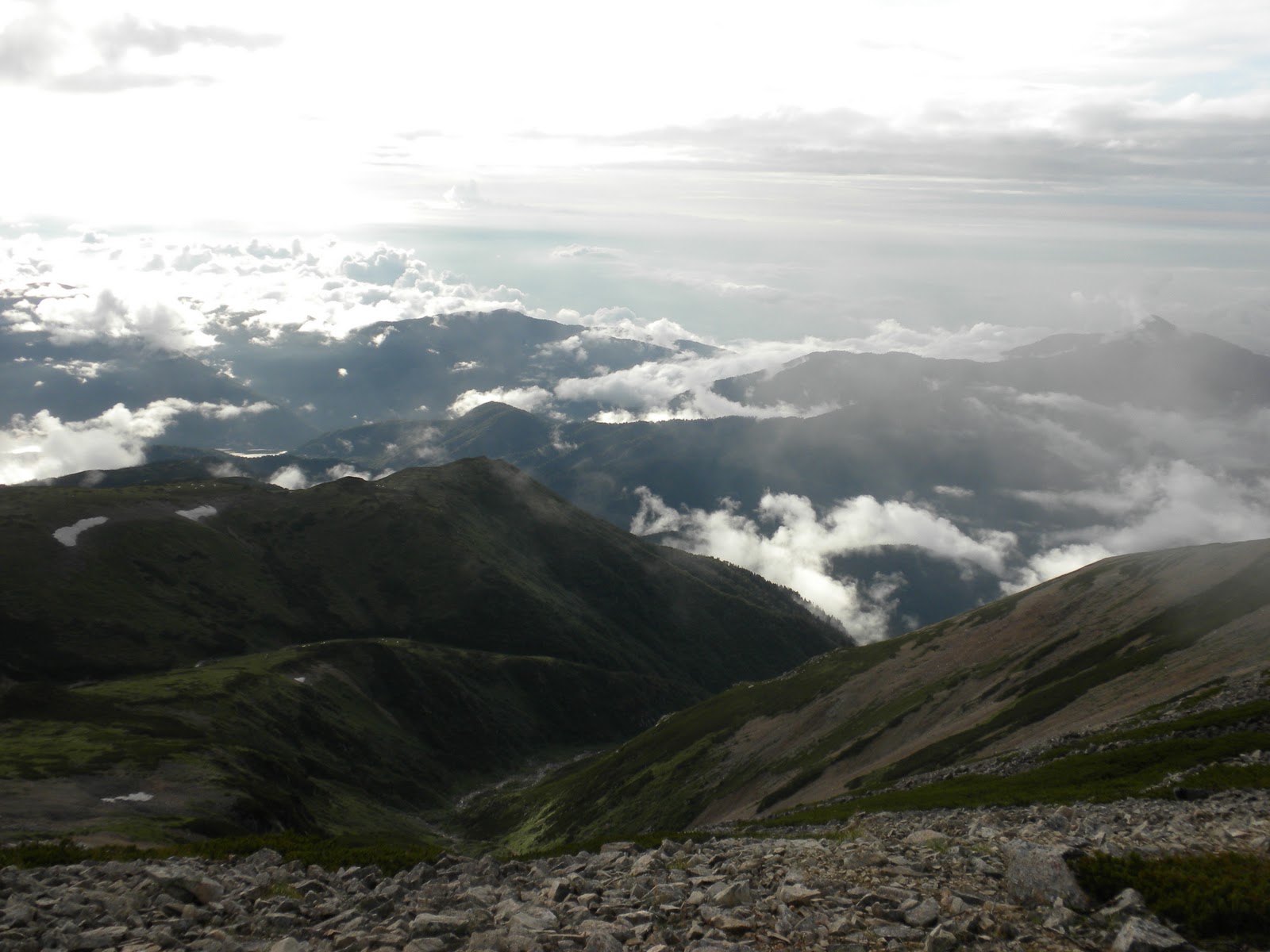
A cloud passes over the mountain. How could I see every blade of vegetation around the river?

Anyway, my Kyudo sensei is cool and I look forward to continuing this journey in the art under his supervision and guidance.

I just stepped outside and heard some dude playing the guitar and singing next to the river. A brave artist. I wonder what it would be like to do the Tai Chi form in the park for everyone to see. That's not going to happen now. Hey seasoned martial artists, does that get easier to do? And why are these damn Japanese apartments always hotter than outside?

Check in soon about more budo experiences in aikido, my new study of kyudo, zen meanderings, and maybe some mountain adventures. If any of you practice kyudo, please let your voice be known in the comment section!

Have a nice day.


Tuesday, July 10, 2012

Kyudo: My New Study


Almost a year has passed since I shifted jobs and locations here in Toyama Prefecture, Japan. That's also how long I've been away from frequent and consistent Aikido training. For almost a year I've been in exile here in Toyama City, visiting children's English classrooms instead of dojos after nightfall. I had a lot of ideas about how this new chapter would run, and how it would transition to the next phase. I suppose I was accurate in the presumption that I would take advantage of this new situation by cultivating a solid independent study of martial arts and Japanese. Those have been successful I'd say. But I didn't foresee the large amount of time ... wasted(?) ... perhaps that's a little harsh ... time spent ... worrying(?) ... or maybe just brooding, on my life and current situation. What I have with my new situation is a large amount of free time in the mornings and afternoons. With that I've climbed mountains, literally as well as figuratively with my own studies ... but I also went through a lot of swampy terrain in my head, which I'm not sure was necessary. Well, it is what it is, and without digressing too much, it is enough to say that I haven't taken the time to find new budo practice with my free time; at least until about a month ago. It all started with a conversation with one of my sempai, a coworker-mentor of sorts; English doesn't seem to have a good word for this particular relationship.

Sempai: "Dude, I think I'm going to get back into Kyudo. They're offering a two-month course at Kojo-koen in Takaoka."

Me: "Really? Can anybody join?"

"Yeah, doesn't matter who you are as long as you pay the cash."

"Mmmmmmm..."

"Wanna join? It's Tuesday and Friday mornings from 10 - 12?"

(Thinking to myself in my head: "Mmmm, Kyudo??? I'd rather just worry about aikido. And 10-12 in the mornings? I'm kinda trying to do my own English lessons on the side for cash, I can't be starting Kyudo as well right?")

"Nahh dude, I'm kind of busy."

"Whatever, dude."

After I went home ... with a lot of that open time I have, and just thought. I thought and thought and thought a lot. I guess that's how a lot of my time has been spent. It sounds boring, but when you drown it with coffee and think about all the other little details of things you should do, it really feels pretty busy ... hectic even ... actually apocalyptic at times.

So I thought, and then a part of me stood against the rest of me:

"Are you f$%#ing SERIOUS!?!?!?!...

 You came to Japan exactly for this reason! You would have done tea ceremony if it was offered from the beginning, but instead you found exactly what you wanted in aikido. Well, things changed, and you're trying to get back ... but are you seriously going to whine about not being able to practice budo in Japan while being offered this course in one of the coolest budo of all? TAKE THE FLIPPING CLASS!!!"

I then talked to my sempai face to face about joining and he took me immediately to the park to sign up.

And so now, two mornings a week, I practice Kyudo and I absolutely love it. Should I have started it earlier? That's a stupid question. I'll just write down some of the details about the class now, and elaborate with funny stories and revelations later on.


Location: Kojo Koen, the most beautiful park in Toyama Prefecture in my opinion, located in Takaoka City, the second biggest city in the prefecture and a 20 minute train ride from my house (close compared to aikido practice). The dojo is a beautiful building, with a long grass lawn until the 5-target set up.

(a picture of the Takaoka Dojo, the grass is more overgrown right now and looks cooler I think, also there's usually one more target on the left side)

Cost: 5,000 yen for the 2 month course, 2,500 yen for the small essentials like a rubber practice apparatus, string, guidebook, cloth that goes over the hand underneath the glove you use. (once I get more familiar I'll probably use the official Japanese terms. But I don't expect you guys to be familiar with the terms either, so maybe it's for the best)

Class Members: Tuesday mornings: Me, my friend, Sensei, and three of his senior members present solely for the purpose of helping me and my friend. Any of you budo practitioners should be messing your pants after reading that, because it's an unbelievable oppurtunity! 2 students and 4 teachers! All to ourselves for 2 hours! Friday morning, there are two other members, which hardly affect Sensei's time. If that's not enough, there's an evening class offered as well, which has 18 students. I don't even know how they all fit in the dojo holding bows. And, there's only Sensei and one senior member helper. I guess I'm pretty lucky for my open mornings after all.

Sensei: Strong, funny, aware. Excellent qualities. I've come to like this guy a lot, and have built quite a bit of trust with him. In my budo experience, the people, and for a student's sake, the teachers, are what are most important, and with that, I progress happily through this two month course.

(this is a picture of the actual inside of the Takaoka Dojo)

This morning I realized we only have three classes left in our 2 month course. Due to prior obligations, my friend will return to his prior dojo at the end of the course in another town. But as for this gaijin, I will be taking measures to make Kyudo a very important practice in my life with this dojo.

But not too important. I still have other things to do ... like drink beer ... or at least the cheap imitation stuff I can afford to consume.

Monday, November 21, 2011

Elbow Stacking in Shihonage

Weed out the worms,starve them of the poison they love.
Replace it with knowledge,
that will shine light on the dank stagnant boils where they fester.
Dry them up until they crack into dust, then sweep them out.
Expel the worms that work towards your premature rotting.
This cleaning is infinity.

Continuing on with my discussion from the last two posts on elbow stacking, putting one's elbow directly above or below a partner's for ideal positioning, here I will show it's application in shihonage, a basic technique in Aikido. This particular version of shihonage starts from gyaku hanmi katatedori : in this case it's where I started with my left leg and arm forward and my partner started with their right leg forward and they grab my left wrist with their right hand.

The picture above does not match my ideal for elbow stacking. Can you see why? Because the elbows are not directly above and below each other! But perhaps this is the phase just before reaching the point of elbow-stackage, which reveals one problem I mentioned earlier about trying to break down these techniques; they should be done in continuous fluid motion. Stopping them allows us to take a picture and have a discussion on a particular point, but it is not the technique. Unfortunately, in the few pictures I took, I just couldn't get the shot right. Not to blame a partner, but successful completion of this technique does require some things from the partner, which my partner may not have been so privy too. First of all, one must maintain a solid grip on your wrist through the technique. If it is too lax and there is space, then my wrist will slip out of the partner's hand, connection is lost, and another technique would suit the situation better. Perhaps these pictures serve as a better image of what it looks like just before you stack the elbows. Or maybe I just don't know what I'm talking about! HAHA!


Anyway, I wanted to show this particular example of elbow stacking because in my last two posts, the tori's elbow (person doing the technique, me in these instances) is above the opponents, breaking their balance and dropping them downwards. With shihonage though, we get the opposite effect. As I move to put my elbow directly underneath my partner's as they maintain an honest grip, they will be forced upwards on to their toes to get the effect of what is often called, "floating waza"; a technique that utilizes this uprooting of the partner giving them a brief feeling of floating. If you don't stack the elbows properly, you probably won't get the "floating" effect which is key to breaking the balance of your partner.

Of the many potential boundaries I create in my technique keeping me from efficient movement, it's the tension in my shoulders which I think is most problematic. If one can relax their upper body, primarily the shoulders, then a solid/fluid (funny how those antonyms are both part of the same thing here eh?) connection with the ground is made, which is your greatest support and strength in this technique. You are the tool, the medium between the earth and gravity, the magician of forces that utilizes certain facts of life to produce certain outcomes, in this case, unbalancing your opponent and putting yourself in an advantageous position. If you are clean of impurities, in this case, muscle tension in the shoulders, then those forces you seek to utilize can work to their greatest potential.

Saying this, my shoulders are not completely relaxed in my technique. This is the greatest difference between me and my teacher. I can talk about it, but achieve little results in actuality whereas my Sensei can just do it. Well, how do you breach that wide gap between our respective abilities? Time and experience I suppose ... at least that's what everyone is saying.


But I need to go to sleep soon, and then I have to go to work, because I have bills to pay, and then I have to go to the supermarket to buy food, then I have to cook the food and then spend time in the bathroom. Then there's places I need to go in order to see people I need to meet. I'm here ready to devote myself to improvement in technique but it's just so ... complicated sometimes. Maybe not, it's all just time and experience right? I suppose there is also a gap between the realization of this ideal and practical daily life. It's all physics ... no magic.


Well, doesn't stop me from searching for the Holy Grail. Gonna live forever I swear, even if it kills me.


Wednesday, November 2, 2011

Aikido: Kotogaeshi and Softness


This is part of a move in aikido called kotogaeshi, and there are a lot of intricacies involved. Three I'd like to talk about are elbow placement, points of contact, and angle of the hand.


Ah, the concentration. How can I show this technique, take a picture of it, and not concentrate too hard on the pretty girl.

Anyway, elbows. When doing this technique, it's easy to just grab your partner's wrist and swing around pulling them by their wrist, but that puts you in a weak position where you'll probably be relying on muscle strength or your partner's lack of skill. To prevent that, we need to find ourself in a position where our elbows are above our partner's. This is apparent in a lot of different aikido techniques, and is one of the gems Sensei is always trying to get us to focus on, but it's one that usually isn't remembered or at least executed. If your elbow is in the right place as tori (person executing the technique), then you can be in a comfortable position of strength without relying on muscles and your opponent will be forced into one that's compromised.


But first, points of contact need to be correct. (This is actually one part that hasn't really been explained to me, but I'll try and interpret it from all the times I've felt and seen it). The focus of my intent is on my hand, particularly the base of my palm next to the wrist. According to the pictures, it's actually best two pictures before this text. My hand should be such that my fingers raise up a bit, placing the base of my palm close to the wrist pushing downwards. If my weight is relaxed, this point will bear down on the partner in just the right place: the first quarter of the partner's arm towards the wrist. This point on the partner's wrist we're talking about is huge in the aikido my Sensei does; a point on the body with great potential. Usually we focus on this point as the person executing the technique (me in the pictures) as a point of contact and a place we keep heavy to bear down on or guide our partners through techniques, but here we focus on that point of strength in the opponent and use it against them. Proper uke is executed when you are mindful of this spot and don't let your partner break that part of your structure down.


Then the hand. Our index finger should be such. Also take a look at where my hand is (the one on top), the base of my palm is on my partner's arm arm about a quarter of the way from the wrist.


But we we don't just have our hand flat-parallel with the floor; it should be at an angle. As I follow a horizontal circle with my hand going in the direction of my index finger, there should be a slight angle just like a train going around a bend. The train, or car, or any such vehicle, doesn't take turns staying straight up, but goes at an angle while making the turn. Our hands should be like this. It can be really uncomfortable for the partner to keep their balance or take control of the technique.

I'm not sure how you do kotogaeshi, but these are a few of the details we focus on considering hands and arms.

I have to say that I don't see myself doing this perfect in any of the pictures. I've done this technique hundreds of times, and putting special effort into making it accurate in a still position, and I still can't get it right! I'd say that's a testament to the time it takes to become a skilled aikidoka. These are not techniques you see and do and BOOM it's perfect. It takes time. But here's me in a funny position in this funny place and time. I'm also unsure of my descriptions, but I don't ever know exactly what my Sensei is saying anyway! Haha! Maybe my aikido is more like interpreting a piece of art rather than analyzing an engineering manual.

Anyway ... softness.

I'm going to aikido about four times a month now, which is not very much. So when I go to practice, my whole being is like a laser, focused on what Sensei is doing and what he wants his students to do. There are a lot of shortcomings that go along with my recent infrequency, but one thing I've noticed is a heightened sensitivity on feeling how much people struggle, use muscle, and grab (negative connotation here) throughout techniques. It's too much in the wrong place. There's also a lot of stops. When Sensei does a technique, he is incredibly strong, but this has to do with body placement and weight distribution, not muscle. So if you're using extra muscle in the technique ... it's not it, and so it's not so wise to keep doing so. Sensei holds on to you with grabs and locks through techniques, but he never feels like he's really grabbing you. Again, negative connotation. He's not excessive. But many people, probably due to concentration on doing a technique right, often are way too grabby. This is also not good technique, and annoying for uke. Sensei is also fluid. When he does a technique, it is not broken up or especially emphasized in one aspect (unless he is trying to show something specific). His move is one fluid motion. When learning a technique, we may often stop, make it choppy, or over emphasize one part. This is part of the learning process and necessary to an extent, but I try not to do it so much when I come to class and rather make each technique one fluid motion.

Sensei will point something out if it's done wrong or can be improved, but he doesn't nag. If he commented on every mistake that happened in his dojo, he wouldn't stop talking. So I see sensei watching students and going through ukemi, and I've identified a very specific look on his face. A face probably accompanied by the thoughts, "I wish they'd just relax, stop being so grabby, and do the whole technique."

90% of my efforts in aikido class are based on getting the opposite reaction out of my sensei. It's a very slight nod and an short utterance of "OK."

Monday, October 17, 2011

Assaulting the Japanese Language


Perhaps the title was a little strong, (a product of more metal in the itunes playlist maybe) but it actually fits my mood concerning the issue pretty accurately. I majored in Japanese language at university, and have lived here in Japan for almost two years, but am continually appalled at how inadequately I can express myself and how far I still am from reading Japanese texts. Hands down and a round of applause to all those people who can just live in a country for a year or two and become fluent by just "picking it up", but that ain't me. If I'm going to become fluent in this language, it's going to take a well calculated mass conquering strategy operating on all fronts in all terrain. Time to move to the next stage of Gaijin's invasion of Japan!

I contemplated taking Japanese classes in order to give this aspiration some kind of tangible form, but that seems absolutley ridiculous to me. I have stacks of Japanese textbooks to study from and Japanese friends to consult with questions. Tens of thousands of dollars were already put into a college education, so throwing more money at the problem isn't the answer either. Besides, if I'm looking for a class to support my system of discipline, then I should take a better look at the two things which interest me most in the world: martial arts and zen. The core of these two entities are qualities of self-responsiblity and self-empowerment. I know that I can pack a lot more learning that is directly applicable to me in one hour of self study than going to a class for the same amount of time. If this is something I really want to do, then I can devote that bit of time everyday to it's cultivation. So anyway, I'm pretty well set on that.

One hour a day; three 20 minute sections.

Section 1: 20 minutes reading through old textbooks reviewing grammar. This is invaluable. After two years, I'm conversational, and I've internalized a lot of the nuances and casual phrases necessary for a flowing comfortable conversation, but I know I'm misusing a lot of the particles and grammatical structures, making me communicative, but extremely gaijin. As an English teacher, I can see a HUGE difference in those who can use the correct grammatical structure versus those who continue to speak their own strange internalized version of the language. Even the simplest grammatical structures, I still mix and match a bit, so it's time to clean that up. This is addressing the cognitive and critical side of my learning.

Section 2: 20 minutes memorizing and mimicking Japanese sentences. A set of textbooks I received while teaching with JET presents particular grammatical points and accompanies them with about ten different phrases, and so in this section of my learning, what I do is I read these and memorize each sentence until I can say each one five times in a row from memory. This is to incorporate the subconscious learning from repeating and mimicking. I do this all the time in daily life by listening to the Japanese spoken around me, but I really feel like I need it written in front of me to totally understand. Listening to Japanese has made me a great listener, but I really need to see this stuff. In my job we focus on tailoring lessons to different learning styles; simply, 1.) auditory, 2.) visual, and 3.) kinesthetic. We all have different ways we assimilate information and often times our preffered method is some combination of these. For me personally, I'm definitely a kinesthetic learner, which may be why I'm so inclined to the martial arts. Give me body movement with something I need to learn, and I'll get it quick. A lot of my language assimilation has happened in aikido because movements are always incorporated with movement. Next for me is visual. If I can see the language that's being used then I am way better off, which is probably why my weakest part is listening. Have you ever played that language game where you listen to a paragraph of what someone said and repeat as much as you can from memory? I am the worst; borderline handicap if you ask me. Just listening is not enough for me. So, in this method of practice, by reading and repeating various sentences, I am internalizing proper Japanese by reading, repeating, and hearing myself ... and as a kinesthetic learner I try to incorporate as much gesturing as possible. One interesting trick to this part is that I'm usually struggling by trying to practice a difficult or new grammar point, but the whole while, what's really being internalized are all those particles and simpler grammar forms that I know pretty well, but have yet to really ingrain in my subconscious.

Section 3: 20 minutes kanji writing practice. This is arguably the most frustrating part of the language. The Japanese uses three different alphabets: hiragana, katakana, and kanji. Hiragana is composed of forty six characters, and is relatively simple. Katakana is another forty six character alphabet, but very similar to hiragana. Learning these two is not too difficult. They are phonetic and can be memorized in a couple weeks. I did it a long time ago in the first term of Japanese class in college. But kanji are 1,945 Chinese characters that are used in Japanese language. This is what I'm struggling with. We studied this in college, but I never made much of an effort to seriously learning them, so it was largely a memorize and regurgitative process. Being in Japan I've gone through a couple phases of seriously studying kanji, which did help, but it's always been random and infrequent, so I've again forgotten a lot of what I've learned. And again, just being here and seeing it is just not enough ... for me at least. So, what I'm doing is going through kanji in a textbook I have, making flash cards, and practicing writing them down. I'm not really sure how good of a practice this is though. The problem is that I'm not directly relating it to any other aspect of the Japanese language, and am still going about it in a relatively random and chaotic manner. The good thing is I'm being exposed to a lot of kanji and processing them through writing, which is something I want. One can learn to read a lot faster than you can learn to write, but if you learn to write it ... you can write! That's what I want.

So, as briefly as I can explain it, that is the skeleton of my plan to conquer Japanese. But it's not enough. There are two more aspects that are necessary for it to fit my ideal of self-education.

First, which goes with the kanji practice, is reading manga (Japanese comic books). If I want to read Japanese, then I have to practice reading Japanese right? There are tens or maybe hundreds of thousands of interesting manga out there, which I am more than enthusiastic about reading, and by reading manga, I can practice reading kanji as well as reading casual conversation through the dialogue. But I'm having some real trouble getting started. There are two different ways to go about this. Some manga, which are often more directed towards kids (which are still incredibly relevant and interesting to adults, a huge difference between Japanese and American comics and animation) have the hiragana characters for all of the kanji. With this, I can read everything and can look up the words I don't know in a dictionary. Two problems though, are going through paper dictionaries which take up a lot of space and time, and always looking at the hiragana translations instead of the kanji. The other option is reading books with only the kanji, which is more difficult, but in the long run will teach me kanji faster and more efficiently(?) The big problem with this, again, is the dictionary. It takes a lot longer, and requires a lot more energy to look up the kanji than regular words. So, in an attempt to have a casual time of enjoyably reading Japanese through the medium of manga, I'm spending my whole time leafing through giant dictionaries. I'm sure already some of you have already began to think of a solution while reading this entry, but the big answer to this problem of dictionaries can probably be found in technology. I've heard that for the Nintendo DS, they have a kanji dictionary where you can just begin writing the kanji in the correct stroke order and you'll get the word ... which would be a giant answer to my question. But do I really want to throw down the cash for a DS, one that will inevitably be a huge distraction for someone like me who has a natural affinity for video games? There are also loads of electronic dictionaries, but I haven't come into contact with one thats really good for processing the kanji. Another answer could be found in an iphone app. I'm not really sure about this, but there's got to be an app for looking up kanji right?

This is probably a fairly simple problem to fix. I could probably fork over the cash for either a DS, electronic dictionary, or an iphone and be on my way to faster language acquisition ... but it seems like a huge technological boundary for me. Maybe I need to just go cry about it for a minute, think about all the money I throw at beer, and just accept I need to upgrade this part of my life in technology and spend a little less money on those things that aren't so important.

OK, last issue with my Japanese invasion plan: review. In my study, I'm going through a lot of grammar structures, vocabularly, and kanji, and I love learning new things, but if I don't review, I'll lose it. This has been my biggest problem in studying Japanese from the beginning. I need to devote some time to this, but reviewing flash cards while on trains or waiting in lines has never worked. It just becomes a fat stack of something I always have to do sitting in my pocket wherever I go. So do I add another 20 minute section to my routine??? I think I max out at an hour of hardcore textbook, flash card learning a day.

I've been operating on this plan for about a month at maybe 70%, due to the fact I'm still getting acclimatized to my new life and schedule, but I'm already feeling the benefits. Perhaps the bugs will naturally work themselves out as I go along ... but that kind of thinking is not really what I'm going for. In this routine I'm setting up, I'm attempting to use my discipline and concsious cognitive workings at a maximum level. I want this language and I want it as soon as possible.

Once I get it, I will now longer be thrashing around in the water struggling to stay afloat, but will gracefully swim along, eventually by a boat, and be a pirate sailing gloriously across the Sea of Japan!

PLEASE post if you have any methods or recommendations for my studying of Japanese.

Thursday, October 13, 2011

Zacky Chan Version 3.0


The mountains are my body,
the clouds are my thoughts.


 How's that for wisdom? When I took these pictures it was a real "Whooaaaaa ... duuuuddde." moment for me.


 I've been foibled by the blogging gods over and over again trying to put a first entry in over the past couple days, and so now you're getting a very very condensed version of what I imagined. Screw it, look at these interesting pictures I took on a week-long hiking trip from Tateyama in Toyama Prefecture to Kamikochi in Nagano, drink your preffered blog-reading-beverage, and read some ramblings about my recent transitions and thoughts on martial arts.


 First off, I have left my old job working as an assistant language teacher with the JET Program at Sakurai High School in mid-smalltown Kurobe to be a children's eikaiwa (English conversation school) teacher for Peppy's Kids Club in small city Toyama City. This means I moved from the rice paddies to the grey concrete blur to work for less pay and reduced vacations for a job that's 100x more challenging ... oh yeah, and I work nights so I get to go to aikido once a week maybe instead of three to four. But things couldn't be better!!! They also couldn't be worse. That's just the nature of existence, there is only the now, right?


But seriously, everything is just mountains and clouds.


 And here's my friend.


And his friend. They were cool and liked to drink beer. They saved me from realizing my week of "purity" and bought me a very expensive tallboy Asahi from one of the mountain huts.


 Anyway, everything is different now.

The old thoughts aren't interesting anymore, the don't make sense anymore, the images, the smells, my clothes even, it's all dead history.

The beautiful thing about the New, is that you can't really expect what it will be, and if it really is new, it will be accompanied by new feelings. This is really how you know something is new. It's that easy! You just do it! Right?

Well, not ... really. Our mind, the tool that it can be, categorizes and starts inserting all kinds of opinions on the matter ... which becomes more your habits and tendencies than that new experience itself. For example, your at a festival seeing something you've never seen before and it's great with all these new feelings, but then you start to think ... which is stupid ... "Oh, I know how to make this better" or "I know what this is" or you say some stupid joke that is half-relevant you heard but your friends probably haven't. If this occurs long enough without being checked, then you'll just have a long history of you masturbating all over these passed up new chances. And that's not all that cool.

There's got to be a better way.


Most likely, between the abstract polarities, you find yourself in your specific situation, which is amazing and completely independent and new in and of itself. So, let's get specific here. Concerning this blog, and myself, I will be writing about being an American living in Japan, because that's what I am, Zen and Taoism and mythology because that's what I'm interested in, teaching foreign language, because that's what I spend a lot of my time doing, and then of course, like a giant masterpiece standing in the center of my grand cathedral, exists ... martial arts ...


What an extremely difficult thing to describe.


 A lot of my time is spent on this topic of "martial arts", and I think that goes for a lot of readers here too. It is a beautiful kaleidescopic mandala we form together at "martial artists", with all different kinds of styles and beliefs and directions and histories ... including all our brothers and sisters in the past who punched the air and moved around through imaginary opponents and liked it. One of the particularly interesting things about the "martial arts" that I like to think about is the timelessness of it all. Someone centuries ago may have been doing these same movements and thinking these same things. In a way, we can excuse ourselves from the modern world by engaging in such activity, which is cool! But we do exist now, and are an integral part of the modern world of October 2011. In this respect, we have some very interesting trends in the "martial arts." (I hope the quotations aren't bugging  you, because I must persist until the end of this entry).


We have UFC cage fighting featuring mixed "martial artists", and people practicing "martial arts" who have never encountered violence in their life. The great disparity between "martial artists" leads us to one very big question:


 "What are the Martial Arts!"


And then we have the emergenceof the blogosphere, an electronic voice translated through 0's and 1's given to all with access to a computer with an internet connection.

So let's get talking!

Well, actually that might be enough for now. We certainly don't need to solve the Problem right here an now. Rather, let's discuss over months or years of snipits of discussion. We're so very far from the end anyway.

If I could make one last comment though ...

Recently, there has been great debate over what constitutes a "martial artist." A lot of the people I tend to side with, but don't totally agree with, accuse some of not embracing the "artist" side of the equation. For example, UFC fighters are only just that, and can not be considered "martial artists". But lately I've been looking at the other side of the phrase. I'm comfortable calling myself and artist in my practice ... but martial? Am I martial? Are you?


It's all just mountains and clouds ... and flowers.

I happily look forward to more conversations with you all. Thank you for reading.

Saturday, July 9, 2011

Hauntings in the Mountains


This was the first sign that notified me that I had begun to tread on haunted ground. I didn't see any ghosts or things moving against the normal laws of time and space, but this place was weird. I assume she acted as a sort of scarecrow, but it doubled as a scaregaijin.


Here's another view with her friend over there on the left in purple. If I could, I would love to meet their maker, but maybe in a voyeuristic kind of way. I'm not sure I'd want to talk to her right away, but see what kind of person put together this manakin for the crows. Across the road from these frightful broads was another scarecrow of sorts, but was just clothes on a cross with a large farm hat. From it I could hear nonstop chatter. I quickly realized it was a radio blaring; the only sound in this strange mountain town. I looked to find someone around working who may be listening (seems like a pretty normal thing to expect right?), but I didn't find anyone. I wonder how such a poor farmer can afford such battery use.


And the abandoned granny wagon on the side of the road? How far could someone who needs this kind of transport gone on their own?! Have you reader's ever heard of Tengu? In Japanese folklore they are a kind of half-crow, half-human goblin responsible for various kinds of mischief. I've only read about them in books until now.


But before I move on to the really strange stuff, I'll give you a little background information for this particular trip into the mountains on my mamachari. It was a Sunday morning I awoke to my summer ritual of a fried egg, english muffins with blueberry jam, and a little too much coffee. Oh yeah, and a slightly more than slight hangover this time. The night before was my last enkai, Japanese work party, which are famous for heavy drinking for those willing to go to afterparty after afterparty. Because it was my last one, I made a big speech which I did pretty well with (excellent planning, poor practice, and extremely nervous upon delivery), I talked with a lot of other teachers, and went to a few afterparties with the usuals. I think I'm much closer with my coworkers at Sakurai High School than most other ALTs (Assistant Language Teachers). This is probably because I only go to one school whereas many others often go between 5 or 10 different ones a week. Also, I speak Japanese enough to make conversation, and so I do so daily with the various teachers at my school. Furthermore, I don't mind having the same conversations over and over and over and over again that come up in such enkai scenarios; as long as I can drink and make the other party laugh in the end. If there's no drinking and no laughing, my face gets sore from fake smiling so much and I want to drink way more than I know I should ... that situation happens often in my line of work/life here in Japan.


So, I felt as though I did as much beer imbibing and socializing that a weekend needs and was just writhing to get on my bike and into the mountains. Funny thing is, there was an annual beer festival in Toyama City where small breweries from all over Japan come to Toyama for a big party. The fact I passed this up means I really wanted to be on my bike and away from people. This is kind of like school teachers who are forced to become crabby and bossy when kids drive them crazy at work; maybe they're not like that naturally, but because of their circumstances, they become so. I feel as though I'm a pretty social and extroverted kind of guy, but because I'm constantly around people in social situations that are not fitting to my ideals, I'm constantly finding myself escaping more such events. Perhaps this makes me anti-social. Maybe other people should find more interesting things to do. All I know, is that at the time, being stuck in transit and paying large amounts of money to drink beer while I already had a hangover and have to make conversation with people known and unknown alike made me feel like I'd really hate Monday when it came along. Therefore, I was off.


This brings me to an important tangent about enduring harsh weather and hangovers. Both are quite separate, but first, by far the best way to deal with harsh weather is to get out in it. Lately it's been the rainy season, and so it's in the low 90's, incredibly humid, and it usually breaks out into raging thunderstorms at least once a day in the middle of sunny weather. If I spend all day under air conditioners and fans, my skin and feeling gets all screwy and I hate it. Moreover, when you finally get out into the heat, it's just unbearable because you could just as easily be under the air conditioner which you've grown accustomed to all day, all season long. And you know what? I really don't mind the heat, which sounds weird when I hear myself say that, because usually I prefer colder to hotter temperatures. But seriously, I could care less if I'm sweaty and stinking. I only care because it is uncomfortable for other people if I'm teaching at school or getting together with friends. I'll sit and write on my blog in my apartment and lose track of things in the world and look down at my arms to realize I have more beads of sweat than an elephant in the oven. I don't care! I'll drink water. When I'm on my bike, I'm either not around people, or people are already staring at me because I'm white, so what does the sweaty factor matter? It just adds to my general freakness here in Japanland. Anyway, the same works for snow and rain. Weather only sucks if it keeps you from doing what you want. So you should just do what you want in whatever weather is happening, and if it's really what you want, the weather won't matter. This little conversation has gone differently than I thought, I wonder if you learned anything. Oh yeah, hangovers: if I can manage to get out of bed then I can completley forget about the hangover when I'm leaking sweat in the sun towards the mountains.


My goal for this particular bike trip was a place called "Kitayama", which literally means "north mountain". It's really not that far north and niether a particularly high mountain. One of my maps said there was an onsen there, and it looked a bit far, which were both good enough reasons to get me excited while I stared at them with my coffee cup in hand in my "living room", which has tatami mats and isn't really like what most people would think of as a living room. So I'll call it my "living tatami room". To skip all the little details of things I saw and get on to the weird stuff, I went looking for an onsen I didn't find, and instead found myself in the same place I did almost exactly a year ago in an equally disappointing trip where I was so close to what I was looking for but didn't find. After the initial feelings of failure, I decided to follow the road further up, and found this strange town of Kitayama. It was all rice fields and farm houses ... except ...


FOR THIS BUILDING!


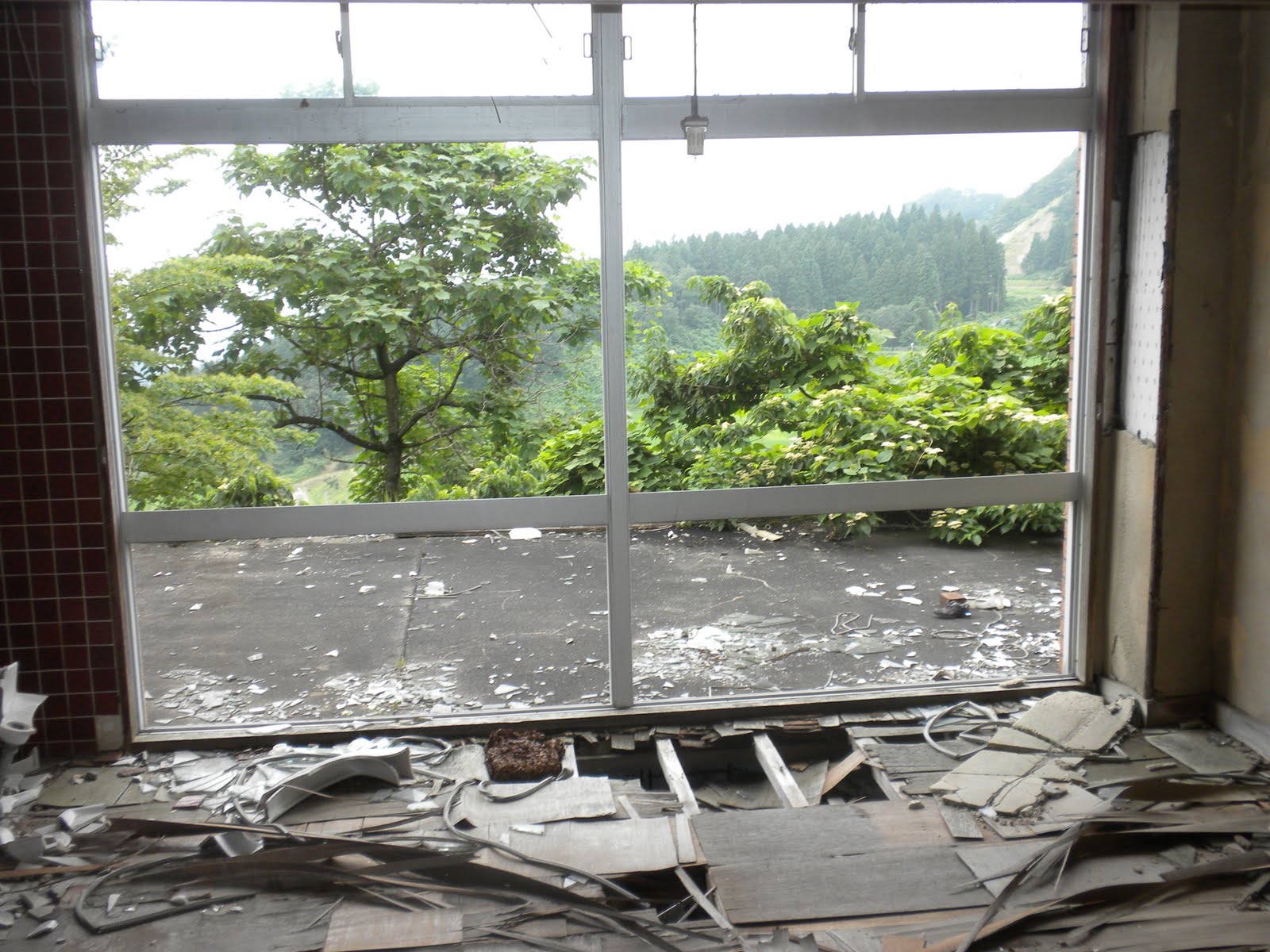
I first saw this unfitting gigantic building from the bottom of town and I was pretty excited to make the rest of my trip downhill. However, I was just mesmerized by the oddity of this building. I thought maybe it was some kind of community center, maybe a hospital? Maybe it would even be an onsen. Many of the nicest onsen are actually in hotels that look pretty bare or even shoddy from the outside. I decided to give it one look before I go down because I was pretty sure I'd never be here again.


As I got closer, I noticed graffiti on the walls and a lot of broken windows. Also, a wall of shrubs grow around the perimeter save a long sheet metal barrier. I rode my bike beyond it to higher ground, like a wolf circling some strange corpse to extend the time of distant investigation.

This place was really tagged up. I couldn't see a single intact window, and any space along the inside looked like it was covered in graffiti. I looked down on the sleepy farming village, and then back to this giant decrepit builidng ... it didn't make sense. From my perch I looked for an entrance and then descended upon the mystery.


I went back to that sheet metal wall, and parked my bike conspicuously across the street. I found a space that was slightly ajar, just wide enough for some punk high schooler with a bag of contraband to get through, which fit me just fine. I walked through for twenty meters through overgrown grass and came to the entrance of the building. A part of me synched right back into a mode of exploration I honed growing up in my forested island hometown. Investigating abandoned buildings alone or with friends always began by rustling through head high brush and grass. The outside had been completely razed by bats (of the swinging smashing sort) and spray paint. There was no real door inside on the bottom level. I could have taken the rusting metal staircase that went along the outside, but I went for the midget-sized cutting in the side of the building which seemed to function as the main entrance for whoever it was that had been here last.


Ever since my plan to find onsen was foiled earlier, all I heard in my mind was "I don't know anything. It's OK if you don't know anything, it's if you do know that you get in trouble." This conversation echoed from the last car conversation to "strange" aikido earlier in the week. Sensei got on the topic of how to get good at aikido, and the concept of time came up ... practicing aikido 3 times a week for 5 years is better than practicing aikido 5 days a week for a year. "But what about practicing 5 days a week for 5 years, Sensei?" I wanted to ask, but for some reason I held back. Anyway, both of those scenarios are better than practicing once or maybe twice a week ... that is way too slow for my liking, however, it is my near future hear. At least for the next year, my aikido training will most definitely be cut down to one, maybe two if I'm lucky, training sessions a week. I told Sensei, "I'm very worried." There was dead silence for about 5 seconds, and then I said something else. I wish I hadn't have said it. I was begging for some kind of fatherly reassurance. "Don't worry, Zac, you'll be good no matter what." Or "Well, maybe I can fit in another practice or two for you sometime." But there was nothing but the dead silent reality of a question with no answer: "How am I going to get better at aikido?" I really wish I hadn't said it, and I understand at least on some surface functional level, that it's way better for me to smile and say no problem than to worry about this ... for so many different reasons.


Where was that onsen? I don't know. What is this building? I have no idea? Nothing ... in reality there's nothing but nothing, and limited questions that lead to real expansive nothing.


It was incredibly dark. Not pitch-black, but incredibly dark. The pictures only reveal as much as they do because I used the flash. I was thoroughly creeped out. It was dead quiet and my eyes were wide open trying to pick up any sign that may indicate I need to get out of there as quickly as possible. The area I had walked into was a wide high-ceilinged ballroom of sorts with stairs on either side spiraling up to other open areas. Graffiti revealed itself quietly through the shadows. My vision was maybe at 20%.


This seemed to be the main piece in the gallery, possibly naming the group that was responsible for the recent life in this place: "MASK THE REVOLT!!! SEXGANG CRU!!!" They really should have had a native speaker look at this to check their English. Maybe I should have left my card in case they need my future services. I saw this slogan along with a drawn face (unfortunately covered by the post on the right) in many different places in the building. Wandering around I was still incredibly weary of whether someone else was in the building at that time. Who knows how recently anybody was in there? Were they punk high school kids? Junkies? Biker gang rapists? A couple weeks earlier I was talking with another English teacher and he mentioned a story about a biker gang about ten or twenty years ago who abducted two high school girls, and took them against their will to an abandoned school in the mountains. They were never seen again. This wasn't a school though. The main area I was in looked like a dining area. I have no idea.


I investigated further and found a few nondescript rooms, totally ravaged and tagged, and found the main staircase. It led to a hallway that could be seen from the outside. (See pictures above of view from outside.) On each floor there were four rooms, which looked like domiciles. Actually really nice ones at that. Each had an entryway, a large main room, a small bathroom, and porch space. It looked like a hotel room to me. The balconies looked out towards the ocean which yielded great views of Uozu City and the ocean. I went through and checked each room, each equally abused and individually marked by artistic creations.


Each hallway as well had been marked. A lot of English phrases you'd expect to find from foreign taggers, but nothing too explicit. When you see amatuer graffiti in the States, I'd say most of it are strings of the most obscene English words available accompanied by pornographic illustrations. There were certainly some explitives written, and strange faces drawn, but nothing like you'd see in bathroom stalls at home. There was a lot of Japanese as well, it looked like a lot were names and locations. Here we can see the musical choice of some of the members: "Metallica" (perhaps a sign of aggression and good choice in music), "Mr. Children" (Really? I don't think anyone who listens to Mr. Children would be responsible for anything more than harmless misdemeanors), and others above read, "Radwimps" (They're OK but still pretty mainstream) and something else I didn't recognize.


There were four stories of these kinds of rooms and I went through each one. As I advanced to the next floors, I had a very ominous feeling like I was ever getting closer to some horrible revelation or impending doom. Perhaps unknowingly I was slowly walking into a trap that would change me forever.


Man this place had some really good views.

One other interesting note about this place is that there were no empty alocohol containers or any trash for that matter that wasn't originally in this place. Isn't that a crucial part of tresspassing and trashing public property? Pissing and throwing your trash around in defiance? Not here. Maybe these were well seasoned hikers well accustomed to "pack-in, pack-out" philosophies.

Ah-ha! Some hard evidence! 2002. Almost ten years ago. I would imagine if someone had been there since for such destruction, it would be written on the walls. But I checked every square inch of wall in the building and this was the only date. That's a pretty long time for the residents of the town to tolerate such a monstrous monolith of youthful rebellion in their sleepy farming village. Such a demolition. project would be incredibly expensive and time consuming.


I have to mention again, this is extremely rare. Perhaps in the city you'll see some abandon buildings taken over by such activity, but this is the first time I've seen it in Toyama. What makes this especially weird to me is that it's deep in the mountains at the very end of the road and civilization. When you live in town and go about your daily life you really don't see the kind of people whom you would associate with this activity. But even in small country towns in Toyama certainly have their own underbelly. If you're out late at night around the highways you'll see and hear biker gangs from time to time. Not quite the Harley image, but a younger Japanese version. If you go to the right bars, you'll find the people who could really care less about fitting into Japanese society, but the difference about Japan is that if it's clear this is the case, then you're obviously an outsider. On rare occurences I have been sitting in an onsen and just before closing time seen bald men with goatees and scars wearing yakuza-esque tattoos on their chest and arms. The other Japanese ignore them with contempt. The counter culture is incredibly hidden in Japan, but most certainly existent.

I made it to the roof and expected some kind of epic conclusion to my shady adventure, but instead found nothing, expect myself standing on the roof in plain view of the town. I crouched down and left the premises soon after. I got back on my bike, which obviously belonged to someone who had went for a tresspassing peek, and descended from the town. As I passed through I rode by an older woman who was certainly surprised to me and let out a "Harro!" and laughed. I said "Hello" back and laughed myself.


In the end I would guess it was a failed hotel project of sorts. One of the many signs, all over Japan, that there was a time a decade or two or three earlier where lots of people had big ideas and wallets. Maybe it was built for workers out there in the mountains. Along the many rivers in the area, there are huge dams everywhere and lots of people come from major cities to do seasonal work in the country on various projects from time to time. But I don't know. Certainly it wasn't to boost tourism. Maybe it was intended as a weekend resort area for people living in Uozu? Maybe there was onsen there one day!


I didn't find my onsen, but I found something far more ... something. You never know what you're going to see when you start taking nameless roads inland. This was definitely the last town into the mountains here, but tiny roads followed rice fields further up, and alternative routes leading out of the town were on either side. This was enough for me on that day, but by no means had I exhausted exploration in the area. I would be back. Especially because I think I saw a sign for castle ruins and an extremely enticing road leading into darkened woods away from civilization.


I'll be back.

Sunday, March 20, 2011

Gaijin's Nuclear Report (Morning of Sunday March 20th)

I turn on the news now and can find nothing about the current situation in Fukushima. Things have settled down. Personally, I'm not letting my guard down, but will probably not be investigating any news more than once a day unless I'm notified of anything in particular. If this is my own notifaction of a personal lack of worry, I think I could have done it the afternoon of Friday the 18th. It was a long week at school were I probably spent 70% of my time actively researching the incident, and usually with a heightened level of concern. After school on Friday, I got together with some of the other ALTs (gaijin Assistant Language Teachers) to play Magic (any of you lucky enough to know the wonders of this game???) and we all commiserrated with each other our feelings and experiences of this all. Now progress is being made to restore power and cool things down at the power plant, and Toyama here has remained unaffected.

Now when I turn on the news, I see war in Libya. I think I remember hearing a Chinese curse that goes something like: "May you live in interesting times."

Wednesday, March 16, 2011

Gaijin's Nuclear Update (Morning of Thursday, March 17)

(While writing this, helicopters have began flying over the reactors dropping water and making readings of the radiation levels.)

Though it's been 6 days now since the initial earthquake started the chain reaction of terrifying events here in Japan, immediate danger still seems far from resolved. Even after reading tens of articles and watching Japanese news for an hour so far this morning, I'm not really sure how things are going. As an American living in Toyama, Japan, it's hard at this point to make sense of the polarized opinions, feelings, and reactions.

'"We are at the beginning of the catastrophic phase," Sebastian Pflugbeil, president of the private, German-based Society for Radiation Protection, said of Japan's efforts to pull the Fukushima plant back from the brink.' says an article from "reuters.com" last night.(http://www.reuters.com/article/2011/03/16/us-japan-quake-worst-idUSTRE72F6H720110316?pageNumber=1)

"If cooling operations do not proceed well, the situation will ''reach a critical stage in a couple of days,'' an agency official said." reports Kyodo News this morning, which claims itself as "Japan's Leading News Network", and seems to present one of the most unbiased articles I've read. (http://english.kyodonews.jp/news/2011/03/78704.html)

Yesterday in the school office I simultaneously swept the web for all hours of daylight while watching the Japanese news on TV and periodically asking Japanese around me what was going on. Yesterday things were steadily worsening, and if I could draw any consensus from the information I got yesterday, it's that something needs to happen as soon as possible! I read no reports that said "Everything will be fine if nothing happens over the next few days."

I've received nothing more than the initial message from the authorities of the JET Programme (my job) stating the facts of the initial tsunami and earthquake and requests to donate money. What are other JETs doing right now? What the hell are the JETs doing in the affected prefectures??? Yesterday I read an account of an Australian English teacher, who along with a few other fellow English teachers who lived in Fukushima, immediately fled to their home countries fearing exposure to radiation and upset at the lack of information and concern by the authorities in their area. (Link to the article: http://au.news.yahoo.com/latest/a/-/latest/9022648/australian-teacher-flees-radiation/) Have any JETs been killed in this series of tragic events? Been exposed to fatal or cancerous levels of radiation?

Well, as soon as I got to school this morning, I turned on the TV and started sweeping the news for information ... nothing seems to have changed.

Until yesterday, the news had a constant broadcast primarily focusing on the immediate nuclear dangers showing current images of the damaged nuclear reactors, substantial speeches from authorities, and animated models to inform people of what is happening in the reactors. Also, video was periodically shown of the areas destroyed by the tsunami and the current status of survivors as well as statistics and predications of those who perished. Despite criticism of the Japanese authorities, I was impressed at the level of coverage by the mainstream Japanese media.

This morning the reports are diluted with uninformative round-table discussions between young TV hosts. Online, I've found articles that are already talking about nicknames for those workers who have remained at the plant to work on the crisis and are deemed heroes. These men are absolute heroes in my opinion as well, but the situation is worsening and you're already giving credit for resolutions??? The headline of Yahoo News was, "Dog in Japan won't abandon ailing friend" This is the best you've got??? This is the most current news on the current nuclear disaster???

AS I WRITE THIS NOW IN THE SCHOOL OFFICE, HELICOPTERS ARE FLYING OVER THE REACTORS... but there is no one around for me to ask what's going on! Wait ... one of the teachers just came up and helped me put the audio into English, bless his soul. (I'm doing my best to keep my biased and judgemental generalizations to myself, but it's obvious I tend to exaggerate impressions a bit sometimes. Also, at this time I don't have any classes today and so have the liesurely time to make my full-time job researching this matter while other teachers still have classes to teach. Now, a few teachers are amassing around the TV because it is a break between classes.)

Helicopters are apparently flying over the reactors, dumping water and measuring the levels of radiation. !!! Yesterday it was said that this was too dangerous because of the estimated levels of radiation. What changed between then and now? I don't know yet. Are those people consciously and willingly going into what really is probable fatal levels of radiation to take these measures of emergency? Have they confirmed that it is safe to do so? Don't know yet.

Anyway, by the current visible attitudes of people in Toyama, life has returned to normal. (Again, I'm trying not to exaggerate things, and trying to be as unbiased as possible, but am just trying to communicate what I perceive here, which is probably only a portion of the actual feelings. Though I've spent a good amount of time here and studying Japanese culture, I still often have absoultley no idea how some people here feel by their outward appearance). Yesterday, the news was on all day, and people periodically were checking up on things, but I sensed no feelings of worry. However I was able to talk with Terao Sensei about the epic possibilities of the Apocalypse stemming from this event to satiate my extreme American imagination. Ever since the event, I have been walking around expecting earthquakes at any moment, visualizing what I would do in such a case, and looking around at the air wondering if I am receiving unusually high levels of radiation. But all else in town seems to have resumed a state of normalcy. Yesterday, junior high school students came to my high school to read the results of their test scores determining if they were going to enter this school next year, so there were crowds of crying (both with excitement and despair) junior high school students, and high school students and teachers alike were observing the soon to be freshmen. Generally, it seems people high school age and younger don't know or care about what is going on, the elderly sit on street corners and in front of TVs rambling with each other, and everyone in between is running around frantically working harder than they should ... all just like normal.

Yesterday I was trying to balance myself between the normal world of Toyama, the seeming apocalypse that was proposed by a large amount of sources on the media, and what I could actually see on the media. My own personal thoughts of the whole of Japan downspiraling into a state of mass anxiety as the plants explode exposing the world to radiation drove me to spend a lot of time pondering my escape and role in the Great Apocalyse. I also drank about four times as much coffee as normal.

As school ended and night drew near, I went home to eat and prepare for aikido. Motivated by the need to "do something", I went to the dojo an hour early to practice jo; which was my solution to the end of the world. When picked up by sensei, I got in the car and we initiated conversation as usual, as just about anyone does in Japan during winter: "Samui desu ne." ("It's cold isn't it").

A few moments passed and I said:

"Soooo, the uh ... nuclear situation is pretty tough huh?"

"Yeah it is huh."

"Are you worried?"

"Hah?"

"Are you worried about the nuclear disaster???"

"Oh yeah, it's going to be really bad for the economy."

I spent most of my day pondering the Apocalypse wondering if I was going to perish from exposure to radiation, and he seems absolutley unconcerned. I didn't really know how to pursue asking him about dangers of radiation, but I asked him about how this may affect him.

(NUCLEAR UPDATE: one of the teachers that pisses me off most just came by and turned off the news. He must be beri beri bizi.)

Sensei explained some things about the economy and how it affects his job as a Buddhist priest, but I didn't really understand and it wasn't satisfying me, so I asked him how Buddhist philosophy would address this situation. He said it was certainly a tragic event with the amount of death and loss, but it wasn't necessarily a bad thing. I didn't really understand his explanation after that, but I think maybe he was saying that it was good because it revealed to people the precious and sensitive nature of life and brought people together. He then began to explain a very interesting analogy about knives and nuclear power. He said there is no problem with nuclear power; the problem is with how it is used. Take a knife for instance, if you want to peel an apple, a knife is a wonderful tool. But that knife can also be used to kill people. The problem is not the knife, but how it was used by someone. It's the same with nuclear power. The problem is how we are using nuclear power. He was very characteristically matter-of-fact about the whole situation.

At the dojo, some chatter about the events started, but it was mostly about the fact that the usual variety shows had resumed on nightly TV, and someone had a story about someone they knew being stuck in the transportation delays in Tokyo. Somewhere in the training, very early on, I had forgotten all about the current events, and had a great aikido practice. I came home and turned on the news, but found no new updates, so I made dinner and watched the last episode of "Pillars of the Earth" on my laptop.

Now, I've been at school for about two hours, have drank way too much coffee, and am subconsciously convinced by my immediate surroundings that everything is OK, elated that helicopters are dropping water and taking measurements of radiation above the nuclear reactors, and just slightly more than annoyed by Japanese society (which is the most reassuring factor that things are normal). Now I'm going to get some more coffee and turn the news back on for a bit. What am I going to do after that? What am I going to think about if it's not nuclear apocalypse? It surely makes everything else seem a bit unimportant. Things seem to be improving though.