Sunday, October 14, 2012

How Do You Commit To Your Art?

Well, a lot of kyudo people do this by paying lots of cash for gear. Like me!


So much to say.


So little time.


I got an off-shade of red because they looked the coolest and they reminded me of the red hair that demons have in Japanese stories. Also it's probably the least likely color I would usually pick ... a kind of way of consciously courting the unknown. It can only end up well.

Tuesday, October 9, 2012

There's Fungus on my Tree

 
I'm on the quest for the Holy Grail, but no one really cares about that goal. As if one day I'll finally have it, but no one will care.

But as a matter of fact, there's a lot of different holy grails I'm after, more than there's time for. The one I really love. The one I really want. The one that others want. The one that I already have ... etc.

I want to go home, but when I do it's over, and so am I. This is "life", and it's so fragile; that which I can see at least. But in the end it doesn't really matter, right? All those dreams of perfection: clouds around the mountain.

My way of living is a struggle over mountains, broken by periods of waiting in the valley. Is it the only way? If life really is about "the Path", then the definitions really don't matter. Why is it that I care so much? Why am I constantly reminded by blissful experiences that my efforts are so small?

Questions. Memories. You can't remember the experience of perfection. I think about aikido, and sometimes its good or bad. When I practice again I experience and remember that feeling of happiness ... and it's not the same thing as what I remembered in isolation. If life is just to be lived, why all of these thoughts? Emotions.

There was once a time that I believe I was sufficiently content. But I know more now than I did back then. It seems simple now looking back. I want to go back, but I can't, because I'm here and need to move forward. But there is some kind of return that I feel is necessary. I want everything from back then, but I want it with all the stuff I have now. It's too much. Now I'm faced with a puzzle: I need to make less with the too-much I have now. It's like a magic disappearing act.

The beauty of Japan is limited and asymmetric. There are minimal ingredients, and they aren't "perfect". It's in this limited and assymetric world that we paint a picture; one in which we live. By making the most of those ingredients available to us, and leaving space for the perfect to form in an abstract image, or emotion, we find some kind of sufficient contentment. If there is a perfect symmetric world that really exists, I don't see it. I read about it, and think about it, but I don't see it.

In this forest, I will pick the pieces for my picture. A few modest entities that won't be so much too fill one's whole view. Just enough objects to tempt further dreams, but give sufficient work to tire my efforts. So at the end of the day I can look at my forest garden content, but excited for tomorrow's work.

A green background. Carefully placed blots of grey. A slice of flowing blue. And one red flame.

A beer, and a moment of hazy elated calm before falling off to sleep. Tomorrow will come after a full-night's rest. I can do this.

Thursday, October 4, 2012

Relaxation, Tension, Chaos, Me

 
Aikido, relaxation upon the form of the spine and situation

Kyudo, tension built to explode

the World, myriad chaos manifestations

Me, a malleable entity instantaneously constructing form around all else

 
Islands we see. There's still the ocean connecting it all ... and the sky ... and the clouds ... and everything else. Budo is everything pointed in a direction. To the relative, yet ultimate position of myself, aikido isolated is not Budo. Niether is, kyudo, the world, or myself. Everything exists. Not-everything also exists. The sum of it all is unrecognizable. Focusing the mind alone on this painting with the goal of understanding is misinterpretation, or frustration and torment. Our focus finds a point, the rest falls into the periphery. Engage the object. Fall into its failure: Real failure.

Leaves fall frail while the trunks of their former bearers come to freeze. Frailty dies. Hardening survives. Can we forgive ourselves for the dead? Walk upon the bridge of the fallen.


The result is a falling parade of red, orange, and yellow.

Tuesday, September 25, 2012

Climbing Hakusan and Temporarily Getting Over Myself

 
Goal: Climb Haku-san (a famous mountain in Ishikawa Prefecture) in the best way possible.

Plan: Take trains and buses to the base of the mountain at a very inconvenient time of 9:00am in which I will wait all day, camp, and leave before sunrise the next day in order to experience the best weather conditions possible. Climb Haku-san that day, camp again, and wake up again before sunrise to descend with the best weather possible. On the last day, hike down, followed by the long transit home by more trains and buses. 3 days maximum Haku-san experience.

Problems: A waste of a the first day just sitting on my thumb reading about zen and scribbling nonsense. The last day being unneccessarily long.


Solution: Just go.


I had this situation of ... me, Hakusan, the weather, the time, and everything else in the world as pieces of a puzzle I had been working on putting together in the perfect way. How could I get it seamless? My answer to the equation, according to precise calculations, was "the best way" to climb Hakusan. But that's no the most important part; climbing Hakusan, that is. I can pretend, train to believe, and declare, arriving at Hakusan at the most perfect time determined by my mind is most important, but it's not.

I know this because of many reasons. The weather was beautiful when the bus approached the base of the mountain. I was abundantly flowing with young male mountain climbing-ness. Because everyone else was doing it. Because if I left that day, I would have a whole night and day to explore the small town of Echizen-Ouno and Fukui City. Because maybe the experience of climbing the mountain at that moment would produce and experience greater than that I had imagined. Perhaps leaving that day would be an experience more horrible than I could ever imagine, but that would be OK too. I decided to leave that morning because it sounded like fun, and I thought the me that had planned all of this looked incredibly small and stubborn; silly and undesirable. Perhaps if I made the decision to leave, I could somehow begin cultivating a me that I liked better than the one that planned vainly for perfection in dark shadows. But that's going too far. That's a thought, but not the one that tipped the scale. Perhaps that thought was in debt to the squabbling self it was pointing the finger at.
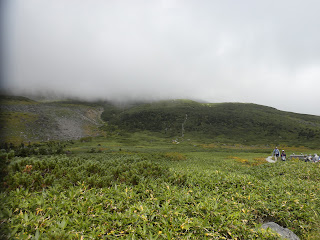

 
Anyway, I left. It was epic. Beautiful weather. I was climbing the mountain with the masses of other Japanese climbers I somehow didn't expect to see. I passed everyone on the way up with a pack much heavier than everyone elses. I'm beyond being proud of this. However I was deeply insulted by a couple who succeeded in passing me. I took pains to notice that they had tiny packs, signifying that they were just making the trip up and down. For some reason it was OK that they passed me then. It seems after my enlightening decision to accept the current situation and climb was not one to save me from still making egotistic judgements of my seemingly innocent surrounding parties.

 
It was beautiful weather until the top. Just as I had suspected, between 1 and 2 o`clock when I would reach the top, it became covered by thick white clouds, blocking vision of anything more than the rocky summit I stood upon. But I expected this to happen when I decided to depart that morning. I have climbed so many mountains to find myself blind at the top like this. It's all good. I climbed down to my campsite, set up shop, read about zen and scribbled small thoughts on paper, watched the sunset, ate my tuna fish and strawberry jam english muffin sandwiches for dinner and went to sleep before 7pm.

 
Darkness brought the usual frenzied dreams I have in tents before long hikes. I woke up prematurely around 12am, and stayed awake for an uncomfortable duration, but was surprsied to hear my alarm at 3:30 in the morning and desired more sleep. Regardless, I awoke. I was not alone in waking, but I didn't see any one else leaving within the long hour I took to get ready. "What is everyone doing?" They came all this way, and even woke up at the right time, but are squandering their time here at the camp when the world's most beautiful moment is about to be revealed an hour hike ahead at the next peak.

As I climbed, black slowly faded to blue, and the stars diminished. Still climbing, the impending sunrise boiled a fuel stronger than any coffee inside of me. Tired legs were invisible as I scrambled the rocks to the peak in front of me: that platform where I would see all that I desired.


I was not disappointed. Just before the sun rose, it's light fell upon the other sides of the mountains in the distance. I saw the sillhouetes of my best friends: Tsurugidake, Tateyama, Yakushidake. Yarigatake, Hotakadake. All friends I stumbled upon to reach their peaks in order to see others. Now I was on top of Hakusan: a mountain I had so many times seen as an island above the clouds from elsewhere. But now I was there! And I saw new mountains. Norikura and Ontake sat before me like new worlds I must find myself atop. The feeling is inexpressable. My words are faulty and immature. The pictures warped by my camera. Budo is my practice, but mountain climbing is the adventure. I am alone. I am not lonely. I do not want others here. It's not that I don't want them there, I just don't want to listen to people talk. I just don't want to wait for other people to get ready when I'm already packed. I don't want to worry about someone wanting to leave before I do. I have many interests, but when climbing mountains this feels the most ... something. I think the only other person that understands this part of me is my brother, and yet I've never talked about this with him. On top of these mountains I find roots much deeper than budo, much deeper than education. There's only love, and then there's thought, and then there's usually something else. And it's gone.


I climbed along the ridges of other mountains in the Hakusan area and made my descent ... with beautiful weather and stunning scenery. Many texts say my mind should be empty so I can experience the world as it is. Well, the problem with that is that my mind is also a part of the world, and actually a pretty big part since it's situated right in the middle of my head. So I have these dialogues with myself about the world and then look up at the scenery, surprised as if it weren't there a minute ago and say, "Whoa." Then I'm back in my mind. Some people like to think about spirit animals and other such non-sense; I am one of those people. Perhaps people usually think of impressive animals: "I'm a tiger." "I'm a wolf." "I'm a dragon." Or I think that's what most young adult males think. Anyway, I get the image of myself as a wolverine sometimes. Does that sound cool? Will that animal forever be limited by the comic book character named after him? The image isn't really all that impressive. It feels like I'm a lonely creature scrambling awkwardly across rocky cold peaks, scavenging and burrowing, alone and busy away from all else.


The rest of the hike down was painfully enjoyable: beautiful scenery accompanied by pains in the legs from relentless descent. That's all normal, but one part of the guidebook I read I didn't pay much attention to (perhaps the author purposely left out extra detail on the matter) was a two hour walk along a road to the final destination of an onsen from where I would take a bus. Plenty of cars passed, but the surly mountain mammal just grumbled ahead. Next time, I'm hitching.

 
I got to the onsen to find I was thirty minutes too late to get in the bath. It wasn't really that fact, but the manner in which I learned this from a grumpy old man who was apparently responsible for things at the time I arrived. I set up shop outside to make my last tuna fish and strawberry jam english muffin sandwiches only to see him shake his hand in front of me and say "dame" ("bad")

"dame?"

"dame."

He pointed to the bench located across the gravel parking lot in front of the benches where I should continue such activities for the next few hours until my bus came. It took my about 30 minutes to move my things, make the sandwich, eat it, and curse him. Then I decided to fall asleep. I woke up a half an hour later and decided to buy a beer from the vending machine from the old man's establishment. I crossed that gravel parking lot to make my transaction with the vending machine. Success. I put the coins in, got the beer, and returned. Soon after, I heard an extremely week "Oy!" cry from the empty porch of the hotel. It was the old man. I looked at him for a moment, and he continued "Oy"ing in my direction so I put down the beer and started walking towards him. For some reason, the walk became a jog and I arrived just before him. "Onsen OK".

"OK?"

"OK."

By Jove the heavens have shifted and this old man has decided to let me take a bath! Hallelueha!

Took the bath.

Rode a bus to the small castle town of Echizen Ouno. Then caught a train to Fukui City.

I drank a bunch of sake and ate fish with two very strange sake-drunk dudes.

Woke up the next day more hungover than I wanted, sightsaw Fukui City, went back to Toyama City.

Then it was back to work ... where I still am ... at.

 
Here is a story from the "Shobogenzo" I would like to share with you here which I found in my most recently read book about zen, "To Meet the Real Dragon" by Gudo Nishijima.

"One day a young monk told Master Dogen that he had a sincere desire to enter a temple and devote himself fully to the study of Buddhism, but that he hesitated to do so because of his family obligations. His mother was very old and completely dependent on him for support. If he entered a temple, he could no longer send her money and she would soon die. What should he do in such a situation?

"Master Dogen's answer was very candid and realistic. He said, 'That is a very difficult question. Even I cannot answer that question for you. It is your problem and only you can find the right answer. However, I feel that there might be a way for you to become a priest and still provide for your mother's health and security. It might be difficult, but if we have a sincere will to do something, a way can usually be found. So I hope you can find such a way. I hope you will be able to support your aged mother and, at the same time, devote yourself to Buddhism by becoming a priest.'"

Wednesday, September 12, 2012

Finishing the Shobogenzo, Aikido Seminars, Frustration

 
"For a bodhisattva bound by one life, there is no intermediate stage."

This is the last line of the Shobogenzo ... or at least for the appendix of the version I just read.

Like a rock sinking through the sea, when I read this line the whole book just went "thud" against the ocean floor.

There is no intermediate stage.

Only beginning, and being.

We don't know. We learn. Then we know.

Or at least that's my immediate feeling.

In that phrase life is fresh; not like this purgatory that I find myself currently in. I am in a phase of "studying". This I am equating with Dogen's "intermediate stage." So often studying causes our minds to separate the ideas of "us" from those of the "real world." "When I'm done studying, I'll really get started. " As if this time studying prevents us from feeling the world as it really is. As if the world's phenomenon will refrain from engaging us until after graduation. As if what we do now in this time of study will not alter our future or dissappoint our past.

I ride trains everyday. I study Japanese on the trains. When I do so, there is this bubble around me. My world of study - separation - everything else. Because I live in Japan, this bubble world isn't interfered with often. I study Japanese so that one day I can be a me that is fluent in this language; this incredibly smart me that can do more than I can currently imagine.

What am I doing?

My whole life is a study. I study aikido and kyudo for the same reasons. That one day I will be an incredibly smart and capable me. That me is invincible, in the purest sense. But it is somehow not me now, and in fact, the opposite of me concerning the relationship of having and not-having. Now I am nothing. I am so much nothing that I am outside of this world, studying.

The things separate from my study are a waste of time. I don't believe they directly contribute to my Becoming. My job teaching English. My friends. My girlfriend. Sleeping. Eating. Social agreements. Holidays. They don't give me black belts or language proficiecy certificates, so they are a waste of time. As if my future ideal will have nothing to do with these current "irrelevant" activities.

What am I thinking?

But it's true.

There is a flash of my fantasy world followed by an image, and that current image is everyone sitting around thinking about me. "Where is he?" "What is he doing?" "He's fluent in Japanese and a martial arts master." In the periphery of this scene is me with the perfect house and an awesome car. It's so cliche. "He's also a famous writer."

So much of the time I just want to get out of here so that people won't limit me to my curent circumstance. You know what I'm talking about, all those people or the idea of all those people who say that you'll never leave, you'll never change, and everyone knows exactly who you are. Once every few years on facebook they'll just check your profile and get where you're at.

This is disgusting.

And this is my mind.

When I drink I often exaggerate it. The other day my friends and I all had a barbecue. Afterwards I was driving to an onsen with my girlfriend. She's been watching "Grey's Anatomy" lately and had it on in the car while we drove. I said, "I want to be a doctor." She laughted and said some contrary comment like I couldn't be a doctor. I have never done anything in my life to put me on track to be a doctor, and probably display a lot of characteristics that just don't fit the image of a doctor. This is also in Japan where people choose their careers very early and undergo a lot of strict passages to reach their them. As an American it seems not impossible for someone like me to decide to be a doctor; here it's laughable. But anyway, that's beside the point. This isn't about Japan. This isn't about my girlfriend. Niether are at fault. The issue is that I took this comment straight in the head and thought for the first 30 minutes of onsen how I was going to be a doctor and prove everybody wrong. I was going to be invincible. Finally somewhere after I stumbled lightheaded out of the sauna and was sitting there dripping pounds of sweat next to a bunch of other naked Japanese dudes, I realized I didn't need to be a doctor, and probably wouldn't have a lot of fun in that process anyway.

These are the episodes of an intermediate.

There are stages in life, and yet there aren't.

Form and chaos. I believe this is the world; some incomprehensible painting.  People, religions, systems try to come up with answers bigger than the picture, but they are all limited. Prejaculatory moments of seeming invincibility.

I don't think the Shobogenzo seeks to answer the paradox of existence. Or at least this is what I think after finishing it. Just about every night since I recevied the four volumes as a present last Christmas, I have gone through reading exclusively this book. I can't believe I just read the last line.

"For a bodhisattva bound by one life, there is no intermediate stage."

I designate myself as a student in an intermediate stage. I don't like this. This is life.

Anyway ...

I've got some other things to get off my chest here; a couple of topics I wanted to write about in their own posts here, but they're just falling into history while new monsters keep coming in.

The Doshu came to Toyama for a training seminar. It was awesome.

Masuda Sensei from the Kobayashi dojo came for a weekend seminar. Lots of training and drinking while I was recovering from one of the worst colds I've had in a while. It was awesome.

Going to aikido about 3 times a month totally sucks. But it's all I can do to survive.

Kyudo books are really boring.

That is all.

Sunday, September 9, 2012

Kyudo Problems and the Philosopher Dragon

(yugamae - starting position)
 
So, I've generally solved the problem with the string hitting my arm. First of all, I bought a sweat band to put over my forearm. HAHA! That's not cheating. Secondly, I've made a lot of progress with Sensei discerning the problems with my shooting and putting correct form to practice. The overall problem is that I have to consiously think of each of these things when I shoot. So, as is, kyudo to me is like this fiery red raining apocalypse where I have to mind all of these different demons with all of my strength and concentration in order to do what I gotta do. It is not the tranquil zen practice that maybe you are imagining. Well, this morning I went from not even realizing all the immediate problems to generally handling them all at the same time when I shoot. That's a big jump and I can't wait until the next training session to progress further.

                                                       (uchiokoshi - raising of the bow)

(tenouchi - hand position)
 
Concerning the specifics, the main problem is my tenouchi, holding the bow with my left hand. When holding the bow, there are some things that should absolutley not change from begninning to end, like a 90 degree angle with the bow and the bottom edge of my hand (tegatana in aikido language), firm and steady contact between the bow and your hand in a perpendicular fashion (in accord with that 90 degree angle just mentioned), there should be a space between the bow and your second knuckles on your fingers, and your thumb should be basically straight because you're essentially pushing forward with your first knuckle that connects the thumb to the hand. A week ago, I wasn't doing any of this. Sensei says this is the most important part of shooting, yet the most difficult to teach because you can't see any of it; it's all happening inside of your hand grip. This is why these problems need to be dissected as such because we can't see directly what's happening.

 
(daisan posture)
 
The next specific problem relates to my daisan posture, that position you keep for a moment between the uchiokoshi (raising of the bow) and kai (drawing of the bow). While some things are supposed to be consistant from beginning to end, it is in this motion from uchiokoshi to daisan that the bow is supposed to slide in the middle of your hand. How are you supposed to protect all these things while the bow moves in your hand? That seems to me one of the great skills of sensitivity in kyudo that takes years of internalization in order to perform well. Anyway, so the bow spins in your hand. From daisan until the release, the grip on the bow should not change, and from daisan you should lower the bow as is. When in the daisan position, the angle between the bow and yourself stemming from your arm should be at about 30 degrees. Before, I was pulling it too far, to about 5 or 10 degrees, and this was also greatly affecting my shooting, most noticeably in making the string whip my arm.

 
(kai - drawing of the bow)

What I've been experiencing with these problems is a kind of stacking of sorts. Problems that start at the beginning, build throughout the process of movements, triggering other problems, that make for a very poor form at the end of it all when you finally come to shoot. I have a lot of these problems, which is why it feels like a fiery red apocalypse raining down on me while I'm standing there just before releasing the arrow.

 
(zanshin - position of mind and body after the release)
 
One other main problem I have has to do with my aiming. Whenever I pull back, I'm always a little too high or low or left or right, and to be honest, I don't feel like I have much bearing at all as far as what I should be doing. But this is secondary to those problems previously mentioned concerning tenouchi and daisan.

With my mind on all of these things, I have totally forgot the other most important part of shooting in kyudo: hanare, the release. Sadly, that will have to wait until the intial problems at hand are tended to. But I'm sure hanare will be the focus of many future posts on kyudo.

I reflect on my kyudo, but perhaps it shouldn't be thought of so much. I can't help but criticize my progress. How is my progress anyway? Is it fast? Slow? Sometimes it can really be hard to tell. When you practice an art alone like kyudo, it can be particularly hard to gauge your progress because there's really no one to compare to. Do I hit the target often? Do I shoot without error? No. But not even masters do these things. I look at my sempai (seniors) and sometimes they hit the target and sometimes they don't. Sometimes Sensei praises them, sometimes he fills them with critique. The purpose of kyudo isn't hitting the target, and you really can't see a lot of the important things that affect shooting, so how can I gauge progress? Like I said, perhaps this reflection isn't so important as is. All that matters is, doing my best to see what's happening, doing my best to observe the kyudo around me, and doing my best to shoot as best I can. Concern without worry. It's like a taught line, not pulled too tight, but not slack.

I am the kyudo string!

 
Oh yeah, I am also host to a particular philosopher dragon. He seeks the freedom of cosmic contemplation; a mountaintop where he can sit and stare at stars. If something prevents him from such an activity, the dragon possesses me, and together we break the obstacles through time and mighty effort. Satiated the dragon is beautiful and merciful, deprived he is relentless. Every time my life changes, the dragon is pulled from the peaks and we work. The dragon is real, but he is not me.

I'm going to sleep now. I wonder what the dragon will do until I wake.

(The series of pictures above is from the website http://www.kyudo.org.uk/default.php?id=7&ad=1)

Tuesday, August 28, 2012

My Current Kyudo


At two months of traning I've learned to stand by myself and shoot at the target 99% sure I won't send an arrow flying over the roof of the dojo and into the nearby park. It's not that you couldn't learn to do it quicker, but this is my experience. This simple of act of shooting a bow and arrow in the tradition of kyudo requires a lot of skills that need internalizing. Like there's so many little things going on, you really can't just say, "OK, stand there, look there, pull the string, aim at that target, and shoot." It's not like that at all.

It's kind of like aikido in that you don't worry about getting all of the details at once. In aikido you get to a point where you can manage through techniques with others and then slowly work on the little details over a long period of time. As a millionth degree black belt, I think you're still going to be working ikkyo, one of the most basic of techniques.

The difference with kyudo is that you don't have a partner who can help you through a technique if you don't do it perfect. In kyudo, you're the only person holding the bow so its all on you. Also, in kyudo you're only doing one thing, and that's shooting at a target at a standard distance and height.

The thought of doing that same one thing over and over again until the very end is a bit ... something. As a beginner, this is realy hard to imagine. In other arts you practice something until you can do it well and then you're teacher will show you something new. But in kyudo, no matter how far you go, you're still just shooting at the target (as far as I know). Some say we're never perfect in our technique. I agree with this. As martial artists we reflect with this thought in mind. But man, kyudo focuses on this point.

Now when I practice shooting there are specific problems I need to assess in order to improve my shooting. There are so many of these problems that I think kyudo will be like this for quite a while. Maybe it will always be like this. I imagine it changes, but I can't see that from here.

A lot of reading material I find about kyudo is spiritually oriented; one could say the same about aikido. However, my experience in aikido for the past two years has been extremely practical. This has changed my perspective on the arts. It was largely due to the spiritual aspects in aikido that interest was sparked, but when starting to learn and practice the art, those spiritual aspects only seemed to get in the way of learning technique. I don't consciously think about the spritual aspects of aikido when I practice. My creed has been to watch Sensei and do exactly what he does. This I believe is the best way to "study" martial arts.

So, this is naturally the mindset I've brought into the kyudojo. It seems to be working well and my teacher appreciates it. Funny thing is that the friend I started kyudo with is completely into the mystical side of it all. As long as it helps you it's good I think, but I've noticed that it often gets in the way. For example, there is one analogy related to the pulling back of the bow. After lifting the bow in front of you, you push and lower the bow in front of you with your front hand, and pull the string and arrow back over and behind your head. The resulting arc can be related to a rainbow. However, if your hands do this in attempt to make a circular arc, your wrist that holds the string may bend excessively, which isn't good. If you're wrist is bent too much, it means you're pulling with your hand and wrist instead of your elbow and chest. Rather what you should do is just pull the string in a straight line from beginning to finish, and it will naturally arc. The final product looks like a rainbow, but trying to imitate a rainbow in practice disfigures correct form. I think the most important thing to realize is that you are not a rainbow. You are a person shooting a bow and arrow in the fashion of kyudo. It is no more related to a rainbow than an ice cream cone. So, I try not to employ these analogies and metaphors longer than their appropriate use. The only constant in my practice is that I watch Sensei and try to do exactly what he does. After building a solid base though, I do look forward to indulging in some of the spiritual aspects of the art; though it will not be without a critical mind.
                                                       ("uchiokoshi" raising of the bow)

("kai" completing the draw)
So that's generally what's been going on. Continue below for details on technique and masochism in kyudo.

The technical problem I must fix which is at the top of my "stupid-gaijin-can't-do-kyudo-right" list has to do with my front hand during the release. This I think is one of the strangest aspects of shooting, but one necessary in order to keep an arrow straight towards the target. At the time that you release the arrow with your right hand, your left hand which holds the bow must rotate to the outside. Just before shooting, your hand should look like a big "Y", and after you release it should look like a little "y".

                                                                              Y


                                                                                y

When I first started practicing, I took this very literally and just rotated my wrist. For some reason, it kind of worked at first, maybe because I had a very weak bow. But after a couple weeks, I got a stronger bow and something changed. Now when I shoot, the string slaps my front forearm causing a sharp pain followed by a fat welt. For a couple weeks it's gotten increasingly worse. One of the most important aspects of kyudo is zanshin. After shooting the arrow, one is supposed to keep their eyes on the target watching, seeing, being ... empty, and full. However, many people let out grunts or reveal faces of dissaproval at missed shots. That is not good zanshin. Their zanshin sucks because they take their failures personally. My zanshin sucks because after I shoot I inevitably feel this stinging whip in my arm. Usually my eyes bulge wide open and I let out an under-the-breath grunt. After this I prepare my second arrow in great fear for the next shock. Thinking about it now, it must look really funny and sad. Anyway, in attempt to turn my wrist appropriately, I simple rotated my hand, which is the problem. What you're supposed to do is propel the bone that connects the thumb to your hand forward, as if you're launching the arrow forward with your thumb, and you hand will naturally rotate. Sensei and I realized this just before finishing the last practice, so I am looking forward to a future in kyudo that doesn't involve injuring myself everytime.

One interesting aspect to this is the need for communication with a teacher. Though you shoot the arrow alone, to progress in kyudo alone seems impossible. I shoot the arrow and realize there are a lot of problems, but what they are and how to fix them is largely lost to me. Sensei's pointers launch me far ahead into the future. However, Sensei couldn't see this particular problem in my technique on his own. Well, he might of, but maybe it didn't seem so high on the "stupid-gaijin-can't-do-kyudo-right" list. I had to tell him a couple times that it hurt when I shot, and then showed him the welt, and I read the look on his face: "Wow. OK, let's solve this problem right now." And from then we began to dissect the problem relevant problem in my shooting.

In aikido you wear a normal dogi (general Japanese martial art uniform) until your black belt and then you wear a hakama (usually black extremely baggy legged piece of clothing that looks more like a skirt) over the pants of your dogi. It looks really cool and has been demonizing me since I'm still just a stupid white-belt. However, in kyudo you generally wear the hakama from the beginning. Until now I've just gone to practice in track pants and a long sleeve shirt, but since I've joined normal classes I thought I should probably follow suit and get the hakama and kyudogi (the top is a white short-sleeved dogi). I asked Sensei about when I should start wearing the traditional wear and he said, "When I stop coming into kyudo with huge revealing welts on my forearms."

Yosh! Next week I'm going to begin consistent practice in kyudo and fix this painful problem. Then, I can don the hakama without embarrassment and enjoy kyudo as a safe practice.