Showing posts with label Kyushu. Show all posts

Saturday, January 25, 2014

Kyudo Progress


Tonight was another classic case of having the chance to go to night kyudo, almost opting out in order to relax at home, but going and having an excellent session. It was a day off and I spent the day with the wife out exploring our new home of Nakatsu. It was raining and I thought about just relaxing and cleaning at home, but ended up going to practice anyway and it was definitely worth it. It's funny no matter how long you practice martial arts, this tendency to opt out of practice still remains strong. I guess I recognize it when it happens better, "Ah, I feel like not going, but I know if I don't I'll regret it." It takes us back to rule number one of practicing a martial art:

Just go to training.

Anyway, I went around 6 o'clock, just before most everyone shows up and the first person I see is the head 8dan (hanshi [8 degree black belt]). I perked up right away as we greeted each other. I knew right away it was worth it to come. Such a high ranking and highly skilled kyudoka is rare and to watch him practice, and have him watch you and comment is a very special opportunity. Getting changed I was aware of him the whole time, and knew he was aware of me. It's kind of like how I feel around the other head sensei in iaido. I feel like they're always critically watching, and so I'm especially sure to be on my best behavior, not without a little healthy anxiety.

When I first told my kyudo sensei in Toyama I was moving to Nakatsu, the first thing he did was grab the official book of kyudo dojos and looked up Nakatsu. When he found that Nakatsu had a hanshi sensei, his eyes widened and he said, "When you go to Nakatsu, go there immediately and start training with him." He also said I should do my best to be on good relations with him and talk to him as much as I can, and that was also the first thing I thought of. This is only the second time I've seen him at training because I can so rarely go at night when he shows up. But like I said, just having him there put me on my toes and made me excited about training.

Anyway, going back to anxiety ... I think it's really helpful in kyudo to have. When I first started, I was shocked at the amount of times that you shoot while other people watch you. At first it's like, "Please don't watch me, it makes me nervous," but I learned quickly you can't say that, and it's just a natural part of the art. We learn from watching and being watched by others. One of the most important things about kyudo is learning to get used to people watching you shoot alone. It feels like someone watching you when you're naked. You probably don't like it at first, but in kyudo it's something you have to get used to, and it will make you a lot better. This is also why it's important to participate in tournaments and tests. It's about doing your best and shooting as you are, even when everyone is watching you, especially under the pressure of competitions and exams.

I used to hate this nervousness and fight against it, trying to relax and eat away at the nervousness so shooting alone and shooting in front of others became the same, but I don't think so anymore. In fact, that nervousness I think makes you a better archer.

I'm not sure about how to explain it in a way that is honest to the feeling. Because it's mostly just a feeling. I feel nervous, and when I do, I shoot better. I miraculously do a lot of the things I've been trying to do subconsciously and for some reason snap into some ideal budo mode where I do my noble best without caring too much about hitting the target. It's when I'm left alone and without any pressure at all that it all falls away.

So the head sensei was there watching, I was nervous, shot a lot, and did fairly well. I was ever conscious of him, waiting for a chance to talk to him. Just to run up to him and bombard with questions or ask him to watch you seems a bit much. Everyone wants his help and attention. To single yourself out and just approach him like he's another archer seems to go against some unsaid rules of protocol. But then again, he is just another archer, and if I have a question I shouldn't hesitate to ask him. I shot a lot, felt pretty good, and right when I was going to go and sit next to him and initiate some conversation I got distracted by other archers who started talking to me. We talked for about 15 minutes and then I walked over to where I thought sensei was, to find him gone. I looked around for him, but apparently he had already sneaked out and gone home when I wasn't aware.

So I'll just have to wait until next time. But no one here is in a hurry, so it's all good.

I finally feel like I'm in a good place now in kyudo. My hand is completely healed and I'm doing my best not to instigate a reinjury, which shouldn't be a big problem. In fact, it helps me focus on proper technique. I've also been going consistently lately, maybe 3 times a week (I hope to make it 4 or 5 on the average) and so I've found a consistent rythm where I'm not embarrassingly bad. I've been around long enough that I recognize most people in the dojo and am not just "the new guy", and have developed friendships with others around. This is probably the most important part of practice, getting along with others. Once you establish that, everything becomes the best it can be. After that, I think at the one of the deepest levels, the greatest part about kyudo is the relationships with others that you make. Definitely.

I've said it before, and will say it many more times in the future, if it weren't for all the incredibly genuinely nice people in kyudo, I would have quit so many times a long time ago.

But anyway, specifically about technique, my two main issues are ones that have been around for a long time:

First, the string pre-releasing. It only happened once today, and I noticed it within the glove before it could slap me. In fact, it happened just before people were about to pull the arrows out of the targets and I was the last one shooting all by myself. I noticed that the arrow had slipped out but still in my grasp. I returned to the starting position, everyone looked at me strangely and I said that it slipped out, and then I told the people to take the arrows so they didn't have to wait for me. The other people around said, "No no no, wait, he's going to do this next one!" And told me to go ahead and do it again.

Goddamn. It's very unnerving to have that happen, and to have everybody watching and waiting while I try again is a special kind of hell. I realized the best thing to do was just bear up and do my best and try again, which I did, and I hit the target to my great surprise.

That was a little lesson in kyudo. We must face our fears and shoot in the face of potential failure and humiliation. Sometimes we will fail embarrassingly in front of everyone, but sometimes we will succeed.

So anyway, I said a long time ago that I realized this problem wasn't just in the kai (draw of the bow) where the string slips out, but in dai san (a transitional period where you change positions with the bow over your head), but then thought that maybe I'll realize it starts much sooner like in uchiokoshi (where you raise the bow). Recently I realize it's earlier than that at the very first moment you grip the string and arrow (torikake). Crazy, but I'm happy I've traced the problem back to here. I had a senior student show me how to do it right, and I did it with great success. But I've forgotten exactly how it goes, and am searching to find it on my own, to some success. This is another thing in kyudo. Learning how to fix something, doing it right, then completely forgetting. It's incredibly humiliating and embarrassing for your self and spirit, but we must accept these facts and humbly move forward doing our best. Failure upon success upon failure, we keep folding over this experience until one day we can just do it.

After that, there's my tenouchi (hand that holds the bow). I have certain bad tendencies I've had from the beginning but haven't fixed completely yet. I had a senior student help me out a lot tonight, telling me things I've heard maybe a hundred times before. I know this so well, but for some reason my hand won't do it. I am grateful for his help and don't regard it with frustration, but consider it helpful advice that will definitely contribute to my future success.

But then again there is no future,

and if something isn't a success now,

it's because I won't let it.

The beautiful humble path of an archer. I've never experienced a budo like this.

I can't wait to go back tomorrow morning.

Sunday, January 19, 2014

Meeting the Head Iai Sensei


So iaido is going well and slow. I meet on Friday mornings to practice with Yamamoto Sensei and one other student and practice on my own time in my apartment (trying my best not to slice up the walls and ceilings.)

But last Snday afternoon I got a call from Yamada Sensei, the head sensei of the dojo. I was surprised to get the call and picked up immediately. He asked if I had time to meet the next morning for training. I was caught off guard but accepted and told him I'd be there at any time in the morning or early afternoon. This is what I'm here in Japan for anyway, right?

So I showed up about 15 minutes early for our 10:30 training, earlier than I usually do. The dojo door was slightly ajar. I went in and said my morning greeting, but nobody was there. Maybe somebody was in the bathroom? I heard nothing for a few minutes, so I assumed I was alone. I thought about getting changed and ready, but then I decided against it. In Japan, and as a student, it seemed best to do nothing until I was specifically told to do something. But then maybe one plays into the stupid student role where the teacher comes in and gets mad at you for not getting changed, but if you got changed the teacher asks you why you took the liberty of getting changed without knowing if that's what you should do. Or maybe that thought is just silly. Regardless, I decided not to get changed.

So I walked around the inside of the dojo looking at the scrolls and weapons on the wall waiting for something to happen. After about 5 minutes nobody came and I felt a little weird just standing in the dojo alone, so I decided to wait outside next to my bike. About 3 minues later Yamada Sensei came around the corner fully dressed and said good morning. We went into the dojo. He told me to go ahead and get changed so I did. When I got out we started talking about budo. He's a nice guy and was asking me the normal questions one would ask like, "Why did you want to start iaido?" This was normal, but he seemed much more inquisitive in a way. He was very silent while I talked, which made me a little nervous. I said that I have a great interest in budo, have practiced a few other arts, and since I found the dojo's website online and I've never done iaido before I wanted to give it a try.

We talked more and he mentioned another foreigner who trained with a partner dojo in Tokyo. He's an American and has been training for a while and is currently a 6 dan in iaido.

Then he asked me about reigi in the other arts I've practiced. Reigi is roughly translated as etiquette, and I thought he meant about formal bowing in and such, so I said that in aikido when you enter the mat you bow and then before beginning you bow one more time in the seiza sitting position. I think he was more concerned about timing. Specifically, I think he was trying to get to the point that in this dojo if the sensei says 10:30, then the student comes with enough time to get dressed, sweep the dojo, and get stretched so that practice can begin at the agreed upon time. At that moment is was about 10:43, and the point was made, those thirteen minutes should be spent training, any getting ready and chit chatting should be done before. He was very polite and matter of fact about it, but I laughed a little inside,

"This guy might be more strict than other teachers I've had before."

But that's good. Part of trying new budo is seeing the way other people do things, and I will do everything to adapt to this new environment. I'm happy he told me this straight up because I've actually been a little weary about the reigi of this dojo. The other teacher Yamamoto Sensei is much more informal, and when I was initially told to come at 10:30 the first day, I did and got changed and we usually just start when we do. Now I know, and if I go to another iaido dojo I'll do the same.

A little later on, the other woman who I usually train with showed up (she agreed to come at 11:00), but it was more like 11:04 and the sensei mentioned that she was late. I could see the look on her face which was the same as mine when he told me.

We got started and we did a lot of the same things we have done with Yamamoto Sensei. I think largely Yamada Sensei was gauging these two new students and making sure that we were clear on a lot of the basics. First he asked me to explain what I was doing when I swung the sword, which wasn't easy, but I did so and he reminded me of things I forgot to mention. He spent most of the time repolishing a lot of the things we had learned. It was great and made me much more attentive of the little details. He's the kind of teacher that will naturally make you a lot more conscious of doing the little details right when he's around.

Here are a lot of the specific details we went over in the class:

-Don't move the body up and down when you swing.

-Slice with the tip of the sword, the landing spot being an opponents face, and from there pull back to your stomach.

-10 back, 8 forward. This is with swinging the sword. Raising the sword to the ready position is arguably the most important, because if you're not there, you can't swing it down, so there is an emphasis getting to that ready position, which makes it a bit fast than the downward slice. Also, it puts a good tension in the movement, spreading the chest and elbows out.

-When raising the sword above your head with the previous points, act as though you're stabbing something behind you.

-The power of the cut comes from your rear hand, the forward hand is largely for guiding the blade, and so tension should be taken out of that front hand on the sword.

-When stepping forward, you step (pat-pat) instead of sliding the feet. Also, when stepping forward, the blade slices before the feet, because that is where speed is most important.

- Also practice in the left stance.

-Keep mouth slightly open to relax, act as though you have a small egg you don't want to crack in your mouth.

-Breath in as you raise the blade, out as you swing down. Hide the breath so that an opponent can't read your intentions and movements.


He's a very nice man, and seems proficient in his art, but honestly I really can't tell well what it means to be a great iaidoka yet. I enjoy his crisp and strict attitude and greatly look forward to training with him again. I'll go to the next normal Friday training with Yamamoto Sensei, but then he asked us students to come again on Sunday.

Anytime I hear the word "Sunday" come from a teacher is a small time of panic for me. I keep myself busy through the week, and Saturday is usually no different with work, errands, budo, or planned events, so Sunday really is my sacred day. I never really worried about this so much until I came to Japan, the number one offender of countries not respecting Sunday freedom. Generally, everyone in this country works hard at jobs or school throughout the week, and so when special group events happen (as they often do with work, school, extra curricular activities) it happens on Sunday. I think when Japanese do relax, they are really good at doing absolutley nothing or drinking a lot, because they usually do have to do something on their days off. Anyway, I cringed at the sound of Sunday training, but then again, this is what I came here to do anyway, so I agreed happily, if not a bit hesitant. The wife and I are strapped for cash after making the recent moves and perhaps this Sunday training will keep me from extra spending. No matter how awesome the budo, I don't think I could ever consistently give away the Sunday.

But then who knows.

The path of the sword continues!

Friday, December 20, 2013

My New Sword


I got a fricken sword!


And I'm super happy about it.


Because it's very cool, I'm learning how to use it, and now I can practice anytime I want.

But I'll need to get some kind of shoulder strap. Walking around Japan with a sword is definitely illegal. I can keep it in the bag shown in the first picture, but I need some kind of strap to hang it around my shoulder when I ride my bike to the dojo. That will make it comfortable and look less like a sword. Today after I left the dojo with the sword I wanted to get straight home with it, but unfortunately I had a lot of things to do on the way: get lunch, go to city hall, and go grocery shopping. The whole time I was trying to hold it in a way that made it not look like a sword, but I probably just brought more attention to myself. I wonder if anyone noticed.

So how did I acquire this fancy piece of equipment? From Sensei ... for a price of course: about $300. The dojo has had it for a while but nobody has been using it, so it worked out perfectly. I really don't know anything about sword quality, but I trust my sensei has endowed me with a sufficient blade.

I was worried about when I was going to get one because when I initially asked sensei where I could buy a sword he said the internet would be the easiest way (not many swordsmiths in the area). After that though, I ran into the other sensei (who I think is the head of the dojo) and he said he would see if there's anything he could find. I guess this was it. I had a feeling they might have something for me, so I brought the cash, and it all worked out perfect.

Now I have my own sword! I'm very excited about this.

And the practice as well.

Today was my second day and the time just flew by. An hour and a half just disappeared as I focused on working the movements of the sword with sensei and the other student. We start class by practicing swinging with a bokken and then after a few minutes go to the real blade. We start by swinging straight up and down from a neutral stance facing forward. Then we start swinging with a step. Today he showed us about diagonal cuts. Then we move into drawing the sword and going through the motions which must be the first kata or waza or something. From a standing position you draw, make a horizontal cut, then step forward with a vertical strike, then step back and sheathe the blade. After that we practiced the traditional bowing out with the sword, which may take me a couple practices to get. Then he showed us how to tie the knot of our string on the sword, which I'm fighting against just completely giving up. I don't know what it is about my brain, but I have serious issues with knots. I used to work in the tree service and making knots was a big part of the job, but one I could never get down. I guess this is my chance to get it right. That's what budo is about. None of us are going to get it right immediately, but all of us can learn.

So yeah, practice is super exciting and I'm really enjoying the teacher and other student, especially now that I have my own sword. Any good budo practice will have ups and downs, easy parts and hard parts ... but right now it's all effortless smiling fun. I'm interested to see how it goes.

Do we really need to struggle with our art? I mean, what's so bad about it being fun? Is it possible for one to practice a budo by simply floating straight up the mountain without falling into the valleys? That's an interesting thought, I'll give it a try.

I'm going to go over a few details of what we learned. I hope to do this after every practice so that I can process what I've learned, teach you about what I'm doing, and maybe hear back from you guys if you do it a different way. These things are learned on the second day and probably going to seem very simple, but that's because it's just the beginning. I'm sure there are lots of ways to do the same thing, and better ways as well, but this is where I am.

1.) When swinging the sword you need to loosen and flick your wrist for two reasons.

First, it's to relax your body and use forces other than just your muscle strength, making the strike more effective.

Second, it's so that your blade can reach the target as quickly as possible. If you're swinging so that your hands arrive before the sword, you're too slow and will get cut by the opponent. One must swing so that the tip of the blade reaches the target as quickly as possible. This was new info to me.

2.) You only need to cut with the end of the blade enough to slice, and when you do, you draw/pull the blade across the surface ... this is opposed to hacking through something. I was aware of this from the aikido sword work, but it's a super important thing to know.

3.) There's only one angle you cut at when it's not vertical or horizontal. All cuts, be it to the head, shoulder, waist, arm, leg ... they all follow one single line, so becoming familiar with that line is super important. We practiced doing this cut by aiming at an invisible opponents head and going diagonally through it, both from the left and the right.

4.) All cuts with the sword follow straight lines. Any deviations will reduce its effect.

5.) When sheathing and unsheathing the blade, you need to do so so that the blade does not cut the inside of the saya (sheath). So, this means that when we draw the sword, we hold it so the sharp edge faces up, so the bottom dull side slides across the bottom of the saya, and the blade doesn't touch anything at all. When you unsheath the blade, you are sliding the dull side of the blade across the inside of the saya (putting no strength into the movement) and you draw until there's only a couple inches of the tip inside of the sheath. At that point, you pull the sheath back and swing the sword which is practically already drawn.

It's hard to see in the picture below, but the blade is facing up, with the dull side on the bottom completely resting on the saya, this is how it should be when you draw.

 
This was big for me because I thought that you drew the sword straight into a swing. Perhaps that's what it's like for the masters, but if I try that I would completely cut up the inside of the saya and have a weak swing. What we are really doing is drawing the sword out of the saya, and then cutting.

...

There are certainly a lot of other things going on, but these are the main points I'm focusing on right now.

Sensei is really funny. He's a very cheerful big smiling chit chatty kind of guy when you first walk in the dojo, but you can also see him switch into his serious budo mode. When he teaches us, he acts very much like a teacher, treating us as equals, explaining things, and helping us to achieve results, and sometimes making jokes to lighten the atmosphere. I can't tell how good he is at iaido, but I can tell he's a great teacher. We flowed continuously through the entire practice though it was made up of many different parts. Part way through I thought, "Wow, he transitioned through that perfectly!" I wish I could do that in my English classes.

It's funny when I think of my other senseis in aikido and kyudo ... and they're all very different.

 I think my aikido sensei was the least teacher-like. 90% of our practice was physically doing the technique, and that's mainly how he taught us. He taught by doing, and for aikido I suppose that is most important. Certainly he would explain things the best he could, and tell us when we did something wrong, but a lot of times he would tell people they were doing something wrong but couldn't quite tell them how to do it right. Perhaps that's just part of aikido. But I also know he wasn't the most "teacher-like" of teachers.

My kyudo sensei in Toyama was an excellent teacher, but different than my iaido one now. He was a bit more authoritative/strict, like he would tell us to fix something, we'd do it wrong, and he wouldn't be satisfied until we did it right. But of course he try different methods to explain these things to us. But in kyudo you're essentially doing the movements all on your own, and doing things that viewers can't see easily, so it makes for a difficult time learning sometimes, I think.

Wow, it's strange to look back on it all ...

Anyway, time to get swinging!

Monday, December 16, 2013

Gaijin Bike Adventure: Kunisaki Penninsula

Saddle the bike and ride!
 
This was the feeling I had on this epic bike trip. Until now I've made lots of small meandering rides around the area I live. That's been great. But this time I needed the full deal: an epic ride as far away as my body and the sun will allow for. I needed to go somewhere magical, and I knew just the place.


For such a trip I had to go to bed early in order to wake up before the sun. This is harder than it used to be. Something inside of me tries to sabotage these epic plans. I finished work on the Saturday evening, went to onsen, and made the thirty minute bike ride home. I had to eat, but knew if I went to an izakaya like I wanted I'd spend lots of money and drink beer ... both of which would keep me from making the honest bike ride the next day. So I went to the shitty diner-like chain, "Joyful". Surrounded by chattering obachans (old ladies) eating my subpar meal, I had to get out as quickly as possible, get home, and just go to sleep before anything happens to keep me from my ride. It's amazing, you come to Joyful any other night and it's filled with high schoole girls and men in their young 20's who are trying to impress the high school girls. Come here at 9 on a Saturday night, and the old ladies take over the turf. So anyway, I hurried home with my blinders on and woke up the next morning at 5:45, fifteen minutes before my alarm. Well, that's better than waking up to the alarm and not feeling like going, so I got up and began preparing my things and stretching. Then I was off, nothing but the path before me. 


So, it's mid December, and the fact I'm going off on a bike-ride at this time of year is unbelievable to me after living in Toyama for four years. Actually in the past week, Toyama got dumped on with snow, and it will probably be white until April. That means hanging up the bike aside from necessary trips to the train station and super market. Unfortunately I'll miss out on epic snowboarding and the quiet beauty of the snow that a life in Toyama allows for, but I'll also be able to ride the bike all year long down here in Kyushu, and that's something for me to get excited about. The weather report said sunny weather, and I was ready for it.


No snow, but damn this place is cold in the morning! I had on pants, a long sleeve shirt, a fleece, and a beanie as the normal wear, and a scarf and gloves in case it got cold. Those extra pieces went on immediately, and I tied the scarf around my face ninja style to keep my face from falling off in the freezing wind. It was 3 degrees celsius, but my body was warm, I had successfully fought off temptation the night before, and I had made it right to where I wanted to be. It's only going to get warmer from here.


So where was the magical destination of this Sunday?

The Kunisaki Penninsula.


It's the large penninsula jutting out from the northern side of Oita Prefecture. Below you can see it in relation to Oita Prefecture as a whole. I started from Nakatsu City which is the farthest north western town in the prefecture on the border of Fukuoka, and planned to ride to the center of the penninsula.


Penninsulas in Japan are usually pretty cool places to go. Often they'll be close to large cities, but seemingly cut off from the modern world. Trains don't run in these places because there's no business to be had in such isolation. So Japanese penninsulas are usually composed of lots of small towns and farms around the coastlines, with mountains and temples in the center. One of my favorite parts of the Hokuriku region (Toyama, Ishikawa, and Fukui Prefectures) was the Noto Penninsula in Ishikawa Prefecture, a forgotten land stuck in the past with hidden folk mysteries. Looking at the Kunisaki Penninsula in Oita, I thought it must be the same. When I've looked at the penninsula before from groundlevel afar, it looks like a separate island with many strange mountains. It looks like a video game to me, like Zelda or Mario. The image was captivating, but the land was far. The only way to get there by bike was on a full day trip, so that day was today.


I live north of the Nakatsu City center next to the ocean which is made up of rice fields and houses/apartment buildings. It's really nice apart from the new apartment building they're building a pissing space from the one I currently reside in. (I now curse new construction built just in front of pre-existing buildings, and look at my apartment and realize it's the same. My hands are just as bloodied.) There is a wide road along the coast all the way to the penninsula, which is much better than taking the main road a bit further inland through Nakatsu City.


To the left is the ocean, to the right, the mountains, and in front of me off in the distance are these mountains of the Kunisaki Penninsula which are my destination.


It's not a bad ride, but man it's long. I judge distances often by the number of towns. I live in Nakatsu City. To the east is Usa. After that is Bungo Takada, which is the gateway to the penninsula. In my mind, I pass through one city, and then I'm already at the gateway to my real adventure. In my mind, that's like thirty minutes, but goddamn Usa covers a wide area. It's much smaller than Nakatsu, but while Nakatsu runs more north to south, Usa goes west to east ... nothing but farm fields and shrines ... for a really long time. It takes me about 20 minutes to reach Usa from my house, and then it's about an hour through Usa. Filled with energy and rushed by the freezing morning air, I made the passage as quick about as fast as any human on a bike could.

That is while allowing breakfast time of course, a conbini (convenience store) breakfast bread type thing, banana, orange juice, and coffee. I got the goods, sat on a bench outside, and crammed it all into my mouth, shivering on a steel bench. I drank the coffee while I rode, spending more time with the warm drink to my mouth than not, and so before I knew it my happy morning liquid ration was over. So I stopped at another conbini for another hot coffee, and jumped on the bike again.


Eventually the sun began to rise and I was comfortable. The towns were waking up as I rode past them, as if I was pulling the blanket from off their bodies. Above is a picture that I feel captures my image of Kyushu pretty well. I came here to find another version of Japan, so I'm constantly searching for its individual qualities. It is different, that's for sure. But how? Mmmmm, it seems more left alone (?) It reminds me of New Zealand a bit, there will be cars and houses and gardens that are used, but not perfectly maintained (?) Gardens surrounded by overgrowing bushes. Cars a few years older than the rest. One story houses next to the ocean without extraneous design. It's simple, natural, and less obsessed over. There's also lots of yellow: yellow yuzu fruits, yellow leaves, and other yellow whatevers. I like this image, it definitely has it's own charm. Something about people living in snowy climates with more money changes this.


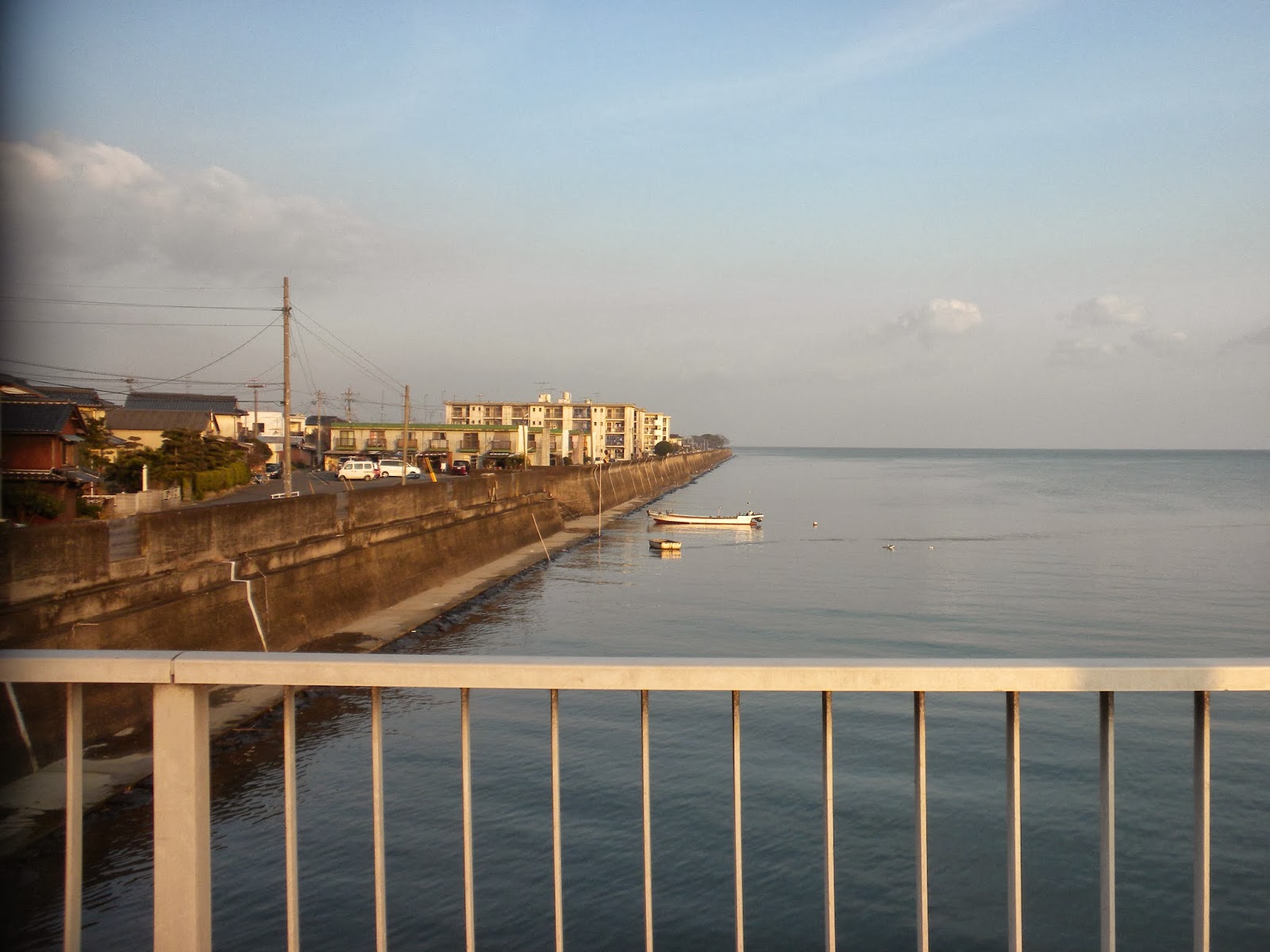
More ocean. This side of Oita is protected within a bay with Yamaguchi Prefecture (and Honshu as a whole) right across the way. Due to this, it's not much of a swimming area, but it's safe from big waves and tsunami. This allows civilization to be brought right to the shore, which is nice. There is a combination of the fear of tsunami, and the utilization of port industries which makes the Japanese coastline not always a charming place to be. For an island nation, I've been shocked at the lack of beautiful seaside for people to live on and visit. But I suppose as I mentioned, due to the fear of tsunami, cities are built far inland and large concrete tetrapods litter the oceanside tens of meters out to sea. Or perhaps it's due to the fear of invasion of feudal lords in the past, or even modern attacks. Furthermore, a lot of accessible waterfront property in Japan is taken up with industry. I was initially shocked in Toyama the first time I tried to ride my bike along the ocean. For some reason I just couldn't get there. Surely they'd have some kind of pathway for walkers and bikers to enjoy the seaside? Nope. Mostly factories and ports. This is not one of my favorite parts of Japan, but what the hell, can anywhere be perfect? (The idealist in me says yes though. Do something about it, Japan. make me happy all the time!)


Here is another mark of Kyushu: temples and shrines everywhere. I think it has to do with a few things: Kyushu being one of the first places immigrants passed through from mainland expeditions makes people's presence old in this area. Also, the island doesn't have too many dominating natural obstructions. The mountains aren't too high, and there are passages all throughout the island, which means people can inhabit just about anywhere. In Toyama you'll find old culture for sure dating back to the Jomon, but for the most part, you'll have sparse temples and shrines dating back a couple hundred years. In this part of Kyushu they're everywhere and often dating back 1,000 years or more.


Finally I made it through Usa and got to Bungo Takada. It's a small town just off the train line and acts as the gateway to the penninsula. There's not much going on, but it certainly has an atmosphere of it's own, owing largely to "Showa Town". The Showa Era last from 1926 to 1989, and the people in Bungo Takada have built and maintained a part of the town in the atmosphere of the Show Era, calling it Showa Town. There are lots of old buildings and interesting shops, certainly a funny place to find yourself and worth a trip.


And so I'm off! Through this gateway town and on to adventure land.


Along the way I found a Japanese hobbit-hole. Surprisingly nobody was home to offer me a mid-morning meal. What would a hobbit call that particular meal I wanted?


And more small caves.


Kyushu really loves its caves, and its shrines, and putting them together.


I give Japan a C+ for this attempt at a sandwich. With black pepper ham, decent cheese, and a ciabatta-like bread, I sense the effort ... but the fact is that it is 90% bread, and Japan not being able to put more than two slices of meat keeps the disappointment at a high. Actually, there are a few things foreigners don't talk about in this country, and that usually has to do with nostalgic food. For me, it's Mexican food and sandwiches. It actually makes me cringe mentioning them here, and will only be able to manage writing such words a bit further. I LOVE good sandwhiches, ones with interesting varieties of bread, loads of tasty vegetables like pickels and jalapenos and sprouts and onions, along with the conventional tomatoes and lettuce. I love sandwhiches with spicy mustard, good quality mayonnaise, and maybe some oil and vinegar or some other interesting sauce. Then that sandwich has got to have a least two different kinds of cheese, niether of them being Japanese super market sliced cheese. And then, above all else, that sandwhich must be dominated by stacks upon stacks of various meats, turkey, pastrami, ham, roast beef, to the point that your arms get a workout by simply lifting the sandwich to your mouth. THAT IS A SANDWICH!!! I won't even take the time to describe how pathetic Japanese sandwiches are. I'll just say that I've never had a delicious sandwich in Japan ... and that says a lot after four years trying every single one I find.

Oh and Mexican food? It's more of the fact that it's non-existent. Very rarely will you find it, and unsurprisingly it is so Japanized it has nothing to do with the original idea. However, I have found a handful of delicious Mexican restaurants only partially Japanized.

I love Japan, so much in certain ways it makes up for it's limitations, but when you drop the sandwich and Mexican bombs, it's hard not to think about picking up shop and heading across the sea again.

(Though I have decided to live in rural places in Japan. Perhaps in larger cities you can find alternatives. The price I pay for the simple.)


This person however gets an A for their English endeavors. Next to a pond where I ate my Japanese sandwhich-like substance, I found this paper as a piece of trash next to a drainage pipe. This country is amazing for how hard it's people perservere in their studies of English. It's also amazing at how hard the Japanese seek perfection in their English; using combinations of words and intonations that a native speaker hasn't used in decades. Good luck to them all! But I hope they remember, that without being able to have a normal conversation with a native speaker, you're missing a big part of the picture. Wanna meet with me for an hour in a cafe for 3000 yen, anybody???

But I digress.


This is my new friend! What a funny dog. I rode past some warehouse like structure on a hill and out came this guy barking. I didn't sense any aggression, so I stopped. He stopped barking, and wagged his tail. I called him over, he came. I put out my hand, he sniffed it, I tried to pet him, he retreated, he smelled some more, I pet him, and we were automatic best friends. I'm certainly less than a cat person, and this is definitely a dog-dog, so I suppose we're not so picky in each other's friendship. I have a cute dog to pet, and he has a human to pet him, sometimes I guess that's all you need for loyal friendship.

So I pet the dog, we became best friends, but eventually had to say goodbye, so I did and rode on. But then he raced past me, and stared at me as if asking where we were headed. Uh-oh ... I realized that no matter how far I was going to go, this dog was going to loyally escort me wherever that was with zero immediate consideration for his home. The result was going to be a lost dog. I searched for an owner to hold him back to no avail. I spent about a good 10 minutes of honest hand gesturing and rock throwing to convey to him this precarious situation, but he just wasn't getting it. I rode on ahead until there was a fork in the road. Downhill both ways, this was good, I would be able to build up enough speed to outpace the dog, leaving him behind in recent proximity to his home. I wanted to go left, but that's where he went, so sped down to the right. I lost him quickly, and wondered about that strange encounter we had.


Welcome to the Kunisaki Penninsula! Ahead lie funny looking mountains and I wondered what strange things I would find in this magic land.


A temple! Surprise! But I knew this going into it, that this area was famous for a lot of old temples, and I was very curious to the kinds I may find. Here is one built into a cave. It is one of the most famous in the area, called Tennenji. Interesting thing about this is that it is a Buddhist temple, but then right next door is a Shinto shrine. I won't go into the history of the two here, but it reminds me how intertwined these two used to be. It wasn't only until the Meiji Era that such clear distinctions were made between the two, and the different sects within. I think originally each region seemed to have it's own special blend of the two, or whatever else they wanted. What we see today is largely a manufactured editing, presented to look a certain way, instead of carry on the beliefs practiced before.


But if we're going to get specific, this area is famous for Shugendo Buddhism. Here is the brief introduction Wikipedia gives:

"Shugendō (修験道?) is a highly syncretic Buddhist religion or sect and mystical-spiritual tradition that originated in pre-Feudal Japan, in which enlightenment is equated with attaining oneness with the kami (?). This perception of experiential "awakening" is obtained through the understanding of the relationship between humanity and nature, centered on an ascetic, mountain-dwelling practice. The focus or goal of Shugendō is the development of spiritual experience and power. Having backgrounds in mountain worship, Shugendō incorporated beliefs or philosophies from Old Shinto[citation needed] as well as folk animism, and further developed as Taoism and esoteric Buddhism arrived in Japan. The 7th century ascetic and mystic En no Gyōja is often considered as having first organized Shugendō as a doctrine. Shugendō literally means "the path of training and testing"[citation needed] or "the way to spiritual power through discipline."[1]"" 


I have no experience practicing the religion, but have read about it from time to time and I always thought it was the most ... something ... of the Buddhist sects. I'd have to say I have the most interest in the Zen tradition for various reasons, but Shugendo with it's mountain ascetics and esoteric practices, I likened it more to the magical side of Japanese religion, which I think is really cool. I still think it's very cool, but in coming here I realize how long it's been since I've thought of such things. There was a time I dreamed of being a Shugendo warrior priest practicing ascetic rituals with the spirits while hanging from cliffs.


So a big part of this penninsula is being the training ground and pilgrimmage path to many Shugendo practitioners. Here on this funny rock formation above you can see a small bridge on the left and small shrine on the right. I'll have to come back to this area and climb on these rocks, but not today.


What makes this specific temple of Tennenji so famous is that it's home to a very interesting festival and dance. I'm not exactly sure on the specifics, but two people dress up as demons (or perhaps two demons take the form of humans), one black and one red (wearing the masks shown above) and dance in a fashion such as in the picture below.


They light sticks on fire and have a mock battle, while also terrorizing the bystanders, slapping them with fiery sticks if they so desire, and light other much larger sticks on fire outside. It looks super cool, and is certainly part of the great hidden rural culture in these parts. Sure if you go to Kyoto and visit the main temples and shrines, and read about zen, you're seeing a part of Japan, but there is a whole different Japan that lives off the main train lines, and runs long back into ancient veins. Here deep in the mountains and forests are demon traditions of fire ... and really interesting costumes. Are these really the traditional clothes? They look awfully post-modern to me.

So many things to see and study and learn! But only so much daylight to go and I had farther to ride.


My basic plan was to ride to the center of the penninsula where it seems all roads intersect (check the map at the top again). Making it to the center where there are lots of strange temples and mountains around, I would then hope to climb one of them if time and energy permitted. I have a mountain climbing book on Oita and two of the featured treks were in this area. The temple I had visited of Tennenji lay at the beginning of this center, so I had a ways to go to the end, but I was certainly already deep in the dream land I envisioned. Mountains were everywhere, but not so tall. Lots of strange rock formations. This also seems very Kyushu to me as compared to the large mountain ranges of central Honshu.

I rode further and found myself making a steady incline. I envisioned most of the area being flat except for the jutting mountains, and was surprised at this. I also felt like I was in the middle of nowhere. I certainly was, but it was different than I imagined. The incline only continued, I didn't see the desired mountains in sight, earlier coffees were wearing off, and I began to enter a darkened mood of sorts.

Looking back, there's not much to complain about. Regardless, low dark clouds settled on my mind all did not seem well. I don't even remember exactly what I was thinking or why? I suppose it is the human condition.

Am I getting older? The obvious answer is yes. My years are counting higher, but it's not just that.

The night before I had to fight unusually hard against sabotaging this trip by drinking, spending money, or getting distracted. It felt like I was fighting against the fat weight of some demons who really wanted me to fail. Like it was grating against the nerves in my skin I was fighting. As for my body, I woke up and felt pretty good after the stretch, but it's the coffee. It's like if I have coffee I can do anything, and if I don't I want to inflict pain on innocent things. I know there are addictions to coffee and whatnot, but really? Is it really so strong? I used to fall in and out of dark thoughts easily and lightly. Anytime I start pushing the bike up a hill this happens, but goddamn, this time it felt so heavy, and it wasn't going away anytime soon. What am I thinking about? What is so heavy as to blind me from the excitement of where I am? When did this happen? Why?

Is it only going to increase with time? What is the purpose and path of this darkness?

I pushed for a long time until I saw a tunnel, something I would usually see in Toyama, but this may be the first one I've found around here on the bike. A nostalgic flash interuppted my stagnating mood, and on the otherside was a steep downhill.

This produced very mixed feelings.

After such a long push uphill, a downhill like this is the greatest thing in the world. That downhill crusing at top speed is the adrenaline gold of these trips. But I knew the only road I would return by was this, and that if I was going to go down, I was going to have to come back up. It was getting later and I had gone even farther than I imagined in pursuit of these mountains. Those mixed feelings drove me mad and I parked the bike and started at the forest.


Like someone pulled down this dream-like curtain before me, I got off the bike without taking my gaze from the forest. Mouth slightly open, I stumbled thoughtlessly to the wooded edge of the road. I was slightly light headed for the sudden change in movement. I walked to the edge of the forest and subconsciously stopped.

This is what you do in Japan.

You walk on the path, and stops where it tells you. There is man, and there is nature. Man can make man into nature with paths and things, but without that, man does not go into nature.

This is not me.

In my home, my childhood was based upon walking into the woods, diving into nature. I walked where I wanted. But I stopped. What has happened to me? I wanted to go in, but there was some small Japanese fear inside of me like I shouldn't, or even waste the time. I saw that there was a light trail into the woods workers had used before. I looked to the woods and saw that it had been heavily affected by man, with lots of fallen trees from chainsaws. I stepped into the woods, maybe thirty meters or so. Stepping on soil, brushing against bushes and leaves, climbing over stumps gives me a feeling like none other: This is where I belong.

I knelt down and just stared at the forest.

I'm not sure how much time passed. I felt the forest. This was different than my thoughts, my plans. I felt the weight of all those plans I have been holding, those chains. What a fucking slave, I thought. Constrained to the path and what others have told me is safe. In choosing the path, I have been blindly accepting the pressures of its expectation. The Fear. I have not rested from these pressures in a long time. Here in the forest I just look. I just breath. I am alive, I am strong, and that is enough. I am also the forest, and it is also me. Everything is OK, because this is just life, a strange amalgamation of phenomenon that eats, lives, dies, and creates. I thought of my plans in search of the mountain I wanted. I thought of kyudo. I thought of learning Japanese, getting married, having friends, writing on the blog, teaching English, being succesful, being home on time, eating the right things, not drinking the wrong things, thinking the right things... everything down to every ridiculous letter, I thought ... I am a fool.

I am alive, I am strong, I am the forest, and everything is OK.

I pulled myself from the forest because I have to move on.


I got back on the bike and proceeded further, just a little, I said. That downhill was looong. It was incredibly fun to ride, and at the same time I cringed thinking about pushing my bike up it again.

At the bottom of the hill I soon found my mountain, small marks of civilization, and an onsen.

All that's left is to climb it. From there the long return will commence.


As you can see, the mountain is lone and steep. It's not so high at 605 meters, but man was it the tallest 605 meter mountain I can remember climbing. Just trudging straight up.


Up up up through the forest. It reminded me of Toyama, lots of small cedar trees and steep climbs. It felt good to be in my boots in this forest.


Up and up and up, what a mighty little mountain this is. I was happy, but also frustrated as one can be on the climb. I wanted to be at the top. I dreamed of what captivating views I would have. Being one of the tallest mountains in the penninsula I imagined all of the surrounding Zelda/Mario-like hills. I imagined seeing the sea, my home in Nakatsu, and maybe even Oita City on the other side.


The top! It only took about 45 minutes, and I had made it. It had the feel of a small mountain top, trees and picknick benches.


On such low mountains there are often still lots of trees to conceal good views, so I climbed one of them to get these pictures.


The views!


OK. I'm not trying to be a miser, though it may sound like it, but I was kind of unimpressed with the view. I'm not saying they should cut down all of the trees so we can appreciate it all, but couldn't they build a small tower to take in the impressive view? I wanted it to be sunnier, I wanted to see more, I wanted it to be more like the video game images in my head. Instead it was real, on this early winter cloudy afternoon. There's lots of mountains around here, is this really the one featured in that book I had? I had reached the top, and the only feeling I had was that to descend. So down I went.

This was good. I found the mountain I wanted, I climbed it: success. But more dark thoughts came in. Not so dark, but questioning. I thought of how much effort I had put into this trip. I thought of how I'm the only person I know who would do this kind of thing. I thought about how wonderful a thing it is to use discipline to get to bed early, get up before the sun, eat healthy, ride a bike where you live, then far to places unknown, where you find old temples, cultures, and then climb a mountain to top it off. I thought about how I have to do these kinds of things to feel alive and be happy, but that nobody else does it. I thought how lonely that can be. I thought of how disappointing the mountain top can be sometimes. I forget about the long rides home.

I had some very revealing thoughts about zen and local traditions. I thought of how limiting zen is. It's a very interesting philosophy, it has a very enlightening practice ... but it makes sense that there are so few people that can understand and practice it.

It's super boring and difficult.

Who wants to just sit there in an uncomfortable position for such long periods of time? For what? For who? How lonely, and boring, and difficult the zen life can be. There's no way normal people can enjoy such a thing. People talk about how universal zen is, how anybody can do it, anywhere, anytime, and it's wisdom is revealed to all who try ... but how few people do you know who can really do it? I think a lot of foreigners get excited about zen and all of its jazz, but they make it something else ... they make it something cool, trendy, or even something we have to do, which is just more trash. I think of a lot of Japanese people I know who don't indulge in the same thoughts, and it's absolutley no surprise no one cares about zen here. People don't want want boring, lonely, and difficult. Why am I the only person I saw on the mountain that day? Or on the road on bike? Or waking up at 6:00 on a freezing Sunday morning? Why do I like this boring, lonely, difficult stuff? I don't know exactly, but I do.

Anyway ...

nobody wants to sit zazen and climb little moutains ... you know why?

Because most people work jobs that are lonely difficult and boring. We already do all of that shit, why would we make our hobbies even more so? Life is full of boring, difficult, and lonely. Work is full of boring, difficult, and lonely. I'm as young and American as the next and indulge in the belief that I should be paid large amounts of money and fame for doing exactly what I want, but ... but ... that's not happening, and it probably won't, because that's just an idea. For the most part I think people in the history of the world have had to put up with a lot of shitty shit including work, life, and responsibilities.

So you want to know what they did in their free time instead of climb mountains and contemplate Buddha???

They got drunk, lit things on fire, and danced around in funny masks and costumes.

It makes perfect sense now. In laboring agricultural society, especialy one pressured by military ruling classes, that sounds like a great thing to do with your free time.

I don't need to do the same exactly, because I live a different life ... but maybe it makes sense if I don't climb mountains and sit zazen and practice budo and write on a blog ... blah blah blah .. all the time.


Realizations. More mysteries. I do not belong to the past, nor the future. I am living a life now that has little definition. In this modern world we are responsible for creating our lives, and largely have the freedom to do so. Ultimate freedom, yet the limitations of reality at the same time. The illusions of society. My mind is broken and useless. It makes no sense. All I know is that I have this body, and I need to get it home before it is too late.


Aren't these cedar trees strange. So long and thin and then just the smallest bushiness at the top. This is very strange.


I went to the onsen and rushed in just before they closed the restaurant. I ordered something quickly and was hackled by an extremely drunk old man. While I was trying to order he was yelling at me telling me to sit down.

"Hey, come on over here and sit down ... Hey, come on ... HEY GET OVER HERE AND SIT DOWN!"

I was tired and ignoring him, the lady at the counter was ignoring him too but very uneasy and embarrassed. She ushered me to a separate room, but the guy kept yelling at me and walked closer to me staring at me with blackout drunk eyes and speaking rude Japanese unintelligible to anywone. I asked him if he was OK, and he stared at me very awkwardly for a long duration. I stared back a bit, but then shrugged him off and turned away. He said something else, then tried to get up but fell over and crawled back to his chair. The waitress came over and closed the door to my area, and the old man continued to hackle. I got my meal, and heard that the lady had called a taxi for him. I heard the taxi man come in. The lady was asking him to leave but he wouldn't. I knew the taxi man was there but he was dead silent. I could see it all behind the closed door: This completely wasted obnoxious old man ordering more drinks, cursing at others, refusing to go home, the very kind old lady waitress asking him to go home, and the awkward taxi man just standing there doing nothing. This wasn't going to end soon, so I decided to step out and pay. The old man seemed surprised to see me, as if he didn't remember me at all from 15 minutes earlier. I looked at him and the others and they were silent. I paid for my bill, said thank you, and the drunk old man said, "Whoa, he's good at Japanese." in a funny innocent way.

"Hey man, the restaurants closed, it's time to go home." I said to him.

The old lady sat for a moment and then said,

"Oh no no no no it's OK, don't worry, you can just go."

I said "whatever" in my head and left. There was nothing for me to say or do, and that was best for me anyway. I just felt bad for everybody. I felt bad for the lady who had to deal with this guy but couldn't tell him to go home. Bound by culture and her job, she had to be as polite as possible while trying to coax him out. The taxi man the same, having nothing to do but politely stand there until somebody fixed or didn't fix the situation. I thought of the obnoxious old man who could have any reason for being so surly. What a strange world we live in. Only in Japan would they have the discipline and patience for such an ordeal. I thought of America where the lady waitress would tell the guy to get out, the taxi man who would try and help do something, and a bystander who might say something. But no ... not here. I respect the Japanese way of doing things, and admire it in a lot of ways, but man sometimes I think there's got to be a better way.

So as you can tell, it was a day of quickly changing moods. This happened, and it really put a wet rag on the mood. That along with the thought of a return trip which may take as long as four hours (which it did) after all that had happened, I thought that maybe I didn't need to come so far. Getting into onsen was a small goal of the trip and I had found one, but there just wasn't enough time for it all.

I quickly entertained the thought of just continuing to the end of the penninsula and staying the night. But that return trip was there no matter what. The only way I was getting back with my bike was on it, and I couldn't afford to blow the money necessary to stay the night, plus trying to get home the next day before work.

So I headed home after my epic adventure, exhausted by the ride, confused by the world, and haunted by that drunk old man.

I can't help but think that in some strange way, this is just what I want.

 
USA Driving School! Where I can just walk in and they'll give me a driver's license and a car good in Japan!!!

Yeah right. It's just the name of the town, Usa (pronounced oo-sah). I heard that in early modern manufacturing times companies would have their products made in the town so they could say, "Made in USA."

What a loooooooooooooooooooooooong ride home. It was a magical land, but I don't think I'll be going back to the Kunisaki Penninsula on the bike again anytime soon. When Satomi gets here we'll take trips in the car ... nice warm happy trips. Maybe next year when I forget how hard it all was I'll saddle the bike for a summer ride or something.


What a strange place we live in. Each and every one of us, with our own little world of our own. "What is yours like?" I wonder.

Thank you very much for reading this post.

Sunday, December 8, 2013

I Finally Found Iaido ... and Jodo

 
I did it, and I'm overflowing with budo happiness and general excitedness about life.

I've mentioned in the past few posts my growing interest in a dojo that teaches iaido and jodo in Nakatsu. Until now I've been just trying to get used to the new home with the area and work. After a few weeks I started kyudo here and found an excellent dojo, but I've had trouble getting started, and still haven't found a rythm. I thought I'd wait at least until I get into the rythm of kyudo, maybe a few months or so, before trying anything new. But I have too much time and energy on my hands to just sit around and plan. That frustration, plus the intrigue of finally exploring new budo boiled over and I couldn't help but contact the dojo and make introductions.

Two days ago I decided to make the call despite all warnings against. I woke up, went through my morning routine, and then decided to call. But something felt wrong. Was I really going to put this whole thing in motion? The thing is, if I make the call and initiate contact, then I'm going to have to show up. I'm going to have to present myself and my situation and take that teacher's time and energy to feel me out and accomodate me as a prospective student. After that I will be asked if I want to start. If I just talk about the limitations of practice (acquiring a new practice while still maintaining kyudo, only having weekday mornings to train) and give vague answers ("Well, I want to start, but I dunno ...) then I'll be considered a flake (because it is flaky) and any future potential contact will be limited by that first impression.

First impressions are so important, maybe a little more so in Japan. If you start off on the right foot, you can fall as much as you want as long as you try to get back up ... and finishing is really important in Japan, too. As a matter of fact, compared to my feelings about home, how you start and finish things is way more important here. As for the actual mid-way participation, it doesn't have to be perfect, not by a long shot. (The reasons why will demand another post!)

 
So, I decided to make the call, which meant following through with whatever came after, even though I was extremely nervous and hesitant. But whatever, I was going to do it. I decided that whatever I do in my first contact, don't be flaky, and more importantly, don't be annoying.

Don't be annoying. If there's any advice my small years can offer another person when meeting a new person in which you'll receive a great service ... like a job or a new dojo ... don't be annoying.

OK, don't be annoying.

So I called at the awkward time of 2 p.m. What normal person calls someone else at this time of day? Regardless, it's what I did. It rang and rang and eventually went to voice mail.

SHIT! I didn't think of what to do if it went to voicemail.

Of course before the call I went through my head what I would say, but setting anything in stone is just setting yourself up for failure (no matter what language), plus all the thinking taxes my resolve, so I just said screw it and call and see what happens.

But it went to voicemail, and I didn't expect that, and so I hung up before leaving a message.

Shit. This guy probably won't call back this random number after one call (though Japanese seem to be better at calling people back, I think). So, I'm going to have to call again, and I'm going to have to leave a message.

OK.

So I rehearsed a couple times what I was going to say and was ready.

I called. It went to voicemail. I began to speak:

"Hello. I'm calling for Yamada Sensei. My name is Zac and I'm an American who just moved to Nakatsu. I found your website and am interested in learning more about what you do. I've always had an interest in budo and ~"

BEEEEEEEEEEEP!

 
Shit! It cut me off before I was finished! This is definitely annoying. But I have to call again to finish what I was saying.

OK, I'll call one more time and see.

I called, it rang, someone picked up, but I couldn't hear anything. Maybe he was busy and couldn't deal with the constant ringing. Maybe the button was pressed without his knowing? I have no idea. But I hung up after 10 seconds of silence and left it at that. Though this teacher got three phone calls and one half-message from a gaijin which he may or may not have understood, if he's a good teacher or person at all, he'll understand he should call me back. If not, I'll call again tomorrow.

After that, I called it enough and left for work. The whole time riding my bike and the train, and a bike again, I thought about what ripples will happen from my initial tossing of the stone. Did I understand what I had started? How far would this go? I thought of many different things. I thought of finding the perfect dojo and experience I've been waiting for my whole life. I thought that the sensei would be crap, or their training time wouldn't work with my schedule and it would end before I ever unsheathed a proper katana.

 
After I finished my last class I dashed to my bag to find my phone and realized I had a missed call from the sensei and had a voicemail. In the message he told me to call a different number and we could talk more about the subject. I called it back immediately and it went to voicemail. I didn't leave a message because I figured they knew once they saw it what I wanted, which was to talk to about budo. I cleaned up the classroom and right as I was locking the door and heading out I received a call from the dojo. I picked it up and ran outside as quickly as possible to escape the echoing halls. This man was very friendly and very easy to talk to, which was a big worry of mine. It doesn't take much to run out of patience talking to an unknown foreigner on the phone, but he was very friendly and seemed very interested in meeting as soon as possible (another thing I think Japanese are really good at) to talk further, which was exactly what we needed to do. We needed to see each other face to face. This may be more important with budo than other social meetings. He asked me about the next day but I had plans and couldn't meet until the day after. He asked if 10 was alright, and I said sure, and the meeting was set. I don't think I was too annoying, and was really impressed with the teacher over the phone.


I jumped on my bike and raced to the station, heart pounding and mind racing with excitement.

 
(Funny story: Along the way, probably taking my gloves or phone out of my coat pocket, my house key fell out somewhere and was never found. I realized it when I got to the train station, took a taxi back to the classroom and convenience store I stopped at on the way to check if it fell out there with the monetary transaction, couldn't find it, and ended up paying loads of money for taxis, express trains, and slept on the floor of the other gaijin who lives in Nakatsu. Next day I called the landlord for help, didn't get an immediate answer, and made the smart yet extremely shady choice of climing up my downstairs neighbor's balcony to mine and get in. )


So yeah, the next day I did my thing and thought the whole time of that Saturday morning meeting to come.

The night I had a beer and quite a few glasses of wine. But totally within my limits, and went to sleep knowing I would just wake up, take a shower, eat, and then this quest for further budo would be happening to me.

I woke up and took longer than I thought in preparation squeezing my time short. I stopped at a convenience store for a coffee and gulped it down while I raced on my bike over bumpy sidewalks to the dojo. From my apartment it's about thirty minutes on the bike. Is that long? Certainly not the epitome of convenience, but I swore before if I didn't have to ride a train and make a commute of over an hour one way to budo training like I did for kyudo in Toyama, I wouldn't complain. And so I won't.

Along with first impressions, being on time, or early is sooooooooooo important in Japan. No matter who or what you are, just don't be late. I had to throw my coffee cup away and take a piss before going in the dojo (I knew I would have to wait a long time before next chances of relief) so I stopped in the shopping center across the street, literally ran to the bathroom, finished, jumped on the bike and screeched to a halt in front of the dojo at 9:57.

YES!

Perfect. Truly perfect, I think.

I climbed the four steps of the dojo, stopped and stepped back down for a 30 second breather. I saw a shape come to the door, open, and then it began.

 
The man, Yamamoto Sensei, dressed in training garb, told me to come in, and so I did.

The dojo is ... NICE.

I saw pictures of the outside online and it looked like a nondescript square white building: Super not-interesting. On the outside are wooden signs with the name of the dojo, but if you didn't know what you were looking at, you definitely wouldn't notice it. When I got to the dojo for myself I though about how unimpressive it is, which is often a good sign of a dojo.  But ... I was impressed in a very subconscious way when I went in. It smelled of fresh hinoki wood, was not a huge hall, but certainly not cramped for space. It was clean, there were martial arts paraphernalia on the walls, and there were big mirrors. The sensei was very nice and welcoming and we began talking. We had a minute of chit chat, and then he began showing me some of the scrolls on the wall which told of the arts that were practiced in the dojo. Not but two minutes later, another man came in the dojo and began getting dressed.

He asked why I came and I said that I was interested, really interested, in the iaido and jodo it looks like they practiced. He smiled wide and then asked if I had any experience in martial arts. I said I did. He asked if it was karate, or something, and I said that in high school I started karate. He seemed to expect this. After I graduated from college I came to Japan and started aikido. He seemed interested in that. I said I did kyudo as well, and he didn't seem interested at all. I didn't mention my time in other Chinese arts like Tai Chi, Ba Gua, and Hsing I, mostly because it would inundate everything else, and anyone who has done so many different things is probably not good at anything. I remember when I first talked to my aikido sensei, who was a little less friendly at first meeting than this guy, I mentioned I did karate and tai chi chuan. He asked what kind of karate and I said Hawaiian Kenpo. He had never heard of it before and didn't seem to care, and didn't say anything else at all about tai chi. Since then, I probably won't mention at first meetings I practice tai chi chuan, not for any other reason than it doesn't seem to resonate with the Japanese audience all that much. (But if brought up I would happily talk for hours attesting to its legitimacy and the fact that if all else faded away, I would still be standing there practicing the tai chi form, and idealizing about push hands as the best martial arts practice I've ever felt). So he didn't seem very impressed with kyudo, and that is another thing I've noticed among other budoka. I'm excited to get back to other budo and see kyudo from a distance, but any misjudgements of kyudo are just that, misjudgements. It is a legitimate budo and should be admired with the rest, training the mind body and soul sufficiently (but further explanation will require a whole separate post as well! Too much to say, too much.)

So, we talked about these kinds of things and he told me about the dojo and after five minutes he told me to take a seat and relax and watch the training session.


I was impressed with everything I had seen so far, and was happy that I was able to sit in on a training. Before, I really wasn't sure what this meeting was going to be like. Would we just talk for a few minutes? Would he expect me to start training right then? Would I watch a training session first? I was happy for the latter, which is what I expected anyway.

I sat in a chair in a corner and watched.

 They started with jodo. By "they" I mean Yamamoto Sensei and the lone student.

Yamamoto Sensei is an interesting looking guy. Many of my Japanese teachers and friends in the martial arts have been far more normal than I imagined, which is perfectly fine, but there's something about this guy that stands out a bit more. He's pretty tall for a Japanese, maybe six foot, which makes him considerably taller than me, and any other Japanese martial arts teacher I've had before. My aikido sensei was maybe 5'9, kyudo sensei in Toyama about 5'7, and kyudo sensei in Nakatsu about 5'5, and all fairly average looking Japanese dudes. So this Yamamoto Sensei is pretty tall, and old enough to have half of his full head of hair greying. The thing I noticed most though was his beard. He has a beard, and it's cool. You can tell he takes his time trimming and shaving around it, and in fact his demeaner shows that he isn't lazy about his physical hygiene. I know think this is a good thing. He's in good shape, not super thin, but also not especially muscled. His limbs seem a bit long, but I suppose that's normal for people of his height. His hands are pretty average sized. He has very attentive eyes, but he doesn't stare at you or anything. His gaze simply looks sharp. He moves within his bounds and balance, but he looks like he can move fast when he needs to, which is something I haven't seen much of in my other Japanese teachers. Fast movements don't happen often in kyudo or aikido, though I have seen my aikido sensei move fast when practicing his kenpo.

The student looked like a good student, but definitely a beginner. At one point we chatted for a moment and he said he'd only been practicing for a month now. So short. It made sense. In the movements he found himself in strangely off balance positions, and struggled to remember all of the little details involved in sitting, standing, preparing movements, etc (as anyone would and I will!).

I was totally impressed by the one on one class they were having. I haven't had that in a long time. To have your teacher's full attention in improving your technique is a very special experience. In kyudo I was lucky to get my sensei's full attention often, but even then it's not like the whole time he's there with you. He'll watch you, help you, stay for 2 to 15 minutes, and then shoot or help someone else and come back later. In aikido this never happened because there were always a lot of other people, though I had lots of one on one conversations with the sensei. Furthermore, a lot of things in aikido deal with very subtle body movements where the sensei will tell you to do something that really feels impossible. My impression with this kind of iaido and jodo is that a lot of it starts off with and can ride along with imitation. Imitate your teacher, do exactly what movements he says, and you're good. This is much more difficult to do immediately in aikido and kyudo.

So they worked on jodo, and I watched from the corner. I've had experience with the jo in aikido, but I knew that it would be different than non-aikido jodo. The jodo I've done was good, but extremely limited ( not because of the teacher, but because of my rank and time). Most of the jodo I've done is solo waza, with very little experience doing waza with opposing partners, and always relative to aikido movements. I think it's good, but different than this jodo, perhaps. There were lots of similarities, but that had less to do with my knowledge of the jo and more about general rules about budo like body weight, hand positioning, and distance.

Yamamoto Sensei talks a lot. For him, it's a good thing. He explains everything he does and why in a very practical manner. He also gives stories or further examples to explain his points. He talks a lot, but for him it works. He also moves a lot, and by that I mean practices each movement a lot to show and work with the student. You can tell he has a goal, which is the student performing the full movement correctly with a partner. He does whatever it takes to get that student to that point the fastest and most thoroughly. He'll start with introduction movements, explanations, speeding up of the movement and timing. When there is a problem, he'll go back and fill in the gaps until the student understands. He watched the student very carefully, focusing on the necessary missing pieces, and not bothering with other small things that will come with time.

 
He's concerned with kuzusu, putting an opponent off balance. There are points when contact is made in a smacking motion between partners' jo's and ken's, but he made a big point to say it's not about hitting the opponent's weapon out of the way, because it doesn't do anything, and good ken-wiedlers train their wrists to be soft so that when hit in such a way they can react and whip back even stronger. Instead of slapping another person's weapon, you make contact and move in a way that off-sets the partner's balance, making for a successful technique. Sometimes it may look like just hitting an opponent's weapon, but it's much more. This reminded me of my aikido, where movements are made sparingly and with the intent of unbalancing and opponent. You're not just flailing your arms around and making unecessary movements, though I have seen that kind of aikido before.

The jo is used in context against the ken (sword). In this respect, you have to analyze the pros and cons of this particular weapon. Pros, it has twice as many options as you can use either end interchangeably. It also has reach. However, it's just a stick compared to a long blade, which in my opinion seems like the greatest disadvantage. Because of this, one must be persistent in examining their practice of the jo. Every advantage must be taken to it's maximum. I saw this in practice as Yamamoto Sensei told the student to hold the jo or his body in a certain way as not to waste the length of the jo, and also to move in ways as to not give an opportunity for the opponent's blade to slash you or your jo, which would be the end of everything.

After an hour they moved on to iaido.


During this interum I looked around the dojo from my perch on a stool.

The dojo is NICE!

Fairly simple, but it looks very recently built. I asked later and he said it's been about a year. He seemed surprised at my interest in this detail. It smells like fresh hinoki wood and has beautiful mirrors, as I said before. The ceiling is high, and there are racks with lots of weapons (something I haven't seen since my first karate dojo). It's not a giant hall or anything, but very comfortably sized. Looking around, this is the perfect dojo, I thought.

They began iaido and the practice was similar to that with the jo. Just the two of them, and the teacher read and reacted to his student very well. There were lots of key explanations, and Yamamoto Sensei commented that though it looks like we practice iaido alone, it's impossible to do alone or think of as a solitary person's art. This hit home with my kyudo which is just the same. In jodo there was more of just starting, but in iaido a lot of time was spent on the proper introductory movements and etiquette. I also empathized with this from my experience in kyudo. The student was having trouble with it, and I just wanted to start doing it myself. I looked down and saw my hands realizing moving, mimicking the movements Sensei was teaching. I wanted to start there so bad, but today I would just watch.

 
Part way through Yamamoto Sensei was telling a long story. It had importance, but maybe was a little long for a training session. I was thoroughly interested and following, but I looked at the student and could see his mind was completely full. Eyes partly glazed over falling asleep, partly on fire trying his best to follow the teacher. He had reached his limit and I totally understand. After one month spending two hours on such tiny little details with the teacher's full attention. I totally understand. But I'm also chomping at the bit to get started.

When they finished, the student looked happy to call it a day, and the sensei laughed. This is a guy who loves his arts, has practiced diligently for a long time, and has a mind for an encyclopedia.

For some reason, in some way, I've been looking for this kind of training and teacher for a really long time. He asked me how it was and I said it was really interesting. He asked if I wanted to try and I said I really wanted to.

So we began discussions of the logistics. In this, my biggest worries were relieved. He teaches in the mornings according to the student's time. My work time will be no problem. Furthermore, I was really worried about him wanting students to spend a lot of days in training, but when I asked how often most students train in the beginning, he said just one day a week.

One day?

I was really hoping that he was going to say you don't have to come all the time, but one day? Wow. I guess ... that's ideal to start. I'll start with the one day a week and move on from there. In all of my martial arts experience it starts like this. You show up for the limited time at first, get used to each other, and things grow from there, and I can see there certainly is room for there to happen.

I was sure to assert my dedication to kyudo, but of course asked what he thought about practicing the two. I think the best situation for him is to have a student solely devoted to his dojo, and when that attention is diverted, it's a red flag in any situation. He tentatively said it would be no problem, but that it can get difficult to handle the details of it all when your mind is divided. I know this all too well, but I think it can work out for now, which is most important. I'm held back by my hand in kyudo, and I think my practice is hampered by my sole focus on it. I think for the most part I need to just chill the f&%k out on kyudo, go a few times a week and not worry about it instead of bouncing between the heavens and hells of it's affects. One day a week? This is ideal in a lot of ways. I'll start with this and see. I told him, and believe, that if it's too much I'll have to scrap one.

That's kind of scary. Because looking at this dojo, letting go of the interest and curiousity in it is impossible. In the beginning it will be one day a week, but I can tell this dojo is really into it's arts and will take it as far as one wants. I love kyudo, and I've come to an excellent dojo, after such a great experience with my past teacher in Toyama, I can't just throw it away ... but to only do kyudo now is torture and a waste I think. I'll progress in both slowly and see how it goes.

So it's good to go.

There was just one issue I hadn't predicted: money. I have a jo and dougi to use which is great. They use hakama when they train, and I have one from kyudo, but I have a feeling it's a bit different from the ones they use here. Other than that, the sword is left. The sword which is super necessary and not cheap. I asked how much it was and he said about $400 straight faced. They talked and said they've seen some for a little less than $300, but he definitely didn't try to pretend it would be any cheaper, and I appreciate that I guess. So after the move and all the unexpected expenses, here's one more. To the woe of everyone else concerned about my funds, that sword will be bought as soon as possible, before I really do have no money.

Unfortunately, my jo is still in Toyama, and I'll go and pick it up, along with my wife! in two weeks when I go back to Toyama for a few days. He said that's good, and until that time when I have all the gear we can just chill. I'll go in next Friday to sign paperwork, and train "just a little". He said this with a smile which gave me confidence. Though there is paperwork and gear to be had, he is a teacher and I am a student and we're ready to get started. I also liked that he said we'll start slowly at whatever pace works best and move from there.

 
After that I left the dojo and no idea what to do. I was so impressed with it all, and I couldn't believe I had already made all the moves to put me in the place to start this training. I was planning to ride the bike to a mountain onsen, but I wasn't ready to get started. I had to do something, but I didn't know what. I needed to drink a coffee or write something, so I started with a chahan and gyoza meal followed by a coffee, writing in my notebook all the while.

After that I rode to the mountain onsen of my desire. I thought. I soaked. I forgot. I thought.

I hate the supermarket, but I loved it today.

Everything about this place has blossomed. At points I've doubted my time, but today it feels right.

Today it feels like there are no such things as mistakes,

because there isn't.

We just move, and go, and things react, and so do we, and we have a thought, perhaps a desire, and it becomes real ...

This is the Becoming, and I'm very excited.

 
(These photos are of the bike ride after the dojo meeting to Nishitani Onsen. On the way I passed Yabakei, which is the most famous natural attraction in Nakatsu City, cliffs in which the side is carved out by temples. Not a bad place at all.)