Showing posts with label beginning iaido. Show all posts

Wednesday, January 29, 2014

Sensei's Greatest Concern


Will I continue?

I'm thinking of my specific situation in iaido, but it relates to all sensei and students everywhere.

In my experience, and from what I've read of other traditions of martial arts, meditation, or anything in particular involving a teacher and a student, the number one most important factor, and so therefore the most brooded over by teachers, is this question:

Will the student continue training?

On the one hand, the idea of all of these practices is that one's training is never finished, so we must continue cultivation until our end. In a way, once a person stops, it's all over. One could say it's a waste of the teacher's time if the student quits early. In that respect, ideally a student should practice until they improve beyond their master and can then pass the teaching on to someone else, who will then again surpass the teacher. This is an idea you can rationalize, but it's also the number one most serious feeling I've ever sensed from my teachers. I've practiced many martial arts, and so I've moved and stopped training in many of them. I've said a lot of goodbyes, and aside from the excitement of moving on, the goodbye's totally suck, because of a hidden love between teachers and students, and the hope that the student will continue on even though they move.

On the other hand, such transitions are inevitable in life and should be understood and accepted by teachers. I've moved many times and changed teachers and arts, and though I've chosen to do so everytime, it feels inevitable. This is my life, and I am just the person who can't sit still in his 20's. Though I've moved around, I feel as though I've been cultivating the same internal practice, be it karate, tai chi chuan, ba gua, aikido, kyudo, iaido. I am continuing self cultivation by using the body, working towards some invisible goal with kindred spirits. I feel as though I am doing honor to the teachers of my past, though I may not continue their art. There is a practical aspect of passing on an art where such movement doesn't help, but for that overall picture, I think a student and teacher should trust that this journey will not end, and blessings should be given instead of dark judgements. Like, "Great. What a waste of time. He doesn't respect the art and will lose all he's gained." But then again, if a teacher feels that way, they're probably not a very good teacher.

Back to the specifics, I think this is something my iai teacher is really thinking about with me. He knows about my past trainings and movements and must think that this will be no exception and I may just leave in a couple years. If such is the case, why would he teach me? It is a service of sorts I pay money for, and I'm not a bad student, so I don't think he'll just refuse to teach me. But assuming I do just leave after a couple years and not continue iaido, this isn't desirable for the teacher.

The issue is, I don't even know what I'm going to do. Who knows how long I'll be here. At least a couple years. A lot of years? Forever? Nobody really knows the answers to these kinds of questions.

As much of a hassle it may be for a teacher to lose a student, it is also undesirable for me to invest so much time and money and effort into an art that I will just forget.

So this is life. The teacher and student come together and have an experience in that very moment. It's not just for the future, it's not for physical gain, it is an experience of life. This is where we are now, and I know we are both doing our best. He's watching me giving me little bits here and there, and I am practicing like I'll be here forever.

We'll see how it goes.

Tuesday, January 21, 2014

Iaido Progress


Today I had my second practice with Yamada Sensei and it was invigorating. I was sure to get there early, and ready to see what was going to happen. When I went the door was locked and nobody was around, but I saw Sensei's car. Last week Sensei said I should go in myself and get ready before the lesson, but now it was impossible. Is this another test!? I mused wondering if sensei's trying to mess with my head in some extra training. But he came out of the nieghboring house, and showed me the key hanging just outside the door. So I went in, got ready, the other student came, and we started practice. Time disappeared as I focused on the immediate.  At one point I thought about looking at the clock, but decided against it. It ruins everything, and by not looking I think I build a habit of not caring. I had nowhere else to be that day, I was consumed with iaido at the moment. There's no need for clocks in this time.

Yamada Sensei is a great teacher. We start by practicing swinging the sword straight up and down, the most basic of techniques, move to something else, then go back, and I'm way better all of a sudden. He shows us the basic movement in so many different ways, training the little details of the single movement in various movements so each time we build and build these little bricks to make a big swinging sword castle. We move to something else, and come back and I'm way better again. In the end all we're doing is swinging a sword, but when you look closely, there's a lot more details than you noticed a first. I feel like I'm making a lot of progress with this practice.

Here's some of the details we worked on and things that come to mind now.

Changing tenouchi, position of the hand holding the sword. Sensei showed us that we change the tenouchi in iaido sometimes when we went to quickly swing the sword in the opposite direction it ust came. He said that when we change the grip with the jo (short staff) you change the jo within your hand because it's round and the same no matter how you hold it, so you can switch it easy in your hand. But the sword isn't round, so you change your hand around the handle of the sword.

I realized my worst habits are not keeping my back straight and bouncing when I swing. It's also not raising the blade in front of me from the tip. Then there's also squaring my shoulders straight when I'm facing forward (maybe a habit left from aikido where you're also in the hanmi position and never facing forward with square hips).

The two biggest things helping my technique are cutting with the back hand while the front guides the sword. Also stretching my self, arms, and blade at the furthest point of impact, extending completely. When I relax my front arm, extend fully, and snap with the back hand, it feels good and I can hear the swish of the blade through the air, which is a good sign.

This is one of the interesting parts of iaido, and perhaps where one can learn from the sword itself.

Sensei said we learn aikido using the 5 senses. We watch a teacher, we feel the weight of the blade, we listen to the sound of the  blade, smelling ... not sure about that one yet ... taste ... I'm not sure I want to taste the blade, but for some reason I can imagine learning iaido by taste ... I'll have to work on that in my head, though.

One other interesting point we worked on was the sensitivity of our hands on the sword. If we stand with another person and touch blades, we can sense so easily the slightest little bit of movement with the nerves in our hands. An amazingly small amount of movement or pressure is so clearly felt. I remember going over this in aikido, like when someone grabs our wrist, they can feel you react by flexing or moving our hand, so you work to move in ways that people can't detect what you're going to do. I forgot how sensitive we are to this without even noticing.

So yes, progress with the sword! Things are moving slowly and well. I think I'm building a good schedule between iaido and kyudo ... and everything else in life! I don't know what's going to happen in the future, but it feels good today.

Friday, December 20, 2013

My New Sword


I got a fricken sword!


And I'm super happy about it.


Because it's very cool, I'm learning how to use it, and now I can practice anytime I want.

But I'll need to get some kind of shoulder strap. Walking around Japan with a sword is definitely illegal. I can keep it in the bag shown in the first picture, but I need some kind of strap to hang it around my shoulder when I ride my bike to the dojo. That will make it comfortable and look less like a sword. Today after I left the dojo with the sword I wanted to get straight home with it, but unfortunately I had a lot of things to do on the way: get lunch, go to city hall, and go grocery shopping. The whole time I was trying to hold it in a way that made it not look like a sword, but I probably just brought more attention to myself. I wonder if anyone noticed.

So how did I acquire this fancy piece of equipment? From Sensei ... for a price of course: about $300. The dojo has had it for a while but nobody has been using it, so it worked out perfectly. I really don't know anything about sword quality, but I trust my sensei has endowed me with a sufficient blade.

I was worried about when I was going to get one because when I initially asked sensei where I could buy a sword he said the internet would be the easiest way (not many swordsmiths in the area). After that though, I ran into the other sensei (who I think is the head of the dojo) and he said he would see if there's anything he could find. I guess this was it. I had a feeling they might have something for me, so I brought the cash, and it all worked out perfect.

Now I have my own sword! I'm very excited about this.

And the practice as well.

Today was my second day and the time just flew by. An hour and a half just disappeared as I focused on working the movements of the sword with sensei and the other student. We start class by practicing swinging with a bokken and then after a few minutes go to the real blade. We start by swinging straight up and down from a neutral stance facing forward. Then we start swinging with a step. Today he showed us about diagonal cuts. Then we move into drawing the sword and going through the motions which must be the first kata or waza or something. From a standing position you draw, make a horizontal cut, then step forward with a vertical strike, then step back and sheathe the blade. After that we practiced the traditional bowing out with the sword, which may take me a couple practices to get. Then he showed us how to tie the knot of our string on the sword, which I'm fighting against just completely giving up. I don't know what it is about my brain, but I have serious issues with knots. I used to work in the tree service and making knots was a big part of the job, but one I could never get down. I guess this is my chance to get it right. That's what budo is about. None of us are going to get it right immediately, but all of us can learn.

So yeah, practice is super exciting and I'm really enjoying the teacher and other student, especially now that I have my own sword. Any good budo practice will have ups and downs, easy parts and hard parts ... but right now it's all effortless smiling fun. I'm interested to see how it goes.

Do we really need to struggle with our art? I mean, what's so bad about it being fun? Is it possible for one to practice a budo by simply floating straight up the mountain without falling into the valleys? That's an interesting thought, I'll give it a try.

I'm going to go over a few details of what we learned. I hope to do this after every practice so that I can process what I've learned, teach you about what I'm doing, and maybe hear back from you guys if you do it a different way. These things are learned on the second day and probably going to seem very simple, but that's because it's just the beginning. I'm sure there are lots of ways to do the same thing, and better ways as well, but this is where I am.

1.) When swinging the sword you need to loosen and flick your wrist for two reasons.

First, it's to relax your body and use forces other than just your muscle strength, making the strike more effective.

Second, it's so that your blade can reach the target as quickly as possible. If you're swinging so that your hands arrive before the sword, you're too slow and will get cut by the opponent. One must swing so that the tip of the blade reaches the target as quickly as possible. This was new info to me.

2.) You only need to cut with the end of the blade enough to slice, and when you do, you draw/pull the blade across the surface ... this is opposed to hacking through something. I was aware of this from the aikido sword work, but it's a super important thing to know.

3.) There's only one angle you cut at when it's not vertical or horizontal. All cuts, be it to the head, shoulder, waist, arm, leg ... they all follow one single line, so becoming familiar with that line is super important. We practiced doing this cut by aiming at an invisible opponents head and going diagonally through it, both from the left and the right.

4.) All cuts with the sword follow straight lines. Any deviations will reduce its effect.

5.) When sheathing and unsheathing the blade, you need to do so so that the blade does not cut the inside of the saya (sheath). So, this means that when we draw the sword, we hold it so the sharp edge faces up, so the bottom dull side slides across the bottom of the saya, and the blade doesn't touch anything at all. When you unsheath the blade, you are sliding the dull side of the blade across the inside of the saya (putting no strength into the movement) and you draw until there's only a couple inches of the tip inside of the sheath. At that point, you pull the sheath back and swing the sword which is practically already drawn.

It's hard to see in the picture below, but the blade is facing up, with the dull side on the bottom completely resting on the saya, this is how it should be when you draw.

 
This was big for me because I thought that you drew the sword straight into a swing. Perhaps that's what it's like for the masters, but if I try that I would completely cut up the inside of the saya and have a weak swing. What we are really doing is drawing the sword out of the saya, and then cutting.

...

There are certainly a lot of other things going on, but these are the main points I'm focusing on right now.

Sensei is really funny. He's a very cheerful big smiling chit chatty kind of guy when you first walk in the dojo, but you can also see him switch into his serious budo mode. When he teaches us, he acts very much like a teacher, treating us as equals, explaining things, and helping us to achieve results, and sometimes making jokes to lighten the atmosphere. I can't tell how good he is at iaido, but I can tell he's a great teacher. We flowed continuously through the entire practice though it was made up of many different parts. Part way through I thought, "Wow, he transitioned through that perfectly!" I wish I could do that in my English classes.

It's funny when I think of my other senseis in aikido and kyudo ... and they're all very different.

 I think my aikido sensei was the least teacher-like. 90% of our practice was physically doing the technique, and that's mainly how he taught us. He taught by doing, and for aikido I suppose that is most important. Certainly he would explain things the best he could, and tell us when we did something wrong, but a lot of times he would tell people they were doing something wrong but couldn't quite tell them how to do it right. Perhaps that's just part of aikido. But I also know he wasn't the most "teacher-like" of teachers.

My kyudo sensei in Toyama was an excellent teacher, but different than my iaido one now. He was a bit more authoritative/strict, like he would tell us to fix something, we'd do it wrong, and he wouldn't be satisfied until we did it right. But of course he try different methods to explain these things to us. But in kyudo you're essentially doing the movements all on your own, and doing things that viewers can't see easily, so it makes for a difficult time learning sometimes, I think.

Wow, it's strange to look back on it all ...

Anyway, time to get swinging!

Friday, December 13, 2013

My First Iaido Practice

What a very special day in my budo life. After this much time on the earth, I've come to really appreciate beginnings, "first days", and such. Our life is sprinkled with them sparingly here and there. Any day we begin a new training, or anything at all I imagine, it's the first last and only time that will ever happen. I will appreciate this first day and the great changes that will grow from it.

I feel like a puppy that just learned a new trick. Man, it's been a long time since I started something new like this. So fresh. I am the unmolded clay, and today were the first imprints. When starting something where so many movements are unknown, so much honest concentration is used, nothing but focusing on what your teacher just told you and trying to put all of those pieces together before he comes back again. It's been a long time since I've been in this place.

And MAN do I reek of newbie green wood. :)

So, last week I went to watch a class. After that, he said come back next Friday to fill out paper work, and maybe I can do a little training ... a little he said while smiling. Well, I brought my aikido dogi (training outfit) and hakama (black traditional Japanese warrior skirt [ha, I like that description]) first to see if it would work to train in, and then to actually use in it in case it was alright to start swinging weapons around. Maybe he would have me watch again, or maybe he would have me train. In case of the latter, I was damn well going to be ready.

So I got up and went through my morning routine. Saddled the bike, and began the thirty minute ride to the dojo. It rained all night, but had stopped just before I left, lucky me. I cruised at a medium high speed and it felt great. Then my bike slipped on a metal grate and had a little mini crash falling over and scraping my hands. Luckily I was right in front of a conbini and there weren't more than a handful of people in cars to see my embarrassing folly, so I went in, cleaned up, and continued on. I got to the dojo a few minutes early and Sensei walked out just as I pulled up.

"Ohayou gozaimasu!"

"Oh, ohayou gozaimasu!"

We both had big morning budo smiles.

I went in, we chatted for literally a minute and then he asked me if I brought my dogi.

"Yes, I did" :)

He said go ahead and get changed.

SEE! One must always be prepared to pick up the stick and swing.

I was really glad he asked me to get changed, of course because that meant I was going to train, but also because I was worried about my random pieces of a uniform working out. I have my aikido dogi, but I wasn't sure if it was different than the dogi they usually train in. It's a different company, and a little different, but as far as I know, a dogi is a dogi and it's good to go. What I was really curious about was the hakama. I have a hakama for kyudo, and I'm all good and used to it, but it always looked a lot different than what non kyudo people used. When watching my aikido partners put their's on, for some reason it looked so different. But I began to put mine on while sensei watched, and he said that it's all good. There's just one difference in the last bit when you tie it. I have to say, I felt super awkward at first, half kyudo, half aikido, starting iaido. But after I started swinging the sword I forgot about it all, and I now stand as this strange amalgamation starting a new journey in iaido. My super hero outfit is good to go.

He said at first we'll start with iaido, and after a while if things are working out I can begin the jo.

That's perfectly fine with me. This time, slow and steady is OK. Let's start with iaido and move from there. OK OK OK.

During this time there is another woman student who apparently just started about a month ago. She's in the same boat and hasn't started the jo yet either. It looks perfect. We can begin together in iaido and continue to wherever we go. It seems as though my Friday mornings from now on will be like this: Sensei, the other woman, and I.

We started training, and the teacher spent his time between the two of us. He gave me a bokken and showed me how to swing it in the mugai-ryu iaido fashion, then told me to do it a bunch while he taught the woman. He came back in a few minutes and showed me how to swing it while stepping. Then he'd go back to the woman and come back a few minutes later to show me what I was doing wrong, then go back. Then he came back, showed me how to unsheath and sheath the wooden sword, then went back. Next time, he gave me a real sword and told me to practice. WOW THIS IS COOL! I thought, and dangerous, so I was super careful and slow at first. But after a few times you get used to it and I ended up leaving the dojo without losing my fingers or killing anybody, so I'd say it went well.

But wow, this is all new.

And I totally suck at something again.

Perhaps it's not quite that. You can't really suck at something if you've never done it before. You can only suck at something if you've already had experience in it.

A more accurate sentence might be: I suck at kyudo.

This iaido, is just completely foreign ground, like arriving on Jupiter for the first time.

And oh how much I love it. I couldn't slice the broadside of a drunken samurai if I tried. Everything is weird and wrong and awkward. I couldn't help but laugh at myself looking the mirror, concentrating so hard on doing a simple movement and being so wrong. How many times have I been here before in all of the other arts I've tried? How many times have I been just a stupid white belt, and here I am again. It's a thrilling feeling, and I understand that this is what it's about. It's about starting something completely new in a world where you know nothing, and making the steps of progression which require nothing other than simple time, effort, and instruction. This is how it goes, and nobody just walks in moving like a master.

But, it is different this time, and my past experience does have a great effect on this new beginning.

"How so?" you ask?

WELL!

I think a lot of learning a new martial art, and being good at one, includes two major things:

First, is fitting the shape. This is about putting your body in the places it needs to be in order to do what you're trying to do. We attempt this at first, and maybe we get the general points, but our bodies expend a large amount of effort in doing so, and often find ourselves off-balance and tense.

Next is relaxing. Can you fit the shape while not expending extra effort? Can you move through those shapes and keep your balance?

I think once you achieve these two goals of fitting the shape and relaxing you can start moving on to more intermediate techniques ... but for now ... in the beginning ... it's all about these two points.

So for me, my budo experience makes this a bit easier or faster. When I first begin, I'm just as fumbly as the next beginner, but when I look at my teacher and listen to his voice, I'm picking out specific points I know he is trying to emphasize. I focus all of my attention on what he is trying to get me to do, and I'm mimicking him as closely as possible. My eyes and ears are soft, picking up everything without expending extra energy on the uneccessaries. There is nothing but focusing on the task at hand, but also everything else in the periphery at the same time. This is fitting the shape. Next is relaxing. Of course I'm finding myself off-balance and tense at times, but I can feel that my recognition of this is much faster than it used to be and I can immediately relax the muscles. So it's not perfect, but it's fast. Also, I suppose there is a sort of obeying straight lines and circles in budo as well. Behind all of the movements are shapes and circles, and aligning your body and movements with them is what a lot of budo is about. For example when you cut horizontally with the blade you make a large arc. Once the teacher tells me this, I make connections to the wide arcs used in aikido and it helps me. Also, when sheathing the blade, one must make the blade and the saya (sheath) a straight line, and sheath the blade along the line. In kyudo there are a lot of movements where you must keep that straight line while holding the bow or arrow, and so that feels familiar as well.

But along with that positive experience, are also old habits which can disrupt the new technique. There were two big ones that I noticed, and will have to be careful to watch out for.

First is the position of the hips when swinging the sword down. In Aikido we practiced with a bokken (wooden sword) which is dangerously similar. I say dangerously similar because they are basically the same weapon, but are used differently. In aikido when we swing the sword down, we start and end in the hanmi position (belly button facing a forty-five degree angle from the front instead facing straight ahead) and cut at a slight angle. In iaido (at least with this first introductory strike), we have the hips facing forward the whole time, and so the blade follows a straight vertical line. Now matter what I do, my hips naturally rotate changing it all, which will be something I need to be mindful of when practicing iaido.

In connection with that, when bringing the sword over your head, in Aikido we would let the sword flip down our backs before swinging again. I suppose this practices relaxing your body and flowing instead of inserting strength, and so I got used to it. But in Iaido, this definitely won't fly, and when bringing the sword over your head, you definitely don't go past parallel with the ground. Interestingly enough, this was a big problem I had with aikido at first. I didn't understand why you let the sword move so far back, and I thought it was incredibly unpractical. I suppose that is because the purpose of the aikido sword is to help empty hand techniques and relaxing, whereas the purpose of iaido sword is to ... best cut something (?).

Wow ... what is the purpose of iaido!? I don't know ... but you can bet I'll be writing about what it might mean.

OK, so next big difference is in stepping/walking. He had me practice swinging the sword while taking steps forward. This is like sliding forward, permanently staying in a right (or left) fighting stance, but you're really stepping forward. It's like a step-drag movement in karate. Actually that is exactly what I thought of when going through this. Also, I was naturally stepping like I do in kyudo, where your feet don't leave the ground. In kyudo you slide your feet across the floor as you walk, maintaining your connection with the ground. However, in Iaido, he said we must step forward and bring the back foot forward by stepping, not sliding. He said we must step forward keeping our weight above our center of gravity. He demonstrated this by holding a stick straight up and down to represent his body weight. If you connect the bottom of that stick to your foot, and step forward with that foot while keeping your body weight on your back foot, the stick goes diagonal, which is not what we want. Instead, we keep our body weight above our front foot, so that when we step with that foot, our body weight is above it, keeping the stick vertically straight. This is so we can keep our balance and have a stable structure once we make that step. That all clicked with me well, and I was impressed with how clearly the sensei was able to convey this point. The part that is difficult for me is not dragging that back foot. No matter what, my instincts tell me to let it drag, but I'll have to work on picking it up slightly when stepping.

I left full of new things to practice on my own, and next time I'll come back ready for more, with a pocket full of cash and the required paperwork. Just as I thought in the last week, I didn't know how much this training was going to cost, but I knew it was going to be more than what I had been used to with aikido and kyudo. It ends up being about $50 a month for iaido. When I decide to start jodo it will become $90. That is definitely more than I'm used to (kyudo $10 a month, aikido $30) ... but then again I'm also getting a teacher's almost full attention and beckoning when I'm with him. This is different from kyudo when you go in by yourself and receive instruction as a volunteer favor, or aikido when your renting dojo space and working with quite a few other people. I understand, I can pay, and there's no problem.

But it's hard not to think about money when it comes to budo ... but that will require another post.

I also need a sword. Before when I talked to Sensei I thought he said I could get one close by pretty quick, but today when I asked he said I should find one somehow or maybe get one on the internet (from a credible source of course). It's important to have a real sword in the early training in order to get used to the weight and feel, but on the other hand I don't know how long I'll continue this so dropping a lot of money on a sword right away isn't such a good idea ... mostly because I'll beat up the sword and scabbard a lot with my flailing technique in the first couple years. But I need one.

When I left the dojo, I met the main sensei who had just picked up someone from Tokyo who had come to train.

I'm not sure exactly what the situation is, and I'm running out of steam on this blog as you are too probably ... but I think the Sensei who is teaching me is the second in command, with the main Sensei teaching at other times with other people. But I met this Sensei by coincidence when I was leaving and we had a great little interaction. We made chit chat and he was super nice and funny ... more like a normal Japanese old man than the other guy. Basically he asked what sword I was using and said I was borrowing the other Sensei's. He said using another person's sword was not good. So I asked what I should do and that I was ready to get one as soon as possible. I saw the wheels turning in his head and imagine some kind of solution will appear next week when I go in.

This is how people stay young, by trying new things that they are really interested in. I feel like so many old channels of excitement have lit up in my imagination. All of a sudden I want to do a lot of dorky things I like to do like play zelda video games, Magic the Gathering card game, and read fantasy novels for some reason. I want to ride my bike into the forests. I want to create. I don't want to destroy myself, I don't want to forget, I don't want to run away.

Until I get the real blade, I thought about how I was going to practice all I was learning on my own. I have a whole week! At this point I can't go 15 minutes without running through the freshly learned material.

So, I bought my first sword,

for 158 yen at a children's toy store.

You do what you can with what you have.

Wish me luck.

Sunday, December 8, 2013

I Finally Found Iaido ... and Jodo

 
I did it, and I'm overflowing with budo happiness and general excitedness about life.

I've mentioned in the past few posts my growing interest in a dojo that teaches iaido and jodo in Nakatsu. Until now I've been just trying to get used to the new home with the area and work. After a few weeks I started kyudo here and found an excellent dojo, but I've had trouble getting started, and still haven't found a rythm. I thought I'd wait at least until I get into the rythm of kyudo, maybe a few months or so, before trying anything new. But I have too much time and energy on my hands to just sit around and plan. That frustration, plus the intrigue of finally exploring new budo boiled over and I couldn't help but contact the dojo and make introductions.

Two days ago I decided to make the call despite all warnings against. I woke up, went through my morning routine, and then decided to call. But something felt wrong. Was I really going to put this whole thing in motion? The thing is, if I make the call and initiate contact, then I'm going to have to show up. I'm going to have to present myself and my situation and take that teacher's time and energy to feel me out and accomodate me as a prospective student. After that I will be asked if I want to start. If I just talk about the limitations of practice (acquiring a new practice while still maintaining kyudo, only having weekday mornings to train) and give vague answers ("Well, I want to start, but I dunno ...) then I'll be considered a flake (because it is flaky) and any future potential contact will be limited by that first impression.

First impressions are so important, maybe a little more so in Japan. If you start off on the right foot, you can fall as much as you want as long as you try to get back up ... and finishing is really important in Japan, too. As a matter of fact, compared to my feelings about home, how you start and finish things is way more important here. As for the actual mid-way participation, it doesn't have to be perfect, not by a long shot. (The reasons why will demand another post!)

 
So, I decided to make the call, which meant following through with whatever came after, even though I was extremely nervous and hesitant. But whatever, I was going to do it. I decided that whatever I do in my first contact, don't be flaky, and more importantly, don't be annoying.

Don't be annoying. If there's any advice my small years can offer another person when meeting a new person in which you'll receive a great service ... like a job or a new dojo ... don't be annoying.

OK, don't be annoying.

So I called at the awkward time of 2 p.m. What normal person calls someone else at this time of day? Regardless, it's what I did. It rang and rang and eventually went to voice mail.

SHIT! I didn't think of what to do if it went to voicemail.

Of course before the call I went through my head what I would say, but setting anything in stone is just setting yourself up for failure (no matter what language), plus all the thinking taxes my resolve, so I just said screw it and call and see what happens.

But it went to voicemail, and I didn't expect that, and so I hung up before leaving a message.

Shit. This guy probably won't call back this random number after one call (though Japanese seem to be better at calling people back, I think). So, I'm going to have to call again, and I'm going to have to leave a message.

OK.

So I rehearsed a couple times what I was going to say and was ready.

I called. It went to voicemail. I began to speak:

"Hello. I'm calling for Yamada Sensei. My name is Zac and I'm an American who just moved to Nakatsu. I found your website and am interested in learning more about what you do. I've always had an interest in budo and ~"

BEEEEEEEEEEEP!

 
Shit! It cut me off before I was finished! This is definitely annoying. But I have to call again to finish what I was saying.

OK, I'll call one more time and see.

I called, it rang, someone picked up, but I couldn't hear anything. Maybe he was busy and couldn't deal with the constant ringing. Maybe the button was pressed without his knowing? I have no idea. But I hung up after 10 seconds of silence and left it at that. Though this teacher got three phone calls and one half-message from a gaijin which he may or may not have understood, if he's a good teacher or person at all, he'll understand he should call me back. If not, I'll call again tomorrow.

After that, I called it enough and left for work. The whole time riding my bike and the train, and a bike again, I thought about what ripples will happen from my initial tossing of the stone. Did I understand what I had started? How far would this go? I thought of many different things. I thought of finding the perfect dojo and experience I've been waiting for my whole life. I thought that the sensei would be crap, or their training time wouldn't work with my schedule and it would end before I ever unsheathed a proper katana.

 
After I finished my last class I dashed to my bag to find my phone and realized I had a missed call from the sensei and had a voicemail. In the message he told me to call a different number and we could talk more about the subject. I called it back immediately and it went to voicemail. I didn't leave a message because I figured they knew once they saw it what I wanted, which was to talk to about budo. I cleaned up the classroom and right as I was locking the door and heading out I received a call from the dojo. I picked it up and ran outside as quickly as possible to escape the echoing halls. This man was very friendly and very easy to talk to, which was a big worry of mine. It doesn't take much to run out of patience talking to an unknown foreigner on the phone, but he was very friendly and seemed very interested in meeting as soon as possible (another thing I think Japanese are really good at) to talk further, which was exactly what we needed to do. We needed to see each other face to face. This may be more important with budo than other social meetings. He asked me about the next day but I had plans and couldn't meet until the day after. He asked if 10 was alright, and I said sure, and the meeting was set. I don't think I was too annoying, and was really impressed with the teacher over the phone.


I jumped on my bike and raced to the station, heart pounding and mind racing with excitement.

 
(Funny story: Along the way, probably taking my gloves or phone out of my coat pocket, my house key fell out somewhere and was never found. I realized it when I got to the train station, took a taxi back to the classroom and convenience store I stopped at on the way to check if it fell out there with the monetary transaction, couldn't find it, and ended up paying loads of money for taxis, express trains, and slept on the floor of the other gaijin who lives in Nakatsu. Next day I called the landlord for help, didn't get an immediate answer, and made the smart yet extremely shady choice of climing up my downstairs neighbor's balcony to mine and get in. )


So yeah, the next day I did my thing and thought the whole time of that Saturday morning meeting to come.

The night I had a beer and quite a few glasses of wine. But totally within my limits, and went to sleep knowing I would just wake up, take a shower, eat, and then this quest for further budo would be happening to me.

I woke up and took longer than I thought in preparation squeezing my time short. I stopped at a convenience store for a coffee and gulped it down while I raced on my bike over bumpy sidewalks to the dojo. From my apartment it's about thirty minutes on the bike. Is that long? Certainly not the epitome of convenience, but I swore before if I didn't have to ride a train and make a commute of over an hour one way to budo training like I did for kyudo in Toyama, I wouldn't complain. And so I won't.

Along with first impressions, being on time, or early is sooooooooooo important in Japan. No matter who or what you are, just don't be late. I had to throw my coffee cup away and take a piss before going in the dojo (I knew I would have to wait a long time before next chances of relief) so I stopped in the shopping center across the street, literally ran to the bathroom, finished, jumped on the bike and screeched to a halt in front of the dojo at 9:57.

YES!

Perfect. Truly perfect, I think.

I climbed the four steps of the dojo, stopped and stepped back down for a 30 second breather. I saw a shape come to the door, open, and then it began.

 
The man, Yamamoto Sensei, dressed in training garb, told me to come in, and so I did.

The dojo is ... NICE.

I saw pictures of the outside online and it looked like a nondescript square white building: Super not-interesting. On the outside are wooden signs with the name of the dojo, but if you didn't know what you were looking at, you definitely wouldn't notice it. When I got to the dojo for myself I though about how unimpressive it is, which is often a good sign of a dojo.  But ... I was impressed in a very subconscious way when I went in. It smelled of fresh hinoki wood, was not a huge hall, but certainly not cramped for space. It was clean, there were martial arts paraphernalia on the walls, and there were big mirrors. The sensei was very nice and welcoming and we began talking. We had a minute of chit chat, and then he began showing me some of the scrolls on the wall which told of the arts that were practiced in the dojo. Not but two minutes later, another man came in the dojo and began getting dressed.

He asked why I came and I said that I was interested, really interested, in the iaido and jodo it looks like they practiced. He smiled wide and then asked if I had any experience in martial arts. I said I did. He asked if it was karate, or something, and I said that in high school I started karate. He seemed to expect this. After I graduated from college I came to Japan and started aikido. He seemed interested in that. I said I did kyudo as well, and he didn't seem interested at all. I didn't mention my time in other Chinese arts like Tai Chi, Ba Gua, and Hsing I, mostly because it would inundate everything else, and anyone who has done so many different things is probably not good at anything. I remember when I first talked to my aikido sensei, who was a little less friendly at first meeting than this guy, I mentioned I did karate and tai chi chuan. He asked what kind of karate and I said Hawaiian Kenpo. He had never heard of it before and didn't seem to care, and didn't say anything else at all about tai chi. Since then, I probably won't mention at first meetings I practice tai chi chuan, not for any other reason than it doesn't seem to resonate with the Japanese audience all that much. (But if brought up I would happily talk for hours attesting to its legitimacy and the fact that if all else faded away, I would still be standing there practicing the tai chi form, and idealizing about push hands as the best martial arts practice I've ever felt). So he didn't seem very impressed with kyudo, and that is another thing I've noticed among other budoka. I'm excited to get back to other budo and see kyudo from a distance, but any misjudgements of kyudo are just that, misjudgements. It is a legitimate budo and should be admired with the rest, training the mind body and soul sufficiently (but further explanation will require a whole separate post as well! Too much to say, too much.)

So, we talked about these kinds of things and he told me about the dojo and after five minutes he told me to take a seat and relax and watch the training session.


I was impressed with everything I had seen so far, and was happy that I was able to sit in on a training. Before, I really wasn't sure what this meeting was going to be like. Would we just talk for a few minutes? Would he expect me to start training right then? Would I watch a training session first? I was happy for the latter, which is what I expected anyway.

I sat in a chair in a corner and watched.

 They started with jodo. By "they" I mean Yamamoto Sensei and the lone student.

Yamamoto Sensei is an interesting looking guy. Many of my Japanese teachers and friends in the martial arts have been far more normal than I imagined, which is perfectly fine, but there's something about this guy that stands out a bit more. He's pretty tall for a Japanese, maybe six foot, which makes him considerably taller than me, and any other Japanese martial arts teacher I've had before. My aikido sensei was maybe 5'9, kyudo sensei in Toyama about 5'7, and kyudo sensei in Nakatsu about 5'5, and all fairly average looking Japanese dudes. So this Yamamoto Sensei is pretty tall, and old enough to have half of his full head of hair greying. The thing I noticed most though was his beard. He has a beard, and it's cool. You can tell he takes his time trimming and shaving around it, and in fact his demeaner shows that he isn't lazy about his physical hygiene. I know think this is a good thing. He's in good shape, not super thin, but also not especially muscled. His limbs seem a bit long, but I suppose that's normal for people of his height. His hands are pretty average sized. He has very attentive eyes, but he doesn't stare at you or anything. His gaze simply looks sharp. He moves within his bounds and balance, but he looks like he can move fast when he needs to, which is something I haven't seen much of in my other Japanese teachers. Fast movements don't happen often in kyudo or aikido, though I have seen my aikido sensei move fast when practicing his kenpo.

The student looked like a good student, but definitely a beginner. At one point we chatted for a moment and he said he'd only been practicing for a month now. So short. It made sense. In the movements he found himself in strangely off balance positions, and struggled to remember all of the little details involved in sitting, standing, preparing movements, etc (as anyone would and I will!).

I was totally impressed by the one on one class they were having. I haven't had that in a long time. To have your teacher's full attention in improving your technique is a very special experience. In kyudo I was lucky to get my sensei's full attention often, but even then it's not like the whole time he's there with you. He'll watch you, help you, stay for 2 to 15 minutes, and then shoot or help someone else and come back later. In aikido this never happened because there were always a lot of other people, though I had lots of one on one conversations with the sensei. Furthermore, a lot of things in aikido deal with very subtle body movements where the sensei will tell you to do something that really feels impossible. My impression with this kind of iaido and jodo is that a lot of it starts off with and can ride along with imitation. Imitate your teacher, do exactly what movements he says, and you're good. This is much more difficult to do immediately in aikido and kyudo.

So they worked on jodo, and I watched from the corner. I've had experience with the jo in aikido, but I knew that it would be different than non-aikido jodo. The jodo I've done was good, but extremely limited ( not because of the teacher, but because of my rank and time). Most of the jodo I've done is solo waza, with very little experience doing waza with opposing partners, and always relative to aikido movements. I think it's good, but different than this jodo, perhaps. There were lots of similarities, but that had less to do with my knowledge of the jo and more about general rules about budo like body weight, hand positioning, and distance.

Yamamoto Sensei talks a lot. For him, it's a good thing. He explains everything he does and why in a very practical manner. He also gives stories or further examples to explain his points. He talks a lot, but for him it works. He also moves a lot, and by that I mean practices each movement a lot to show and work with the student. You can tell he has a goal, which is the student performing the full movement correctly with a partner. He does whatever it takes to get that student to that point the fastest and most thoroughly. He'll start with introduction movements, explanations, speeding up of the movement and timing. When there is a problem, he'll go back and fill in the gaps until the student understands. He watched the student very carefully, focusing on the necessary missing pieces, and not bothering with other small things that will come with time.

 
He's concerned with kuzusu, putting an opponent off balance. There are points when contact is made in a smacking motion between partners' jo's and ken's, but he made a big point to say it's not about hitting the opponent's weapon out of the way, because it doesn't do anything, and good ken-wiedlers train their wrists to be soft so that when hit in such a way they can react and whip back even stronger. Instead of slapping another person's weapon, you make contact and move in a way that off-sets the partner's balance, making for a successful technique. Sometimes it may look like just hitting an opponent's weapon, but it's much more. This reminded me of my aikido, where movements are made sparingly and with the intent of unbalancing and opponent. You're not just flailing your arms around and making unecessary movements, though I have seen that kind of aikido before.

The jo is used in context against the ken (sword). In this respect, you have to analyze the pros and cons of this particular weapon. Pros, it has twice as many options as you can use either end interchangeably. It also has reach. However, it's just a stick compared to a long blade, which in my opinion seems like the greatest disadvantage. Because of this, one must be persistent in examining their practice of the jo. Every advantage must be taken to it's maximum. I saw this in practice as Yamamoto Sensei told the student to hold the jo or his body in a certain way as not to waste the length of the jo, and also to move in ways as to not give an opportunity for the opponent's blade to slash you or your jo, which would be the end of everything.

After an hour they moved on to iaido.


During this interum I looked around the dojo from my perch on a stool.

The dojo is NICE!

Fairly simple, but it looks very recently built. I asked later and he said it's been about a year. He seemed surprised at my interest in this detail. It smells like fresh hinoki wood and has beautiful mirrors, as I said before. The ceiling is high, and there are racks with lots of weapons (something I haven't seen since my first karate dojo). It's not a giant hall or anything, but very comfortably sized. Looking around, this is the perfect dojo, I thought.

They began iaido and the practice was similar to that with the jo. Just the two of them, and the teacher read and reacted to his student very well. There were lots of key explanations, and Yamamoto Sensei commented that though it looks like we practice iaido alone, it's impossible to do alone or think of as a solitary person's art. This hit home with my kyudo which is just the same. In jodo there was more of just starting, but in iaido a lot of time was spent on the proper introductory movements and etiquette. I also empathized with this from my experience in kyudo. The student was having trouble with it, and I just wanted to start doing it myself. I looked down and saw my hands realizing moving, mimicking the movements Sensei was teaching. I wanted to start there so bad, but today I would just watch.
 
Part way through Yamamoto Sensei was telling a long story. It had importance, but maybe was a little long for a training session. I was thoroughly interested and following, but I looked at the student and could see his mind was completely full. Eyes partly glazed over falling asleep, partly on fire trying his best to follow the teacher. He had reached his limit and I totally understand. After one month spending two hours on such tiny little details with the teacher's full attention. I totally understand. But I'm also chomping at the bit to get started.

When they finished, the student looked happy to call it a day, and the sensei laughed. This is a guy who loves his arts, has practiced diligently for a long time, and has a mind for an encyclopedia.

For some reason, in some way, I've been looking for this kind of training and teacher for a really long time. He asked me how it was and I said it was really interesting. He asked if I wanted to try and I said I really wanted to.

So we began discussions of the logistics. In this, my biggest worries were relieved. He teaches in the mornings according to the student's time. My work time will be no problem. Furthermore, I was really worried about him wanting students to spend a lot of days in training, but when I asked how often most students train in the beginning, he said just one day a week.

One day?

I was really hoping that he was going to say you don't have to come all the time, but one day? Wow. I guess ... that's ideal to start. I'll start with the one day a week and move on from there. In all of my martial arts experience it starts like this. You show up for the limited time at first, get used to each other, and things grow from there, and I can see there certainly is room for there to happen.

I was sure to assert my dedication to kyudo, but of course asked what he thought about practicing the two. I think the best situation for him is to have a student solely devoted to his dojo, and when that attention is diverted, it's a red flag in any situation. He tentatively said it would be no problem, but that it can get difficult to handle the details of it all when your mind is divided. I know this all too well, but I think it can work out for now, which is most important. I'm held back by my hand in kyudo, and I think my practice is hampered by my sole focus on it. I think for the most part I need to just chill the f&%k out on kyudo, go a few times a week and not worry about it instead of bouncing between the heavens and hells of it's affects. One day a week? This is ideal in a lot of ways. I'll start with this and see. I told him, and believe, that if it's too much I'll have to scrap one.

That's kind of scary. Because looking at this dojo, letting go of the interest and curiousity in it is impossible. In the beginning it will be one day a week, but I can tell this dojo is really into it's arts and will take it as far as one wants. I love kyudo, and I've come to an excellent dojo, after such a great experience with my past teacher in Toyama, I can't just throw it away ... but to only do kyudo now is torture and a waste I think. I'll progress in both slowly and see how it goes.

So it's good to go.

There was just one issue I hadn't predicted: money. I have a jo and dougi to use which is great. They use hakama when they train, and I have one from kyudo, but I have a feeling it's a bit different from the ones they use here. Other than that, the sword is left. The sword which is super necessary and not cheap. I asked how much it was and he said about $400 straight faced. They talked and said they've seen some for a little less than $300, but he definitely didn't try to pretend it would be any cheaper, and I appreciate that I guess. So after the move and all the unexpected expenses, here's one more. To the woe of everyone else concerned about my funds, that sword will be bought as soon as possible, before I really do have no money.

Unfortunately, my jo is still in Toyama, and I'll go and pick it up, along with my wife! in two weeks when I go back to Toyama for a few days. He said that's good, and until that time when I have all the gear we can just chill. I'll go in next Friday to sign paperwork, and train "just a little". He said this with a smile which gave me confidence. Though there is paperwork and gear to be had, he is a teacher and I am a student and we're ready to get started. I also liked that he said we'll start slowly at whatever pace works best and move from there.

 
After that I left the dojo and no idea what to do. I was so impressed with it all, and I couldn't believe I had already made all the moves to put me in the place to start this training. I was planning to ride the bike to a mountain onsen, but I wasn't ready to get started. I had to do something, but I didn't know what. I needed to drink a coffee or write something, so I started with a chahan and gyoza meal followed by a coffee, writing in my notebook all the while.

After that I rode to the mountain onsen of my desire. I thought. I soaked. I forgot. I thought.

I hate the supermarket, but I loved it today.

Everything about this place has blossomed. At points I've doubted my time, but today it feels right.

Today it feels like there are no such things as mistakes,

because there isn't.

We just move, and go, and things react, and so do we, and we have a thought, perhaps a desire, and it becomes real ...

This is the Becoming, and I'm very excited.

 
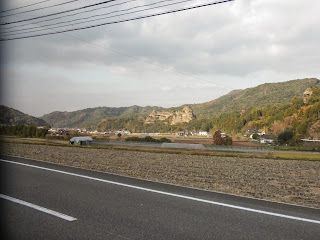
(These photos are of the bike ride after the dojo meeting to Nishitani Onsen. On the way I passed Yabakei, which is the most famous natural attraction in Nakatsu City, cliffs in which the side is carved out by temples. Not a bad place at all.)