Monday, January 20, 2014

Martial Arts Solo Practice: Good or Bad?


I wander in the woods inside of myself, where I just move. Maybe I'm teaching myself. It's good because it's where I go.

But in the dojo I'm holding a tool. I'm working together with this foreign object to fly on invisible straight lines. Alone I warp myself into comfortable awkward positions and become acclimatized to my own particular grains.

Then someone comes and puts stints on my limbs, they turn my head, pull my shoulders back and paint a red dot to catch my attention. It is no longer me but the lines and a master. Because of the world as a whole, my arrow can fly straight.

...

Some say that the bow can teach ou how to shoot properly in kyudo. I've also heard the same with the sword. When I first heard this I thought that you could practice faithufuilly on your own and you'll naturally find the correct principles.

However, in my practice it seems that 95% of the time I just fall into lazy counterproductive habits. (But then that's where all my attention goes. Maybe that 5% is an unseen world of beautiful progress?)

After a while of swinging the sword and shooting the bow on my own, I go to practice to be corrected. A lot of it has to do with kuse. I didn't know what it meant at first, but I've heard so much of it lately I've come to understand it quite thoroughly. A kuse is basically a bad habit.

It's like changing your grip on the sword after everytime you swing it, or bob up and down when you swing the sword. It's like moving your thumb around on your left hand when you do you kyudo.

Perhaps one can learn proper technique on their own, but I'm guessing it would take a looooong time, with a lot of introspection and some natural genius. (but don't we all have these things in our own amount?)

Practicing kyudo and iaido and even aikido without partners or teachers is like falling in darkness alone. Working together with a teacher and other students is like rising to the sun with proper technique.

This makes me think of my solo Tai Chi and Ba Gua practice. I practice alone and believe that by doing it over and over again I can improve in my own way. Yet I don't know for sure because I have no teachers and partners here to check with. I don't know if I'm getting good. I'm not even sure what getting good is. I guess I don't even know really what I'm doing at all.

But I kind of like that. I worry about doing things right in my other arts. Doing Tai Chi and Ba Gua forms is my free time flowing through the movements. It is my own special experience.

I don't know if it's the best because some ideal of "the best" is not where I am. I'm just here, never stopping through the dark forests.

I'm just walking through the forest.

Sunday, January 19, 2014

Meeting the Head Iai Sensei


So iaido is going well and slow. I meet on Friday mornings to practice with Yamamoto Sensei and one other student and practice on my own time in my apartment (trying my best not to slice up the walls and ceilings.)

But last Snday afternoon I got a call from Yamada Sensei, the head sensei of the dojo. I was surprised to get the call and picked up immediately. He asked if I had time to meet the next morning for training. I was caught off guard but accepted and told him I'd be there at any time in the morning or early afternoon. This is what I'm here in Japan for anyway, right?

So I showed up about 15 minutes early for our 10:30 training, earlier than I usually do. The dojo door was slightly ajar. I went in and said my morning greeting, but nobody was there. Maybe somebody was in the bathroom? I heard nothing for a few minutes, so I assumed I was alone. I thought about getting changed and ready, but then I decided against it. In Japan, and as a student, it seemed best to do nothing until I was specifically told to do something. But then maybe one plays into the stupid student role where the teacher comes in and gets mad at you for not getting changed, but if you got changed the teacher asks you why you took the liberty of getting changed without knowing if that's what you should do. Or maybe that thought is just silly. Regardless, I decided not to get changed.

So I walked around the inside of the dojo looking at the scrolls and weapons on the wall waiting for something to happen. After about 5 minutes nobody came and I felt a little weird just standing in the dojo alone, so I decided to wait outside next to my bike. About 3 minues later Yamada Sensei came around the corner fully dressed and said good morning. We went into the dojo. He told me to go ahead and get changed so I did. When I got out we started talking about budo. He's a nice guy and was asking me the normal questions one would ask like, "Why did you want to start iaido?" This was normal, but he seemed much more inquisitive in a way. He was very silent while I talked, which made me a little nervous. I said that I have a great interest in budo, have practiced a few other arts, and since I found the dojo's website online and I've never done iaido before I wanted to give it a try.

We talked more and he mentioned another foreigner who trained with a partner dojo in Tokyo. He's an American and has been training for a while and is currently a 6 dan in iaido.

Then he asked me about reigi in the other arts I've practiced. Reigi is roughly translated as etiquette, and I thought he meant about formal bowing in and such, so I said that in aikido when you enter the mat you bow and then before beginning you bow one more time in the seiza sitting position. I think he was more concerned about timing. Specifically, I think he was trying to get to the point that in this dojo if the sensei says 10:30, then the student comes with enough time to get dressed, sweep the dojo, and get stretched so that practice can begin at the agreed upon time. At that moment is was about 10:43, and the point was made, those thirteen minutes should be spent training, any getting ready and chit chatting should be done before. He was very polite and matter of fact about it, but I laughed a little inside,

"This guy might be more strict than other teachers I've had before."

But that's good. Part of trying new budo is seeing the way other people do things, and I will do everything to adapt to this new environment. I'm happy he told me this straight up because I've actually been a little weary about the reigi of this dojo. The other teacher Yamamoto Sensei is much more informal, and when I was initially told to come at 10:30 the first day, I did and got changed and we usually just start when we do. Now I know, and if I go to another iaido dojo I'll do the same.

A little later on, the other woman who I usually train with showed up (she agreed to come at 11:00), but it was more like 11:04 and the sensei mentioned that she was late. I could see the look on her face which was the same as mine when he told me.

We got started and we did a lot of the same things we have done with Yamamoto Sensei. I think largely Yamada Sensei was gauging these two new students and making sure that we were clear on a lot of the basics. First he asked me to explain what I was doing when I swung the sword, which wasn't easy, but I did so and he reminded me of things I forgot to mention. He spent most of the time repolishing a lot of the things we had learned. It was great and made me much more attentive of the little details. He's the kind of teacher that will naturally make you a lot more conscious of doing the little details right when he's around.

Here are a lot of the specific details we went over in the class:

-Don't move the body up and down when you swing.

-Slice with the tip of the sword, the landing spot being an opponents face, and from there pull back to your stomach.

-10 back, 8 forward. This is with swinging the sword. Raising the sword to the ready position is arguably the most important, because if you're not there, you can't swing it down, so there is an emphasis getting to that ready position, which makes it a bit fast than the downward slice. Also, it puts a good tension in the movement, spreading the chest and elbows out.

-When raising the sword above your head with the previous points, act as though you're stabbing something behind you.

-The power of the cut comes from your rear hand, the forward hand is largely for guiding the blade, and so tension should be taken out of that front hand on the sword.

-When stepping forward, you step (pat-pat) instead of sliding the feet. Also, when stepping forward, the blade slices before the feet, because that is where speed is most important.

- Also practice in the left stance.

-Keep mouth slightly open to relax, act as though you have a small egg you don't want to crack in your mouth.

-Breath in as you raise the blade, out as you swing down. Hide the breath so that an opponent can't read your intentions and movements.


He's a very nice man, and seems proficient in his art, but honestly I really can't tell well what it means to be a great iaidoka yet. I enjoy his crisp and strict attitude and greatly look forward to training with him again. I'll go to the next normal Friday training with Yamamoto Sensei, but then he asked us students to come again on Sunday.

Anytime I hear the word "Sunday" come from a teacher is a small time of panic for me. I keep myself busy through the week, and Saturday is usually no different with work, errands, budo, or planned events, so Sunday really is my sacred day. I never really worried about this so much until I came to Japan, the number one offender of countries not respecting Sunday freedom. Generally, everyone in this country works hard at jobs or school throughout the week, and so when special group events happen (as they often do with work, school, extra curricular activities) it happens on Sunday. I think when Japanese do relax, they are really good at doing absolutley nothing or drinking a lot, because they usually do have to do something on their days off. Anyway, I cringed at the sound of Sunday training, but then again, this is what I came here to do anyway, so I agreed happily, if not a bit hesitant. The wife and I are strapped for cash after making the recent moves and perhaps this Sunday training will keep me from extra spending. No matter how awesome the budo, I don't think I could ever consistently give away the Sunday.

But then who knows.

The path of the sword continues!

Tuesday, January 14, 2014

Don't Rush the Blade


In iaido there are two big things I'm working on, that basically rely upon the same principle: getting out of the way of the sword to let it cut efficiently.

In iaido we rely upon straight lines and non resistance in order to make the most efficient cuts. The sword needs our bodies to manipulate it and execute its purpose, but we must not use superfluous movements and efforts that inhibit the swords function to slice.

So there are two things I'm working on:

1. Drawing the blade. When you draw the blade it is best to draw it along a straight line through the scabbard. When you do, it is effortless and silent. When you don't, you are using extra muscles and effort which will limit the following strike by making it waver. You can tell when someone does this by the sound that the blade makes coming out of the scabbard. If it makes a rough rickety sounds, it means you're banging the blade against the inside of the scabbard in the draw, which means you're putting unecessary strength into a movement that is not straight.

Our teacher has told us this from the start, and I've been conscious of it, however I get caught up in the moment and rush through the draw, which ruins everything. Rushing will do nothing but tense your muscles and make a loud rickety draw. Who cares if you're slow, if you don't do it right, you're not doing anything at all. I'm not practicing very slowly and quietly in my apartment, letting the sound of the blade teach me how to draw it.

2. Swinging the blade. When you raise the sword above your head and then swing down to slash, just like while drawing the sword, one must eliminate extra effort to let the sword fall upon the perfect straight lines of gravity. Our hands and bodies and souls handle and direct the sword, but we do not do the cutting, the sword does. Our teacher tells us to let the blade fall by itself with gravity. In doing this we do not insert unecessary effort.

When sensei swings his swords there is a loud slashing sound reflective of his skilled technique. When us lowly green horn whitebelts swing our swords, there is nothing but the tension in our shoulders and anguish on our faces. In trying to create that sound I naturally try to make that sound by using effort, muscle, and speed, but it won't work. The more I put myself into the sword, the farther I get away from that effortless echoing sound. I need to accept and trust that the sword will do it's job perfectly if I just relax and do only the movements I need to do.

Isn't the same in everything else we do in life?

Cleaning is a practice with a lot of parallels to budo. I like to clean, but I can't stand only cleaning one part of my apartment. I also like drinking lots of coffee and trying to clean in a short amount of time, which means I spend a lot of effort on this task without much of anything getting cleaned at all. Instead of trying to do everything at once in one full sweep, while doing everything else as well, if I can just relax and do clean one room right, that room will be clean and I will be happy ... accepting that maybe I can't clean my whole apartment in the time I've alotted.

Maybe I can accept that I can't do iaido perfect on my first try.

...

What we are training in budo is patience and an inquiring intelligence. We are learning to let things move according to their own ideal time. We are learning to let go of our great tragedy of effort. We are learning to be beautiful. We are learning to be effective.

Perhaps one of the greatest treasures in that great dark deep sea abyss is relaxing and slowing down. It is the key to happiness and relieving stress. Perhaps it is also the key to standing victorious amid violent encounters.

Maybe it's the key to understanding the Great Imminent Failure: Death.

Sunday, January 12, 2014

Budo is Selfish


This is an idea I have every once in a while. Most recently, I had this thought on New Year's Day while watching a Japanese traditional dance at a shrine.

New Year's is arguably the biggest holiday in Japan. It is also one of the few times that Japanese people visit shrines en masse, and perhaps the best chance for modern people to reconnect with older Japanese traditions. One of these traditions is seeing/participating in dance.

A common scene at a shrine on New Year's Day is a long line of people waiting to give their prayers at the shrine while a dance goes on on the shrine grounds. The dancers are specially trained and perform in great costume along with musical accompaniment, usually a drum, flute, and bell. These people practice their art, and probably do so because they like it, however it has no immediate monetary value, similar to many of our practice of budo. However, it's not something they just do with each other or in private, it's something they present to the people, it's something they can give to the people. When people watch these dances they have a multitude of experiences depending on the individual. It is a gift of inspiration in a way. I suppose this can happen with budo in demonstrations, but it seems more selfish in budo for some reason. It's more like "Hey look at us and our practice which makes us stronger." instead of "Hey, look at this dance if you like and feel whatever you want to feel."

The particular dance I saw (which is a common theme in traditional Japanese dances) included two people, one acting as a Japanese Shinto priest dressed in traditional garb, and another acting as a demon wearing a bright red mask with large white hair. I'm not sure exactly about the specifics of the dance, but it looks like they are fighting. It seems to be a dance of deep spritual significance, but to show only that deep spiritual side I think is to be selfish in a way and limiting. For those who are interested in the subject of deep spiritual matters this can be incredibly intriguing, but for those who aren't, or who are averted in someway, it can be very alienating and restricted. To counter this feeling, and in attempt to include all of the people around, aspects of comedy and participation are included.

People go to the shrine to pray to the gods for good luck. One could also say participating in the dance is equally beneficial in the eyes of the gods. So, during the dance, the demon goes into the crowd and pulls young children from their parents to dance with them. Usually, this looks like the demon pulling a baby or small child from the parent while the baby is screaming in terror while grasping the parent. The parent laughs, the child is eventually taken, and held by the demon while dancing and being blessed. The child is returned and another is taken until everyone is satiated.

This is something unique to Japan. In America I think this wouldn't be met with much approval. Why would you terrify small children while tearing them from their parents. This can be seen as a very traumatizing experience! It certainly is for most children at first, but many start laughing amid the dance and are happily returned to the parents, or they're completely scared shitless and have a new found love for the safety of their parents when they're returned.

Japan likes scaring it's children. I think it's to make them stronger. I think it's good and funny. But surely not everyone thinks so. I saw a program on TV where they followed some people dressed up as demons around New Years who ran around towns with giant bamboo sticks spanking young boys. Most young boys see this and run, only to get caught and spanked, but everyone understands what's going on and accepts the pain of tradition with a laugh. However, they showed one boy who really didn't want the spanking, but received it regardless. He was crying uncontrollably afterward asking why he needed to be spanked. The demon consoled him telling him it was to make him stronger. I understand the demon and society's perspective, but I'm sure this kid just thinks the demons a big asshole and getting spanked has nothing to do with anything, which I can understand as well.

ANYWAY!

What I saw on New Year's with the dance was a group of people using Japanese tradition to help, inspire, and include all of the people in society. When I thought of my budo practice, it looks like a very small selfish practice benefitting only myself. Largely what we are doing in budo is exactly that, strengthening ourselves. A big part of this is being able to overcome obstacles with strength and determination. But if all we're doing in budo is working on making ourselves stronger in order to defeat others, I think we're missing the big picture.

I think what we really should be doing in budo is helping ourselves along with everything around us. I think it should be an all inclusive practice with clear merits in society. We can accomplish this by reaching out and working with other people. But how far can we go?

I think at the first step we learn to work with ourselves, as if we are two people. We start a conversation with ourselves in our solo practice, fighting and working together to unite ourselves as one entity progressing on our path.

Next is working with a teacher who we interact with. The teacher gives his/her time unselfishly to help the student improve. The student puts aside him/herself in order to progress according to the teaching of the student. I think this is the first and most necessary stage where we learn to put ourselves in a secondary position to another (while still maintaining our self-preserving strength, but that's another conversation in and of itself.) This is the intimate transmission of life practice through martial arts.

Next is working in a class with others. You have your teacher/student relationship, but then a myriad of other student/student relationships where you work together as a whole. This becomes a small community where everyone benefits each other with their particular personalities and efforts. It is a melting pot where everyone effects others with their own particular presence.

Next is branching out to those who are not directly involved in the art, and I'm not exactly sure how that goes, but maybe we can brainstorm here a bit.

It could be demonstrations to the public. In doing this one can share the beauty and inspiration of the art with others. Some may be influenced to begin a practice, but to focus only on that becomes a form of proselytizing, which is definitely not in-line with the core of budo, I think. Such demonstrations could be less about promoting the art, and rather revealing it like an art exhibition in a park or museum, whose only purpose is to inspire the public.

One could use the specific benefits of an art to help others. But this can be difficult since most arts have become greatly separated from daily use. How can shooting an arrow in kyudo or swinging a sword in iaido be of any direct help to someone who isn't genuinely interested in the art? (Interesting how I've found myself in these two seemingly irrelevant arts!)

However, there are some arts that have great immediate benefits to society. Three immediately come to mind:

First is using martial arts as self defense. Living in a society where violence is a potential threat, one can benefit greatly from having a practice of self defense. This was one of the big draws to martial arts for me at first when I started karate. The teacher focused heavily on practical self defense, and also ran workshops specializing on women's self defense with people who had no experience in martial arts or whatever. This is one of the best ways I've personally seen martial arts be a functional part of society.

Second is using martial arts as a physical means to protect people, by that I mean especially police and military. I have no experience in either, and am pretty sure with those two you're dealing with two different things. Perhaps in military training you're learning to physically eliminate opponents in life-threatening situations where serious violent techniques are required. But for the police, one would need to work on techniques to restrain people instead of harm them. For this I think aikido or jujitsu would be of great worth.

Third is using the martial arts for health. All martial arts can help people improve their health, but for those who need serious rehabilitation working on a soft art like Tai Chi Chuan can be of great help. Perhaps this isn't limited to just physical health, but mental health as well. By utilizing the meditative aspects of Tai Chi Chuan, one can certainly bring balance to a turbulent emotional life. Furthermore, instead of a practice focusing on violence and relying upon phsical strength, one is working with movements that massage and strengthen joints, tendons, and fluids ... which seem to often be the most influential parts of our health.

Having a practice that benefits the self is the first foundation of martial arts, but to have only that is a lonely and limiting experience. How can we use our art to help people? I believe by answering question we will reveal the true worth of martial arts while also progressing it's methods in the modern world and future.

I don't want to talk about budo with only other budoka, but people who seem to have no relation to its practices at all. I want to find the underlying principles of daily life that can be translated by movements found in the martial arts. I want budo to be a gift to those who are suffering. Budo is a way, one that climbs a mountain making us strong and wise and giving us inspiration.

Budo is not a stagnant practice of ancient violence, but a way of living that can benefit mankind.

Tuesday, January 7, 2014

90 Year Old Kyudoka

                                                        (I have no idea who this man is.)
 

Today I met a 90 year old man who practices kyudo.

When he first came in, I could tell he was pretty old, but was lively and cheerful. He started chatting to me in English, and I was surprised at his ability. He was better than most younger Japanese people and could keep a conversation going. He said he was 90 years old and still doing kyudo ... 90 YEARS OLD AND DOING KYUDO!!! Kyudo is no soft art, and pulling a bow at that age standing up straight and straining your muscles and will is no small feat ... for anybody. That surprised me, and he walked away for a minute, and came back with some small Japanese treats for me. (I think every aged person in Japan is always carrying around sweets to hand out to foreigners, because this happens most everytime! Maybe it's a habit I'll start soon.)

So we chatted more, he left, and then came back again with a postcard with him on it and a printout in Japanese that looked like it was from a newspaper and gave it to me. He said it was from about 20 years ago when he was 70, and he looked super strong and healthy ... at 70! At that time I was in elementary school trying to hide picking my nose from other kids on the school bus. He said he was in the coastguard and liked building radios. At that time I was changing ready to head out for work so I didn't see him shoot unfortunately.

After that I went home for a minute and showed the postcard and printout to Satomi and she was super impressed. Curious as to what she found out I started reading the printout on my own.

He started kyudo when he was in middle school, which means he started kyudo about 75 years ago (though he said he's been practicing for 60 years, which probably means he took time off when he was working, not sure). That's unbelievable to me. I can't possibly imagine doing anything for that long. I suppose if I'm lucky enough, I can say that I've practiced kyudo for 60 years one day.

But then, the part that really impressed me was that he pulled a 37 kilogram bow in his prime.

37 KILOGRAMS!

If you don't practice kyudo then that probably doesn't have much context, but the strongest bow I've pulled is 17, but now I'm using a 15 (I think). A lot of perfectly skilled teachers use 20 kilogram bows. Using a 25 km bow is considered really strong. I've never met someone who could pull a 30kg bow, and now I just met this dude who used to pull a 37 kg bow. That's crazy. Apparently he's been dropping the weight as he's gotten older, but I think he pulls a 20 kg bow now at 90, which is impossible for me now at 28.

The numbers are just too much for me, I'm dumbfounded and impressed. In a way I feel like continuing is pointless because I'll probably never be able to pull a 37 kg bow like him, but then I'm also motivated because the only important thing is continuing with a genuine effort. Without that there is nothing. With that, you can do anything ... including doing kyudo for 60 years and pulling a strong bow.

My kyudo practice has resumed after a hiatus during the winter break, and my ability is pretty weak, but it is what it is, and that's perfectly fine. I'm working on humbly going when I do, enjoying it, while focusing on two specific aspects:

1.) Pulling the bow with my back, which means maintaining the stretching tension in my back and backs of my arms from the beginning to the end. When I do this things work out very well and I do great kyudo ... when I don't, it's because I'm afraid of the string slapping my face, and I break the connection somewhere ... I think in uchiokoshi when I raise the bow.

2.) Building a good tenouchi (hand posture that holds the bow in the left hand). I need to keep my and in a vertical position, and relax all of the parts that aren't necessary especially my middle and ring finger. When I do this, my kyudo is great. When I don't, it's because I'm gripping the bow too hard, and don't hold my hand vertical due to the break in tension during uchiokoshi (raising the bow). Also, I need to grip the bow better with my pinky, which locks the hand in the vertical position.

When I started, I couldn't do anything at all, but after about 5 pulls I had about 3 or 4 good shots on the makiwara, then went to the target while doing zassha (sitting ceremonial shooting) shooting two arrows and did great. My first shot was a little in front of the target, and the second hit. I was shocked and elated at the feelings I felt through the shooting. Went back to the makiwara and had about 2 good shots, then it all started unraveling and my technique deteriorated.

Why?

It's a very strange phenomenon in kyudo, and I'm not sure if it happens to everybody, but always with me. I start out well and progressively get worse throughout the day.

I think this is due to two things:

1.) Thinking too much about the specifics while forgetting about the big picture.

2.) My hand/shoulders getting tired and slacking or tensing in the wrong places.

But it's all good. I practice my best, watch myself silently, and do my best to improve for the next time.

Iaido practice is going well. I'm finding time here and there throughout the day to practice, and I think it's great. By doing it in this way, I'll really want to practice, pick up the sword and go for ten minutes, then stop and continue my day until an hour or so later I get the urge again. Each piece is very small, but each drop is pure quality curiousity and effort and all the small pieces add up to a picture much bigger in the end. I'm taking it very slowly in these early stages, we'll see how it goes.

Hope you are all starting afresh in this new year, cause it's a great time to begin.

Sunday, January 5, 2014

Winter Travels - New Year Fresh Start

Hello!
 
Hisashi Buri!
 
Happy New Year!
 
Akemashite Omedetou Gozaimasu!
 

It's been a busy two week break with lots of movement. I went back to Toyama to pick up my wife while staying at her house and meeting with old friends. I had a great time with her family, was super excited to meet with old friends, and had very strange feelings going back to this second home. First I rode a train for an hour from Nakatsu to Kokura (Kita Kyushu City) and then took a twelve hour midnight bus to Osaka, where I rode another bus for 6 hours to Toyama. Once I breached the Hokuriku border when entering Fukui Prefecture, the sky went dark black and snowy mountains loomed in the distance. This is my ancient home, just like northwest Washington where I was raised, and northern Europe where my ancestors came from. I might be getting a little corny, and to be honest I'm not really sure where I came from, but I feel a connection to Toyama that is a little more than mysterious. Anyway ... it was interesting to see the place after 2 months away and adopting a new home ... I love Toyama, and the mountains are absolutley unbelievable. I feel like I could move back anytime and stay a long time ... but now I live somewhere else, in a land of funny shaped cone mountains in the warmer southern island of Kyushu.

So I picked up the girl, and we got in her car and drove to Osaka. We realized when we reached the city borders because the highway walls loomed high enough to conceal our surroundings and giant trucks congested all around us.


We got through the city on time despite rush hour traffic, and boarded our overnight ferry from Osaka to Beppu Port in Oita Prefecture. This was our bed for the trip. (It went well with the giant sento bath on the ferry! A giant bath on a ferry!)


The ferry also came with a buffet that looked way better in the brochures, but it was a nice ferry.


On the ferry deck my wife and I said our great farewell to Honshu (the main island of Japan).


We arrived safely to a much warmer Kyushu, and our home of Nakatsu! Also home to a cool castle.


We had a few days together before two other friends from Toyama came to stay for a couple days. We went to Usa Shrine in the neighboring town of Nakatsu. It's certainly famous in Oita Prefecture and this area around Nakatsu, but one brochure even said it was the most important Hachiman Shrine in Japan (Hachiman is generally considered the god of war in Japan, but is also described as many other things and in much more detail).


We went on New Year's Day, and for some reason I didn't realize how many people would go to the shrine that day. I lost all confidence while we were stuck in traffic on the small country roads, but once we got there I was happy to go to such a special shrine on such an auspicious day.


The shrine was great, and on the ride home I was utterly happy with my wife and a couple of best friends in the new home of Nakatsu ... and a beer in the belly.


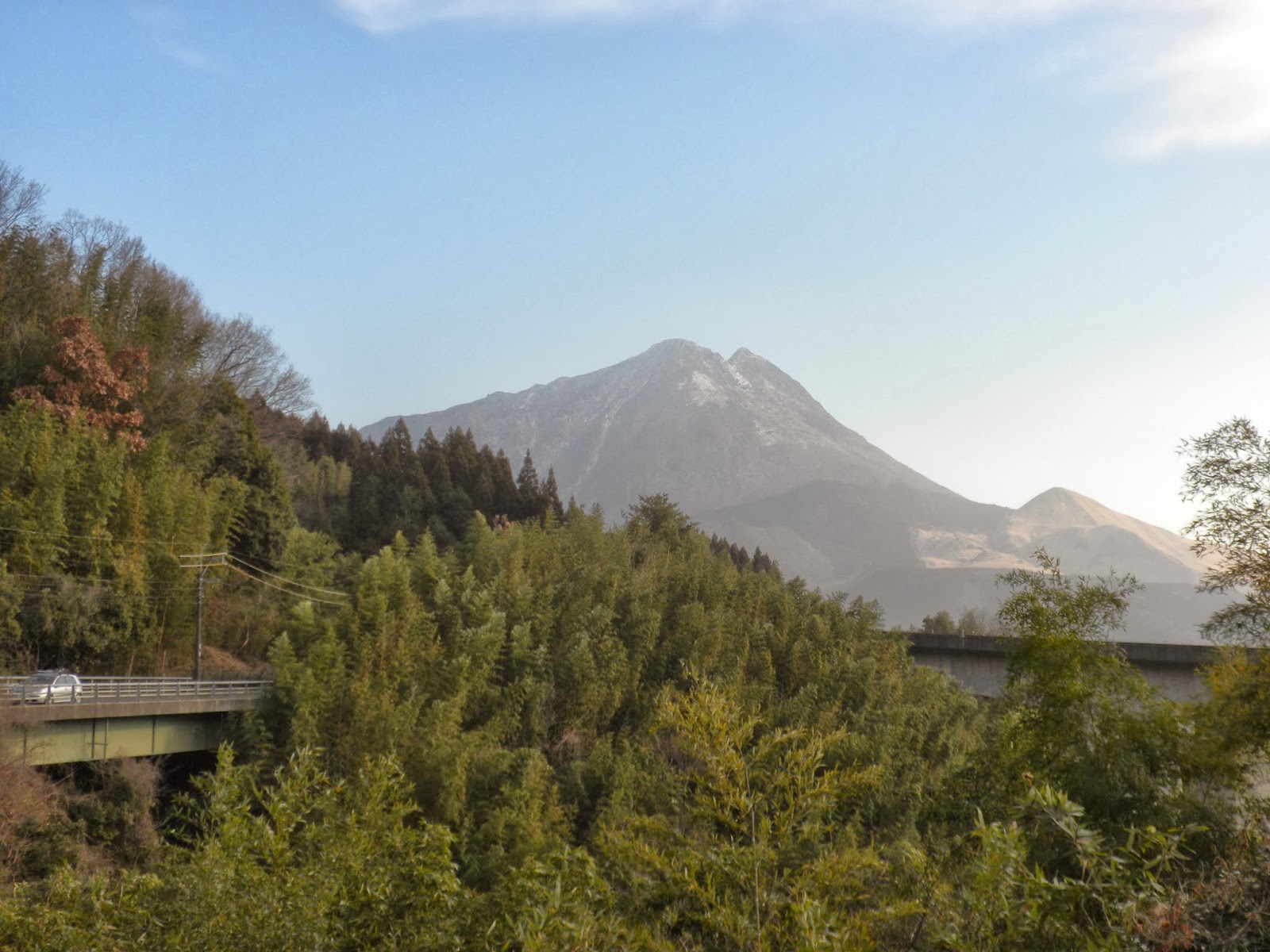
The next day we went to Yufuin, a place in the mountains of Oita Prefecture, famous for the single mountain of Yufuin Dake (shown below), lots of amazing onsen, and a quaint tourist town area. It's been the number one destination in my mind for a while and it didn't dissapoint.


At about 1600 meters it's certainly not the tallest mountain in Japan, but definitely worth a visit, or many.


It's a touristy town with all the touristy qualities one can expect, but it was fun.


After that we went to Beppu, the onsen mecca of Japan. We went to a really cool onsen, ate food, and went home. No pictures, but at about an hour and a half away from where I live, I know I'll be back again and again and again.

The next day we headed to Fukuoka City, the largest city in Kyushu, and one of the largest in Japan.

Getting there takes a little over an hour by express trains and about $50 round-trip. It's close enough to feel like I can go anytime, but far enough to be completely separate.


It really is one of the biggest cities in Japan, and you can feel it immediately. Lots of big fancy building and hordes of people. Very fun to visit.


I've been having small technical problems with the blog lately,


my computer keys are sticky and there is some lag with the typing,


And the amount of Tateyama Sake I'm drinking is enough to draw my attention away from this typing...

So I'll leave you with this ... HAPPY NEW YEAR! I've had millions of budo thoughts lately and want only to tell them you all here. I assure they will flow in a continuous and constant wonderful pattern this year here at Gaijin Explorer.

今年もよろしくお願いします!